

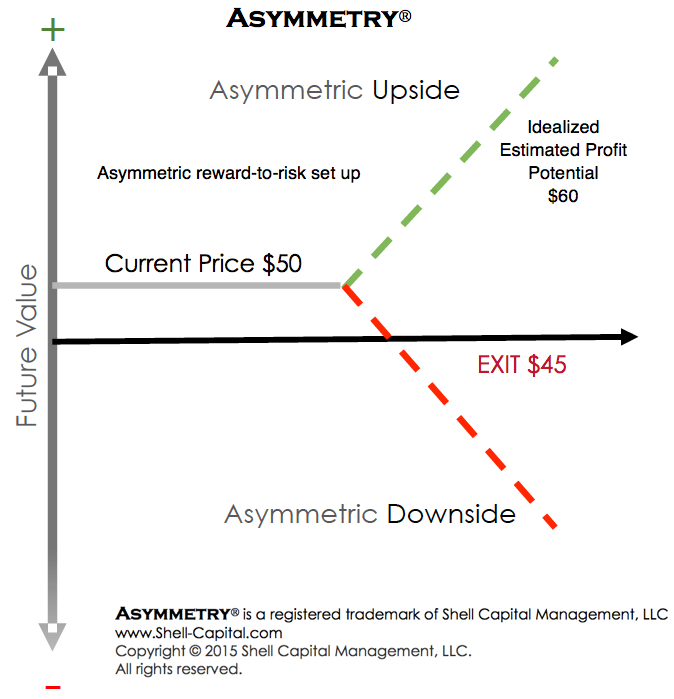
Asymmetric Reward-to-Risk Set Up
An asymmetric reward-to-risk set up is a specific trade or investment configuration where entry conditions, profit target, and stop-loss level are defined before capital is committed, and where the potential profit exceeds the potential loss by a predetermined minimum ratio. It is the practical implementation of the asymmetric risk/reward principle at the individual trade level.
The Three Elements of an Asymmetric Set Up
A true asymmetric set up requires three clearly defined elements before entry. First, the entry point: the specific price or condition at which the position is established. Second, the stop-loss level: the price at which the position will be closed if the thesis is wrong, defining the maximum loss as a dollar or percentage amount. Third, the profit target: the price objective that defines the expected gain, which must be at least 2-3 times the defined stop-loss distance to qualify as a meaningful asymmetric set up. With all three defined in advance, the reward-to-risk ratio is calculable before a single dollar of capital is at risk.
Why Pre-Definition Matters
Defining the set up before entry removes the most dangerous element from investment decision-making: emotion. Once capital is committed, loss aversion causes investors to move stop-losses further away (“giving it more room”), shrink profit targets (“taking the money while I can”), and override rational analysis with hope. Pre-defining the set up creates a commitment device that enforces disciplined execution regardless of how the market feels in the moment.
Asymmetric Set Ups in Systematic Trading
Systematic trading systems codify the asymmetric set up into rules that execute automatically. Entry signals, position size (calibrated to the stop-loss distance and maximum acceptable portfolio risk), and exit rules are all predetermined. This eliminates discretionary override — the primary enemy of consistent risk management — and ensures that the reward-to-risk asymmetry that made the system profitable in research and testing is preserved in live execution.