

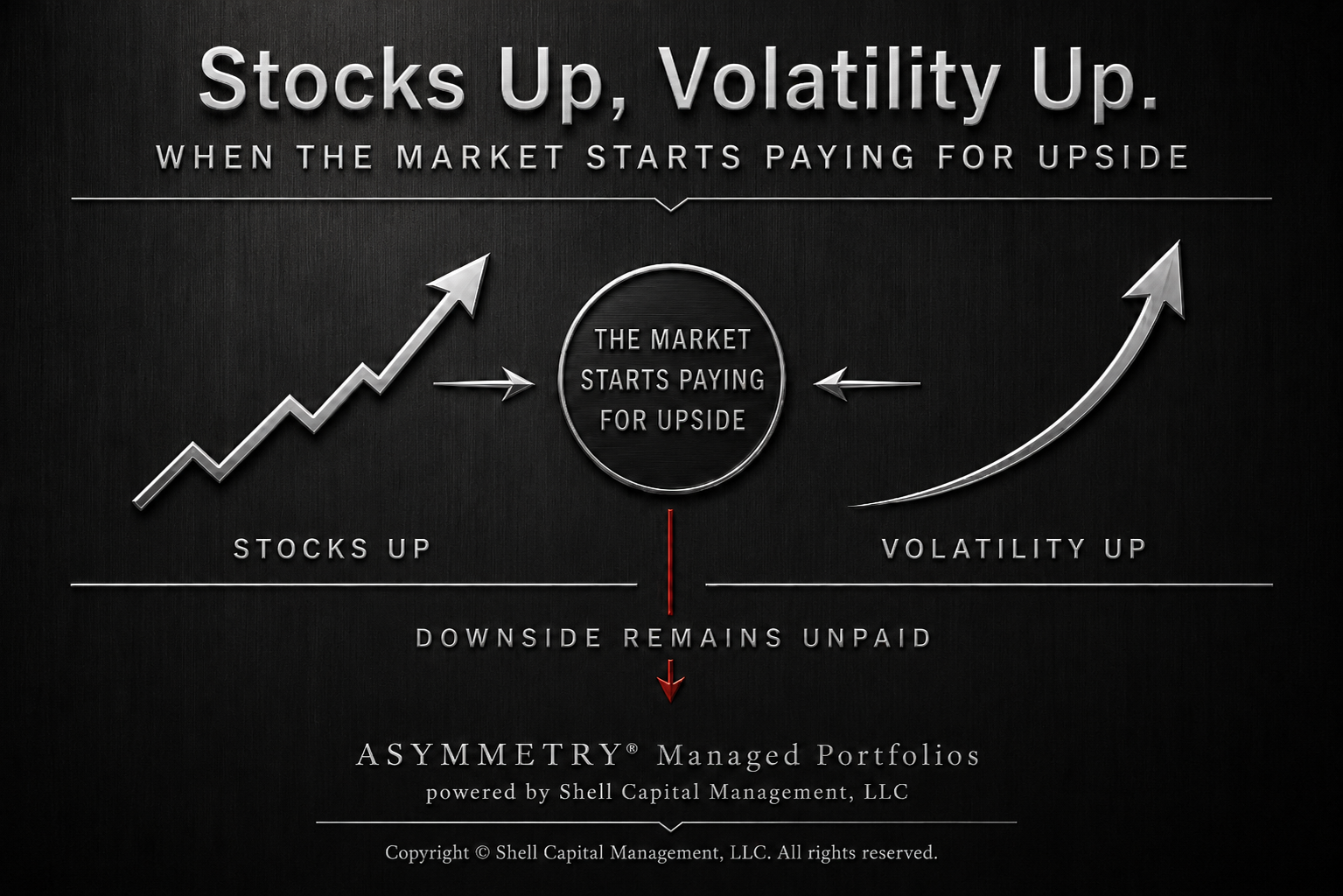
When stocks rise and volatility rises with them, most investors instinctively assume something defensive is happening.
Sometimes that’s true.
If the S&P 500 index is rising, VIX is rising, and put skew is steepening, the market may be advancing with protection underneath it. Institutions are staying long the trend but buying index puts, put spreads, collars, or downside risk reversals to define their downside. That’s the seatbelt version of spot-up, vol-up.
But there’s another version.
It’s more euphoric.
It’s also more fragile.
When stocks rise, volatility rises, and skew flattens, the market is often not paying more for protection. It’s paying more for upside.
That distinction matters.
The tell is not VIX rising by itself. VIX is only the headline. The real information is in the volatility surface. Are puts getting richer relative to calls, or are calls getting bid aggressively enough to flatten skew? Are investors paying to protect downside, or are they paying to rent more upside after the move has already happened?
That’s the difference between a market wearing a seatbelt and a market pressing the accelerator.

That’s not a normal fear signal.
That is upside convexity being repriced.
In plain English: investors are increasingly willing to pay for the right tail while paying less attention to the left tail.
Earlier in an advance, this can be powerful. Underexposed investors buy calls because they don’t own enough. Hedged investors unwind protection because the downside didn’t happen. Systematic strategies rebuild exposure as realized volatility falls. Passive inflows keep feeding the largest index weights. Corporate buybacks add another source of demand. Price rises, positioning follows, and the market begins to create its own evidence.
That’s how upside velocity forms.
But the risk/reward changes as the move matures.
The market is no longer under-owned, under-positioned, and heavily hedged. Citadel Securities makes that point directly. After a large advance, systematic exposure has rebuilt, downside hedging demand has collapsed, and many of the flows that mechanically supported the move higher may become less supportive if momentum begins to fade.
That’s the ASYMMETRY® point.
The best opportunity is often when the market has upside optionality and investors are still skeptical.
The more dangerous phase begins when the market still has upside momentum, but the optionality has shifted from under-owned to crowded.
A spot-up, vol-up regime with flattening skew says the crowd is not simply participating. It is increasingly paying for participation through calls.
That can keep the move going.
It can also make the move more vulnerable if leadership stalls.
There is a mechanical reason.
Call buying can force dealers to hedge by buying the underlying as prices rise, which can reinforce upside momentum. In concentrated leadership markets, that flow tends to cluster in the same exposures: Nasdaq, semiconductors, mega-cap technology, AI-linked stocks, and leveraged products tied to those themes. The stronger the move gets, the more the same exposures attract call demand.
The reflexivity feels bullish while it works.
But reflexivity cuts both ways.
If the upside move slows, those same calls can lose delta quickly. Dealers who bought stock to hedge upside call exposure may have less reason to stay long. Momentum strategies may stop adding. Volatility-targeting strategies may become less supportive. Levered ETF rebalancing can shift from reinforcing upside to adding pressure on the downside. If participation is narrow, the index can become dependent on a small group of crowded return drivers.
That is flow fragility.
Not because the fundamental story is necessarily broken.
Because the payoff has changed.
A market can have strong earnings, strong AI-related capital spending, persistent buybacks, passive inflows, and still become tactically fragile if too much upside exposure gets concentrated in the same leadership at the same time.
That’s why spot-up, vol-up must be diagnosed correctly.
If volatility is rising because investors are buying protection, the market may still be cautiously supported. The left tail is being acknowledged. Downside is being priced. There may be a stabilizing effect because investors already have hedges in place.
But if volatility is rising because investors are chasing upside calls, the message is different. The market is not protecting the move. It is leveraging the move.
That is a materially different risk profile.
The practical tell is skew.
Rising price + rising volatility + steepening put skew suggests protection demand.
Rising price + rising volatility + flattening skew suggests upside chase.
Rising price + rising volatility + call skew in leadership stocks suggests FOMO, underexposure, or performance pressure.
Rising price + rising volatility + small-cap skew steepening while Nasdaq call demand surges suggests a split market: upside enthusiasm in the winners, downside concern beneath the surface.
That’s the market’s message right now.
It is not simple risk-on.
It is not simple risk-off.
It is a market where investors are paying for upside in the same places that have already worked, while the cost of protection relative to additional upside has become more attractive.
For ASYMMETRY®, that’s the key.
When upside becomes crowded, the better trade may not be to chase the same upside convexity everyone else is buying. The better risk/reward may be to define downside while protection is relatively cheaper, preserve participation where the trend remains valid, and avoid confusing momentum with unlimited optionality.
There is a big difference between owning convexity before the crowd discovers it and buying convexity after the crowd has repriced it.
That difference is where risk management lives.
A spot-up, vol-up market can continue higher. In fact, these regimes can last longer than skeptics expect because call demand, dealer hedging, passive flows, and concentrated leadership can keep reinforcing the same move.
But the character of the advance has changed.
Earlier, the market may have been climbing because investors were underexposed and hedged.
Now, it may be climbing because investors are chasing the upside they missed.
That doesn’t mean sell everything.
It means stop treating the upside as cheap.
It means the asymmetry is no longer where it was.
The mission isn’t to predict the exact top. The mission is to understand when the payoff profile has shifted.
Spot-up, vol-up with flattening skew is one of those moments.
The market is still moving higher.
But now it is paying more for the right to keep chasing.
That’s not the seatbelt.
That’s the accelerator getting crowded.
Mike Shell is the founder and chief investment officer of Shell Capital Management, LLC, a registered investment adviser. He serves as portfolio manager of ASYMMETRY® Managed Portfolios, a separately managed account program with trade execution and custody provided by Goldman Sachs Custody Solutions.
ASYMMETRY® Observations are provided for general informational and educational purposes only. They do not constitute investment advice, a recommendation, or an offer to buy or sell any security or investment strategy. The content is not intended to be a complete description of Shell Capital’s investment process and should not be relied upon as the sole basis for any investment decision.
Any securities, charts, indicators, formulas, or examples referenced are illustrative and are not intended to represent actual client portfolios, recommendations, or trading activity. Past performance is not indicative of future results. All investing involves risk, including the possible loss of principal.
Opinions expressed reflect the judgment of the author at the time of publication and are subject to change without notice as market conditions evolve. Information is believed to be reliable but is not guaranteed, and readers are encouraged to independently verify any information before making investment decisions.
Shell Capital Management, LLC provides investment advisory services only to clients pursuant to a written investment management agreement and only in jurisdictions where the firm is properly registered or exempt from registration.
Leave a Reply