
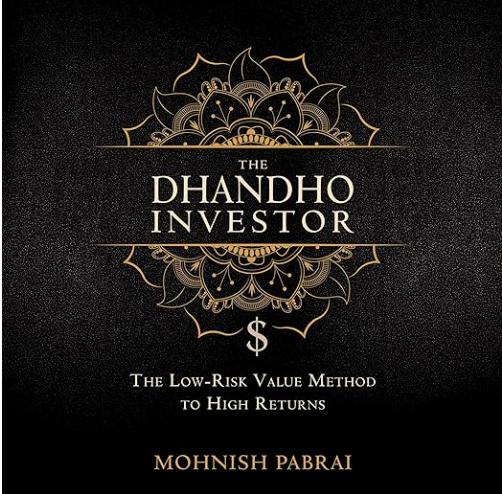
The Dhandho Investor: The Low-Risk Value Method to High Returns By Mohnish Pabrai
Summary and Review of The Dhandho Investor: The Low-Risk Value Method to High Returns By Mohnish Pabrai
Overall Thesis of the Book
Mohnish Pabrai argues that superior long-term investment results come from consistently structuring bets with limited downside and significant upside. He frames this through the Gujarati concept of “Dhandho,” meaning business—specifically, a simple business model focused on minimizing risk while maximizing reward. The core idea is straightforward: Heads, I win; tails, I don’t lose much.
The book synthesizes lessons from Warren Buffett, Charlie Munger, Benjamin Graham, and a set of lesser-known case studies to demonstrate how asymmetric payoff structures can be engineered through disciplined value investing.
Chapter-by-Chapter Summary
Introduction: The Dhandho Framework
Pabrai introduces the Dhandho philosophy as a mindset rooted in capital preservation and return asymmetry. Rather than pursuing high-risk/high-reward ventures, Dhandho operators seek low-risk/high-uncertainty opportunities where mispricing creates convexity. The emphasis is not on forecasting precision but on payoff structure.
Chapter 1: Heads, I Win; Tails, I Don’t Lose Much
This chapter defines the central operating principle. The investor’s goal is not to maximize probability of success but to maximize expected value by skewing the payoff distribution. Limited downside, significant upside, and a margin of safety create positive expectancy.
Chapter 2: Few Bets, Big Bets, Infrequent Bets
Pabrai argues that diversification is often overused as a substitute for conviction. Once high-conviction asymmetric opportunities are identified, concentration enhances results. He references Buffett’s focus strategy and the power of selective aggression when odds are favorable.
Chapter 3: Low-Risk, High-Uncertainty
Markets often confuse uncertainty with risk. Pabrai differentiates between permanent capital impairment (risk) and temporary volatility or informational ambiguity (uncertainty). The latter often creates mispricing. Dhandho investing exploits situations where uncertainty is high but downside is structurally limited.
Chapter 4: Arbitrage Opportunities
The book discusses merger arbitrage and special situations as classic Dhandho plays. When spreads are wide due to perceived uncertainty, and downside is bounded by deal terms or asset backing, the expected value can be attractive.
Chapter 5: Distressed Bets
Pabrai highlights investments in distressed or near-bankrupt companies where asset values exceed market capitalization. These situations can offer large upside if survival occurs, with downside partially protected by tangible assets.
Chapter 6: Hidden Assets and Spin-Offs
Corporate complexity, spin-offs, and neglected divisions can lead to mispricing. Investors who perform deeper analysis can uncover embedded value not reflected in current prices.
Chapter 7: Cloning the Best
Pabrai openly advocates “shameless cloning” of proven investors by tracking 13F filings. Rather than reinventing analysis, investors can piggyback on high-skill capital allocators when valuation remains attractive.
Chapter 8: The Checklist
Inspired by Munger, Pabrai stresses the importance of checklists to reduce behavioral errors and cognitive biases. Avoiding mistakes compounds more reliably than chasing brilliance.
Chapter 9: Circle of Competence
The book reinforces operating strictly within areas of understanding. Simplicity is preferred. Complexity increases error rates and degrades asymmetric positioning.
Chapter 10: Sell Discipline
Pabrai suggests selling when the original thesis plays out and valuation approaches intrinsic value, or when better opportunities with superior asymmetry arise.
Overall Book Assessment
The Dhandho Investor is less a technical valuation manual and more a behavioral and structural framework. Its primary contribution is reframing investing as the repeated pursuit of asymmetric expected value opportunities with controlled downside. The writing is accessible, and many examples are simplified, but the conceptual clarity around payoff asymmetry is strong.
The ASYMMETRY® Perspective
From an ASYMMETRY® standpoint, Pabrai’s philosophy aligns directly with convex payoff construction and defined downside. However, his framework is primarily valuation-driven and event-driven rather than dynamically risk-managed.
Where Dhandho emphasizes margin of safety through price relative to intrinsic value, ASYMMETRY® expands the framework by integrating:
Explicit downside definition through exit discipline Position sizing based on predefined risk as a percentage of total portfolio equity Portfolio risk aggregation (total open risk expressed as %) Trend and momentum confirmation to avoid value traps Regime awareness across volatility, liquidity, and macro conditions
Pabrai’s approach assumes valuation mean reversion as the convex catalyst. ASYMMETRY® incorporates both valuation mispricing and trend persistence as potential convex return drivers.
Dhandho is fundamentally about expected value and payoff skew. ASYMMETRY® formalizes this through risk-first portfolio construction, convexity engineering, and disciplined capital allocation under uncertainty.
In short, The Dhandho Investor teaches how to think in asymmetric bets. ASYMMETRY® operationalizes how to size, manage, and compound them within a defined portfolio risk budget.
This summary is an independent analysis and is not affiliated with the author or publisher. It is intended for educational and commentary purposes under fair use.