facebook twitter instagram linkedin google youtube vimeo tumblr yelp rss email podcast phone blog search brokercheck brokercheck Play Pause

Asymmetric Investing Definitions 

This comprehensive glossary combines definitions from Mike Shell's ASYMMETRY® Observations and expert knowledge. These definitions serve as a foundation for understanding concepts related to asymmetric investing, including risk management, market analysis, asymmetric returns, asymmetric risk/reward, convexity, trend, momentum, and optionality. 

CORE ASYMMETRY® CONCEPTS

Asymmetry

The quality of being made up of exactly similar parts facing each other or around an axis—or more relevantly in investing, the lack of such symmetry. In finance, asymmetry refers to an imbalance between potential outcomes. A positive asymmetry means the potential for gains exceeds the potential for losses. This is the holy grail of investing: situations where you can make more when you're right than you lose when you're wrong. Markets naturally exhibit asymmetry—stocks can only fall 100% but can rise infinitely. Skilled investors seek to engineer additional asymmetry through position sizing, options strategies, and tactical management.

Asymmetric Return Profile

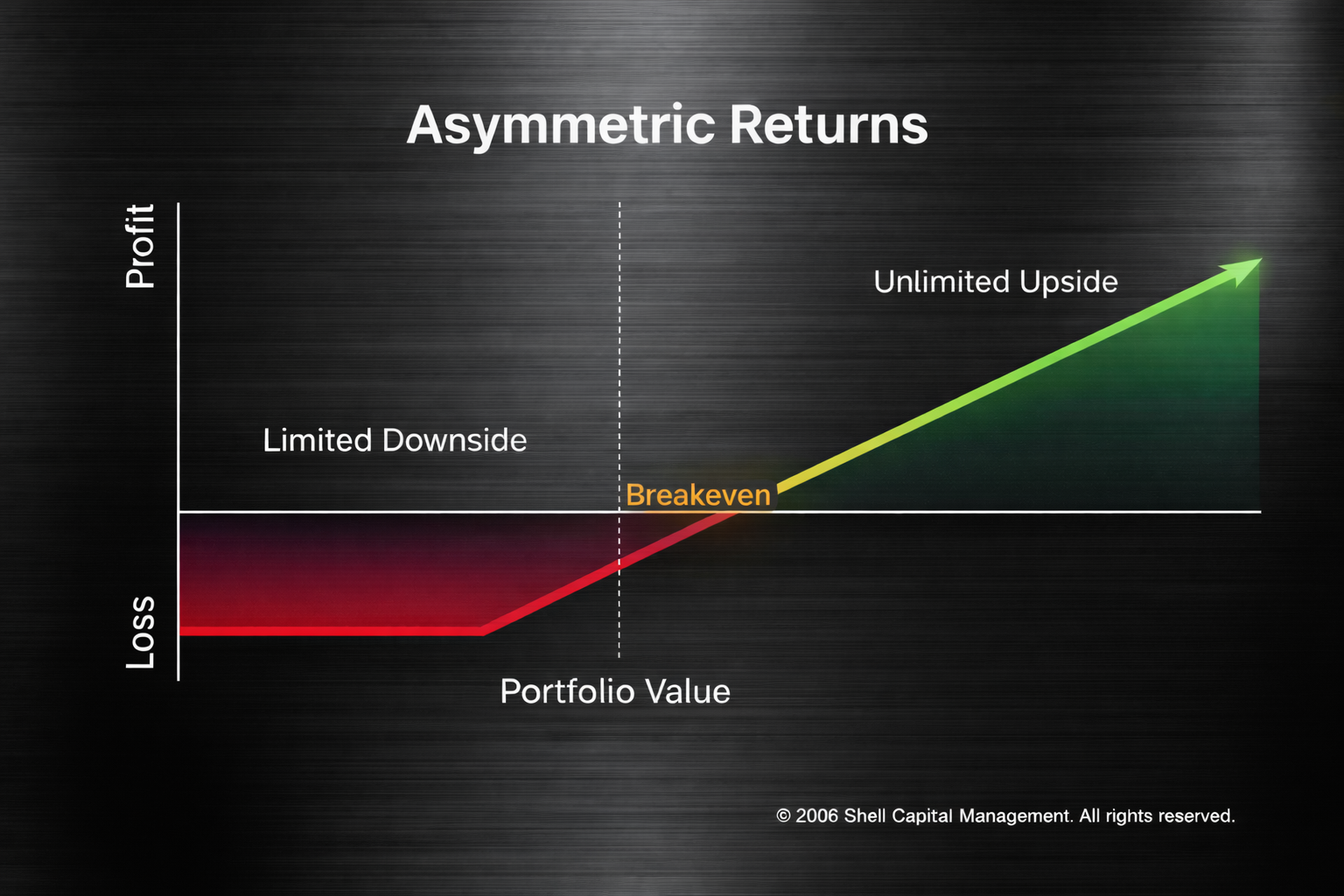
A distribution of potential investment outcomes where the upside potential meaningfully exceeds the downside risk. Unlike a normal bell curve (symmetric), an asymmetric return profile is "skewed" toward favorable outcomes. Example: An option purchase has asymmetric returns—maximum loss is the premium paid, but potential gain is theoretically unlimited. Professional investors construct portfolios specifically to achieve asymmetric return profiles through hedging, position sizing, and security selection.

Asymmetric Investment Returns

Returns generated from strategies designed to capture more upside than downside. This isn't about avoiding losses entirely—it's about ensuring that over a full market cycle, gains substantially exceed losses. Achieved through: (1) cutting losses quickly while letting winners run, (2) using options for defined-risk exposure, (3) tactical allocation that reduces exposure during unfavorable conditions, and (4) momentum strategies that participate in trends while managing drawdowns.

Asymmetric Risk/Reward (also called Asymmetric Risk/Return)

A trade or investment setup where the potential reward significantly exceeds the potential risk, typically expressed as a ratio. A 3:1 asymmetric risk/reward means you stand to gain $3 for every $1 risked. Professional traders won't enter positions without favorable asymmetric risk/reward. This concept acknowledges that you don't need to be right most of the time—you need your winners to be larger than your losers. A trader right only 40% of the time can be highly profitable with 3:1 reward-to-risk ratios.

Positive Asymmetry

A favorable imbalance in the distribution of returns where the magnitude of potential gains exceeds the magnitude of potential losses. Mathematically, this manifests as positive skewness in return distributions. Strategies exhibiting positive asymmetry include: trend following (small losses, occasional large wins), long options positions, and tactical strategies that reduce exposure before major drawdowns. The opposite—negative asymmetry—characterizes strategies like selling options (frequent small gains, occasional catastrophic losses).

Asymmetric Risk

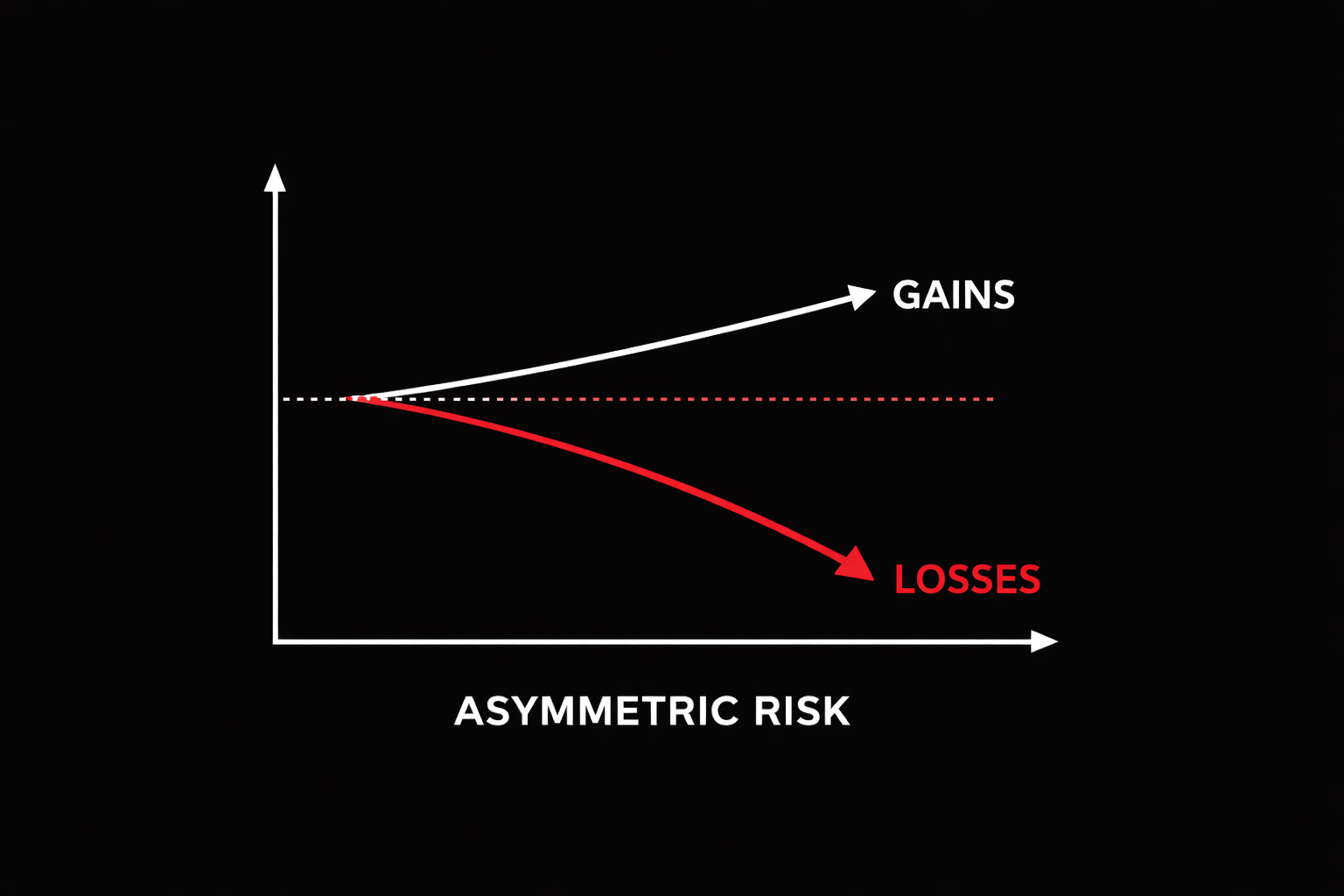
Risk exposure that differs materially between upside and downside scenarios. In most long-only portfolios, risk is symmetric—a 20% market move affects you roughly equally whether up or down. Asymmetric risk strategies use hedging, options, or tactical allocation to reduce downside exposure while maintaining upside participation. The goal is to "bend" the risk profile so losses are contained while gains remain open-ended.

Symmetric Risk

Equal exposure to both upside and downside movements. A traditional 60/40 stock/bond portfolio has largely symmetric risk—it participates proportionally in both rallies and declines. While simpler to implement, symmetric risk means investors must endure full drawdowns to capture full recoveries. Many investors discover their actual risk tolerance only during drawdowns, often leading to panic selling at lows.

ASYMMETRY® Observations

Mike Shell's framework for analyzing markets through the lens of asymmetric opportunities. An observation based on careful, empirical study of investor behavior, price trends, and risk dynamics. The registered trademark signifies a specific investment philosophy focused on identifying and exploiting asymmetric setups while managing risk to preserve capital for compounding.

ASYMMETRY®  Ratio

A proprietary metric measuring the relationship between upside capture and downside capture, or more broadly, the ratio of average gains to average losses adjusted for frequency. A ratio above 1.0 indicates positive asymmetry. Can also measure: (upside volatility) / (downside volatility), or (gain frequency × average gain) / (loss frequency × average loss).

INVESTMENT STRATEGY TERMS

Absolute Return

An investment approach targeting positive returns regardless of market direction, as opposed to returns relative to a benchmark. Absolute return strategies aim to make money in bull markets, bear markets, and sideways markets. They typically employ hedging, short-selling, derivatives, and tactical allocation. Success is measured against zero (making money) rather than against an index. A -5% return in a -20% market is a failure for absolute return but "outperformance" for relative return.

Relative Return

Performance measured against a benchmark index. Most mutual funds use relative return—beating the S&P 500 by 1% is considered success even if both are down 15%. This framework encourages "index hugging" and discourages true risk management, as deviating from the benchmark creates "tracking error" career risk for managers. Critics argue relative return is a flawed framework because investors can't pay bills with relative returns—they need absolute dollars.

Unconstrained Investment Management

Portfolio management without the artificial constraints of benchmark tracking, sector limits, or asset class restrictions. The manager has full discretion to invest wherever opportunities exist and to hold cash when opportunities are scarce. This freedom allows for genuine risk management but requires skill and discipline. Unconstrained managers can't blame underperformance on "the market"—they own their results entirely.

Unconstrained Investment Strategy

An investment approach free from benchmark-relative thinking. Can hold any asset class, any geography, any position size, and any cash level. The strategy adapts to market conditions rather than maintaining fixed allocations regardless of environment. Requires a sophisticated investor who understands that short-term tracking error versus indices is the price of long-term risk management.

Alternative Investments

Any investment outside traditional stocks, bonds, and cash. Includes: hedge funds, private equity, real estate, commodities, managed futures, venture capital, art, collectibles, and cryptocurrencies. Also includes alternative strategies using traditional instruments—long/short equity, global macro, merger arbitrage, etc. The "alternative" designation signifies: (1) not usual or traditional, (2) existing outside conventional approaches, (3) offering diversification from traditional portfolios.

Global Macro

An investment strategy making directional bets across global markets based on macroeconomic analysis. Global macro managers analyze interest rates, currencies, commodities, and equity indices worldwide, taking long or short positions based on economic trends, political developments, and policy shifts. Famous practitioners include George Soros, Ray Dalio, and Paul Tudor Jones. The strategy offers true diversification as positions are based on macro themes rather than security selection.

Systematic Global Macro

Global macro strategies implemented through quantitative, rules-based systems rather than discretionary judgment. Uses algorithms to process economic data, price trends, and sentiment indicators to generate trading signals across global markets. Removes emotional decision-making while capturing macro themes systematically. Combines the breadth of global macro with the discipline of systematic trading.

Tactical Asset Allocation

Active management that adjusts portfolio allocations based on market conditions, valuations, or momentum signals. Contrasts with strategic asset allocation (fixed long-term targets). Tactical managers might reduce equity exposure when indicators suggest elevated risk, or overweight sectors showing relative strength. The goal is improving risk-adjusted returns by avoiding the worst of bear markets while participating in bull markets.

Global Tactical Asset Allocation (GTAA)

Tactical asset allocation applied across global markets—adjusting exposure to U.S. stocks, international stocks, bonds, commodities, currencies, and other assets based on relative attractiveness and risk conditions. GTAA strategies seek to add value both through asset class selection and through varying overall market exposure.

Tactical ETF Management / Tactical ETF Portfolio Management

Managing portfolios of Exchange-Traded Funds using tactical, trend-following, or momentum-based approaches. ETFs provide liquid, low-cost exposure to virtually any asset class, making them ideal vehicles for tactical strategies. The manager actively adjusts ETF holdings based on market conditions rather than maintaining static allocations.

Global Tactical Rotation®

A registered strategy (Shell Capital Management) for systematically rotating investments across global markets based on relative strength, momentum, and tactical signals. The rotation framework ranks investment options and allocates to those showing the strongest characteristics while avoiding or underweighting laggards.

Sector Rotation

Strategy of shifting portfolio weight among market sectors (technology, healthcare, financials, energy, etc.) based on business cycle positioning, relative strength, or other factors. Different sectors lead at different phases of economic cycles. Sector rotation seeks to overweight leading sectors and underweight lagging ones.

Trend Following

A systematic approach to trading that identifies and follows price trends, buying assets in uptrends and selling (or shorting) assets in downtrends. Based on the empirical observation that prices trend more than random walk theory suggests. Trend followers don't predict—they react to price movements and ride trends until they end. Performance is characterized by many small losses and occasional large gains (positive asymmetry). Evidence shows trend following has generated positive returns across markets and time periods spanning two centuries.

Systematic Trend Following

Trend following implemented through quantitative rules rather than discretion. Entry and exit signals are generated by algorithms analyzing price data—moving average crossovers, breakouts, channel systems, etc. The systematic approach ensures discipline and removes emotional interference. Backtesting allows strategy refinement, though care must be taken to avoid overfitting.

Adaptive Trend Following

Trend following systems that adjust their parameters based on market conditions—perhaps using faster signals in volatile markets and slower signals in calm markets. Adaptive approaches attempt to optimize the responsiveness of trend signals to current market characteristics.

Pure Trend Following

Trend following without additional overlays or filters—simply following price trends wherever they lead. No fundamental analysis, no mean reversion elements, no discretionary overrides. Pure trend followers accept that the system will have drawdowns and periods of underperformance as the cost of capturing major trends.

Momentum Investing

Investment strategy based on the empirical finding that assets showing recent strong performance tend to continue outperforming, and recent weak performers tend to continue underperforming. Momentum has been documented across virtually all asset classes and time periods, making it one of the most robust market anomalies. Implementation varies from simple price momentum to more sophisticated multi-factor approaches.

Absolute Momentum

Measuring an asset's trend against itself—is it above or below its own recent average? Rising above a moving average or showing positive returns over a lookback period indicates positive absolute momentum. Used as a filter to avoid assets in downtrends regardless of their relative performance. Also called "time series momentum."

Relative Momentum / Relative Strength

Comparing performance between assets to identify leaders and laggards. Relative momentum ranks securities and overweights top performers while underweighting or avoiding bottom performers. Doesn't consider whether markets are rising or falling overall—only which assets are relatively strongest.

Cross-Sectional Momentum

Momentum measured across a universe of securities at a point in time—ranking all stocks by recent performance and buying top performers while selling bottom performers. The "cross-section" refers to analyzing multiple securities simultaneously rather than individual securities through time.

Time Series Momentum

Momentum measured for individual assets through time—comparing current price to historical prices for that same asset. Positive time series momentum means the asset is trending up versus its own history. Often combined with cross-sectional momentum for more robust signals.

Dual Momentum

Strategy combining absolute and relative momentum. First, use absolute momentum to determine if the asset class is worth owning at all (is it trending up?). Second, use relative momentum to select which specific assets within that class to own (which are strongest?). Popularized by Gary Antonacci.

Countertrend / Counter Trend Trading

Strategies that bet against the prevailing trend, anticipating reversals. Countertrend traders buy after declines and sell after rallies, essentially betting on mean reversion. Requires precise timing and can suffer large losses if trends persist. Often combined with oversold/overbought indicators and support/resistance levels.

Mean Reversion / Regression to the Mean

The statistical tendency for extreme values to move back toward the average over time. In markets, this manifests as overbought assets eventually pulling back and oversold assets eventually rallying. Mean reversion and momentum represent opposing market forces—momentum dominates in the medium term, while mean reversion dominates over short and very long horizons. Francis Galton discovered regression to the mean in the 1880s studying heights of parents and children.

Managed Momentum

Momentum strategies combined with risk management overlays—position sizing, stop-losses, volatility adjustment, or hedging. Recognizes that pure momentum can experience significant drawdowns during trend reversals. Managed momentum seeks to capture momentum premium while controlling downside risk.

Managed Volatility

Strategies that adjust portfolio exposure based on market volatility levels. When volatility is high, reduce exposure; when volatility is low, increase exposure. Based on the observation that high volatility often precedes continued turbulence and drawdowns. Provides a systematic approach to risk management.

BEHAVIORAL FINANCE TERMS

Behavioral Finance

Field combining psychology and economics to understand how cognitive biases and emotional factors influence investor decisions. Behavioral finance explains market anomalies that efficient market hypothesis cannot—momentum, overreaction, underreaction, bubbles, and crashes. Key insight: investors are not the rational actors assumed by classical economics.

Outcome Bias

The error of judging decision quality based on results rather than the quality of the decision-making process at the time. A good decision can have a bad outcome (bad luck), and a bad decision can have a good outcome (good luck). Outcome bias leads investors to: (1) abandon sound strategies after short-term losses, (2) pile into strategies after short-term gains regardless of risk, and (3) fail to learn correct lessons from experience.

Fear and Greed

The two dominant emotions driving investor behavior and market extremes. Fear causes panic selling, driving prices below fair value. Greed causes euphoric buying, driving prices above fair value. Markets cycle between these extremes. Successful investors control these emotions and potentially exploit others' emotional reactions. Warren Buffett: "Be fearful when others are greedy, and greedy when others are fearful."

Fear and Greed Index

Quantitative measures attempting to gauge the level of fear or greed in markets. CNN's Fear & Greed Index combines seven indicators: stock price momentum, stock price strength, stock price breadth, put/call ratio, junk bond demand, market volatility, and safe haven demand. Used as a contrarian indicator—extreme fear may signal buying opportunities, extreme greed may signal elevated risk.

Investor Sentiment

The overall attitude of investors toward a market or security. Sentiment indicators include: surveys (AAII, Investors Intelligence), put/call ratios, VIX levels, fund flows, margin debt, and options positioning. Sentiment tends to be contrarian at extremes—peak optimism often precedes declines, peak pessimism often precedes rallies.

Gauging Market Sentiment

Using quantitative and qualitative measures to assess whether investors are bullish, bearish, or neutral. Sentiment analysis complements fundamental and technical analysis by revealing crowd psychology. Extreme sentiment readings can signal increased probability of reversals.

Using Investor Sentiment as a Contrarian Indicator

Strategy of taking positions opposite to extreme sentiment readings. When sentiment surveys show overwhelming bullishness, reduce exposure; when surveys show extreme bearishness, increase exposure. Based on the observation that the crowd is typically wrong at turning points. Works best at extremes—moderate sentiment has little predictive value.

Investors Overreact

Behavioral tendency to push prices beyond fair value in response to news—both positive and negative. Overreaction creates opportunities for contrarian investors. Studies show stocks with poor recent performance (overreaction to bad news) subsequently outperform, while recent winners (overreaction to good news) subsequently underperform over long horizons.

Investors Underreact

Behavioral tendency to initially underappreciate the significance of new information, causing prices to adjust gradually rather than immediately. Underreaction creates the momentum effect—good news leads to gradual price increases as investors slowly update expectations. The combination of underreaction (short-term) and overreaction (long-term) explains why momentum works in the medium term but reverses over longer periods.

Overconfidence

Cognitive bias causing investors to overestimate their knowledge, abilities, and the precision of their forecasts. Overconfidence leads to: excessive trading (destroying returns through costs), insufficient diversification (concentrated bets), underestimation of risks, and failure to seek contrary evidence. Studies show overconfidence is nearly universal—most investors believe they're above average.

Prospect Theory

Behavioral economics theory (Kahneman & Tversky) showing that people evaluate gains and losses relative to a reference point, feel losses approximately twice as painfully as equivalent gains, and exhibit risk-seeking behavior to avoid losses but risk-averse behavior to lock in gains. Explains why investors hold losers too long (hoping to avoid realizing losses) and sell winners too quickly (locking in gains). Fundamental to understanding asymmetric investor behavior.

Quantitative Analysis of Investor Behavior (QAIB)

DALBAR's ongoing study measuring actual investor returns versus market returns, consistently showing that investors underperform due to poor timing decisions driven by behavioral factors. The "behavior gap"—difference between investment returns and investor returns—averages 3-4% annually. Provides empirical evidence of the cost of emotional decision-making.

Behavioral Gap

The difference between an investment's returns and the returns actually earned by investors in that investment. Caused by poor timing—buying after gains (greed) and selling after losses (fear). A fund might return 10% annually, but the average investor in that fund earns only 6% due to inopportune trading. The behavioral gap is a direct cost of emotional decision-making.

Rugged Individualism

Economic and political philosophy emphasizing self-reliance and minimal government intervention in economic affairs. Term associated with Herbert Hoover. In investment context, suggests investors must take responsibility for their own outcomes rather than depending on external support. Connects to the importance of independent thinking in investment analysis.

MARKET ANALYSIS TERMS

Technical Analysis

Method of evaluating securities by analyzing statistics generated by market activity—price and volume. Technical analysts believe price action reflects all available information and that prices move in trends that tend to persist. Tools include charts, moving averages, momentum indicators, volume analysis, and pattern recognition. Critics argue technical analysis is pseudoscience, but practitioners point to empirical evidence of predictive value for certain techniques.

Trend

A persistent directional movement in price. Trends exist across all timeframes—intraday to secular (multi-decade). The trend following premise is that "trends persist longer than expected" due to behavioral factors (underreaction, herding) and fundamental factors (gradual information dissemination). Identifying and riding trends is a core strategy for asymmetric returns.

Inertia

The tendency of price trends to persist—a body in motion stays in motion. Market inertia reflects the gradual process of information dissemination and investor response. Inertia creates the momentum effect and provides opportunity for trend followers.

Velocity

The speed and direction of price movement. High velocity indicates strong trending behavior. Velocity measures can signal trend strength and potential exhaustion. In physics terms, velocity is the first derivative of price (rate of change).

Speed

How quickly price is moving, without regard to direction. High speed often coincides with increased volatility and can precede trend changes. Speed analysis helps determine appropriate position sizing and stop-loss placement.

Trajectory

The path of price movement over time. A smooth trajectory suggests orderly trending; an erratic trajectory suggests volatility and uncertainty. Trajectory analysis combines direction, speed, and acceleration to characterize market behavior.

Momentum

The rate of acceleration of a security's price or volume—a measure of the speed of price movement. Momentum indicators measure whether prices are rising or falling and how quickly. High momentum can indicate trend strength; divergences between price and momentum can signal potential reversals. Momentum as a strategy involves buying high-momentum securities and selling low-momentum securities.

Moving Average

The average price over a specified period (10-day, 50-day, 200-day), recalculated as each new period is added. Moving averages smooth price data to identify trends. Trading signals: price crossing above MA is bullish; price crossing below is bearish. MA crossovers (50-day crossing 200-day) generate signals. The 200-day MA is particularly watched as a bull/bear market indicator.

Oversold

A technical condition indicating a security has declined too rapidly and may be due for a bounce. Identified through indicators like RSI (below 30), stochastics, or distance from moving averages. Oversold doesn't guarantee a rally—securities can remain oversold in strong downtrends. Best used with other factors to identify potential reversal opportunities.

Overbought

The opposite of oversold—a security that has risen too rapidly and may be due for a pullback. RSI above 70 is a common overbought signal. Like oversold, overbought is a warning rather than a guarantee—securities can remain overbought in strong uptrends.

Relative Strength Index (RSI)

Momentum oscillator (J. Welles Wilder) measuring speed and magnitude of recent price changes to evaluate overbought/oversold conditions. Scale of 0-100: above 70 suggests overbought, below 30 suggests oversold. RSI can also identify divergences (price making new highs while RSI fails to confirm) and trend direction (RSI staying above/below 50).

Keltner Channels

Volatility-based technical indicator consisting of three lines: a middle line (typically EMA) and upper/lower bands based on Average True Range. Prices moving outside channels can signal trend continuation or exhaustion. Used for position sizing, stop-loss placement, and identifying volatility expansions.

Point & Figure Charting (P&F)

Technical analysis method using X's (rising prices) and O's (falling prices) without regard to time. Filters out minor price movements to focus on significant trends. Point & figure charts generate clear support/resistance levels and price targets. The method predates computer charting and remains valued for its clarity.

Pattern Recognition

Identifying recurring formations in price charts that may have predictive value—head and shoulders, triangles, flags, etc. Based on the premise that investor behavior creates recognizable patterns that tend to resolve in predictable ways. Modern pattern recognition increasingly uses machine learning algorithms.

Market Breadth

Measure of how many stocks are participating in a market move. Indicators include: advance/decline line, percentage of stocks above moving averages, new highs vs. new lows. Strong breadth (many stocks participating) confirms trend health; weak breadth (few stocks participating) warns of potential reversals. A market making new highs on narrow breadth is considered vulnerable.

Advance Decline Line

Cumulative indicator tracking the number of advancing stocks minus declining stocks each day. A rising A/D line confirms uptrend health; divergence (market rising while A/D line falls) warns of internal weakness. One of the oldest and most watched breadth indicators.

Support and Resistance

Price levels where buying (support) or selling (resistance) has historically concentrated. Support levels tend to halt declines; resistance levels tend to halt advances. Breaks through support or resistance often lead to accelerated moves. Based on investor psychology—previous buyers/sellers create natural levels of interest.

Intermarket Analysis

Analyzing relationships between different markets—stocks, bonds, commodities, currencies—to understand broad market dynamics. Developed by John Murphy. Key relationships: rising commodities typically mean rising inflation expectations, which means rising interest rates, which pressures stocks. Intermarket analysis provides context for individual market decisions.

VOLATILITY TERMS

Volatility

Statistical measure of the dispersion of returns—how much and how quickly prices fluctuate. High volatility means large price swings; low volatility means stable prices. Volatility is often used as a proxy for risk, though the relationship is complex. Options are priced based on expected volatility.

Historical Volatility (Realized Volatility)

Volatility calculated from past price movements, typically using standard deviation of returns. Tells you what volatility was, not what it will be. Usually calculated over 10, 20, or 30 trading days. Compare to implied volatility to assess whether options are cheap or expensive.

Implied Volatility

The market's expectation of future volatility, derived from option prices. High option prices imply high expected volatility; low option prices imply low expected volatility. Implied volatility is forward-looking, whereas historical volatility is backward-looking. When implied exceeds realized, options are theoretically expensive (and vice versa).

VIX (CBOE Volatility Index)

"The Fear Index"—measures expected 30-day volatility of the S&P 500, calculated from option prices. Typically ranges from 10 (complacent) to 30+ (fearful), with spikes above 50 during crises. VIX tends to spike during market declines and fall during rallies (negative correlation with S&P 500). Used for hedging, speculation, and sentiment analysis.

Understanding the VIX

The VIX reflects expected magnitude of S&P 500 moves, not direction. A VIX of 20 implies expected annualized moves of about ±20%, or about ±1.3% daily. VIX is mean-reverting—extreme highs tend to revert down, extreme lows tend to revert up. VIX futures typically trade in contango (futures above spot), creating headwinds for long VIX products.

Volatility Risk Premium (VRP)

The tendency for implied volatility to exceed realized volatility on average—options are systematically overpriced. This premium compensates option sellers for tail risk and liquidity provision. Strategies systematically selling volatility capture VRP but accept asymmetric downside risk during market dislocations.

Asymmetric Volatility

The empirical observation that volatility responds differently to positive and negative returns—declines cause larger volatility increases than equivalent advances. This "leverage effect" means volatility spikes during market crashes. Important for risk management: realize that risk increases exactly when you don't want it to.

Volatility Expansion

Periods when volatility increases from compressed levels—often signaling the beginning of significant moves. Volatility expansion frequently follows periods of contraction (low volatility). Many technical indicators identify volatility expansions as potential trading opportunities.

Volatility Targeting

Strategy that adjusts position sizes inversely with volatility—reduce exposure when volatility is high, increase when volatility is low. Aims to deliver more consistent risk exposure and returns. Research shows volatility targeting can improve risk-adjusted returns.

Volatility ETF/ETN Strategy

Trading strategies using volatility-linked products (VXX, VIXY, UVXY for long vol; SVXY for short vol). These products are complex and generally decay over time due to contango roll costs. Used for tactical hedging and speculation, not long-term holding. The 2018 "Volmageddon" event destroyed several short-volatility products.

Active Volatility Management

Actively adjusting portfolio exposure to volatility—increasing vol exposure when it's cheap and expected to rise, reducing when it's expensive and expected to fall. Requires skill in forecasting volatility regimes.

RISK MANAGEMENT TERMS

Risk Management

The process of identifying, assessing, and controlling threats to investment capital. Includes: diversification, position sizing, stop-losses, hedging, and tactical allocation. The goal is ensuring portfolio survival through adverse conditions while maintaining upside potential. Many argue risk management—not return maximization—should be the primary investment focus.

Investment Risk Management

Application of risk management principles to investment portfolios. Encompasses: measuring risk (volatility, drawdown, VaR), setting risk budgets, implementing controls (stops, position limits), and monitoring for breaches. Distinguishes professional management from amateur speculation.

Active Risk Management

Ongoing, dynamic management of portfolio risk versus static, set-and-forget approaches. Active risk managers continually assess market conditions and adjust exposures accordingly. May involve hedging during elevated risk periods, reducing position sizes as volatility rises, or shifting to defensive positioning when indicators deteriorate.

Dynamic Risk Management

Risk management that adapts to changing market conditions rather than using fixed rules. As markets shift from trending to choppy, from low volatility to high, dynamic systems adjust parameters. Requires sophisticated modeling and careful calibration to avoid overfitting.

Tactical Risk Management

Managing risk through tactical allocation decisions—reducing equity exposure before expected declines, increasing after expected bottoms. Requires ability to assess market conditions and willingness to deviate from strategic allocations. Success depends on skill, discipline, and realistic expectations.

Drawdown

Peak-to-trough decline in portfolio value—the maximum loss from any high point to subsequent low before recovery. Drawdowns measure the pain investors actually experience. A portfolio might have excellent long-term returns but unacceptable drawdowns that cause investors to abandon the strategy. Maximum drawdown is often more important than volatility for assessing investor experience.

Drawdown Control

Risk management specifically focused on limiting maximum drawdowns. Techniques include: stop-losses, volatility scaling, trend filters, hedging, and tactical allocation. The goal is keeping drawdowns to levels investors can tolerate psychologically and financially. Deep drawdowns impair compounding efficiency and investor commitment.

Drawdown Control System

Systematic approach to limiting drawdowns—defined rules for reducing exposure when losses accumulate. Might include: reducing position sizes after X% loss, increasing cash after moving average violations, or implementing hedges when volatility spikes.

Math of Loss

The mathematical reality that losses hurt compounding more than equivalent gains help. A 50% loss requires a 100% gain to recover. A 75% loss requires a 300% gain. This asymmetry makes drawdown avoidance critical for long-term wealth building. The math of loss explains why many successful investors prioritize capital preservation.

Position Sizing

Determining how much capital to allocate to each position—arguably the most important aspect of risk management. Too large positions create excessive risk; too small positions limit returns. Methods include: fixed percentage of capital, volatility-adjusted sizing, Kelly criterion, and risk parity. Professional traders often size positions so that a stop-loss exit represents a fixed percentage of capital at risk.

Hedging

Using positions that gain value when primary positions lose value, reducing overall portfolio risk. Common hedges: put options, short positions, VIX calls, treasury bonds. Hedging has costs (premium, opportunity cost) that must be weighed against protection benefits. Strategic hedging maintains consistent protection; tactical hedging adjusts based on perceived risk levels.

Asymmetric Hedging

Hedging strategies that provide downside protection while maintaining upside participation—typically using options. Buying puts creates asymmetric hedge: limited cost (premium), unlimited protection, full upside retained. Contrasts with short hedges that limit both downside and upside. Asymmetric hedging aligns with the goal of asymmetric returns.

Dynamic Hedging

Adjusting hedge positions continuously as market conditions change. Options market makers practice dynamic hedging (delta hedging) to maintain neutral exposure. For portfolio managers, dynamic hedging might mean adjusting put protection as prices move or rolling hedges as they approach expiration.

Stop-Loss

Order to sell a position when it reaches a specified price, limiting potential loss. Protective stops are fundamental risk management tools. Mental stops vs. actual orders debate: mental stops allow discretion but risk emotional override; actual orders ensure execution but risk getting "stopped out" on volatility. Stop placement is both art and science—too tight stops get triggered constantly; too loose stops don't protect.

Systemic Risk

Risk affecting the entire financial system rather than individual securities—financial crises, market crashes, liquidity events. Systemic risk cannot be diversified away through traditional portfolio construction. Requires hedging, tactical allocation, or acceptance. The 2008 financial crisis demonstrated how systemic risk can cause "all correlations go to 1" during crises.

When Diversification Fails

Recognition that traditional diversification breaks down during market crises when correlations spike and all risk assets decline together. Diversification works during normal times but fails exactly when needed most. This limitation drives interest in alternative approaches: hedging, tail risk strategies, and tactical allocation.

QUANTITATIVE RESEARCH TERMS

Quantitative Research

Using mathematical and statistical methods to analyze securities and markets. Quantitative analysts ("quants") build models to identify patterns, price securities, and generate trading signals. The quantitative revolution transformed finance over the past 50 years.

Empirical Evidence

Evidence based on observation and measurement rather than theory alone. Empirical research tests hypotheses against actual data. In finance, empirical evidence has documented phenomena (momentum, value, low volatility) that challenge efficient market theory.

Systematic Trading

Trading based on predetermined rules and algorithms rather than human judgment. Systems generate signals, size positions, and manage risk according to defined procedures. Systematic trading removes emotional interference and ensures discipline. Requires robust backtesting and realistic assumptions.

Systematic vs. Discretionary Trading

Systematic: rules-based, algorithmic, consistent execution, backtestable, removes emotion. Discretionary: judgment-based, flexible, adaptive, can recognize novel situations, subject to behavioral biases. Most successful traders combine elements—systematic frameworks with discretionary oversight.

Discretionary Trading

Trading based on human judgment, intuition, and real-time analysis rather than fixed rules. Discretionary traders interpret information and market conditions to make decisions. Advantages: flexibility, ability to recognize unprecedented situations. Disadvantages: emotional interference, inconsistency, difficulty in evaluation.

Algorithm

A defined set of rules or procedures for calculation or problem-solving. Trading algorithms process market data and generate orders according to programmed logic. Algorithms range from simple (moving average crossover) to complex (machine learning models). Algorithmic trading dominates modern markets.

Black Box

A system whose internal workings are not visible or understood—inputs go in, outputs come out, but the transformation is opaque. Complex algorithmic strategies are sometimes called black boxes. Can refer to either intentional secrecy or genuine complexity. Investors should be cautious with strategies they don't understand.

Machine Learning

Artificial intelligence methods that enable computers to learn from data without explicit programming. In finance: pattern recognition, return prediction, risk assessment, and strategy optimization. Machine learning can identify complex non-linear relationships humans might miss. Risks include overfitting and lack of interpretability.

Neural Network

Machine learning architecture inspired by biological neurons, excelling at pattern recognition. Deep learning uses multi-layer neural networks. Applications in finance: price prediction, sentiment analysis, image recognition (chart patterns), natural language processing (news analysis). Powerful but prone to overfitting without careful validation.

Pattern Recognition

Identifying recurring structures in data. In markets: chart patterns, seasonal patterns, inter-market relationships. Machine learning has enhanced pattern recognition capabilities. The challenge is distinguishing genuine patterns from noise.

Backtesting

Testing a trading strategy on historical data to evaluate potential performance. Essential for strategy development but fraught with pitfalls: overfitting, survivorship bias, look-ahead bias, unrealistic assumptions. A good backtest doesn't guarantee future success; a bad backtest does suggest future failure.

The Usefulness and Uselessness of Backtests

Recognition that backtesting is necessary but dangerous. Useful for: eliminating obviously bad ideas, understanding strategy characteristics, stress testing. Useless (or worse) when: overfitted to historical data, assumptions are unrealistic, sample period is unrepresentative. The best backtests use out-of-sample testing, multiple markets, and conservative assumptions.

Data Snooping / Data Mining / Data Dredging

Misusing data analysis to "discover" spurious patterns—running many tests until finding something that appears significant by chance. With enough testing, random data will show "significant" patterns. Proper research controls for multiple testing and validates patterns out-of-sample. Much published financial research suffers from data snooping.

Predictive Power / Predictive Ability / Predictive Value

The ability of a model or indicator to forecast future outcomes. Measured through out-of-sample testing, statistical significance, and economic significance. Most claimed predictors have minimal genuine predictive power. Even small genuine predictive power can be valuable if consistently captured.

Meta-analysis

Statistical technique combining results from multiple studies to identify patterns and draw stronger conclusions. In finance, meta-analysis can assess the robustness of documented anomalies across different samples and methodologies.

Pseudoscience

Claims presented as scientific but lacking empirical support or proper methodology. Some investment approaches (certain technical analysis methods, financial astrology) qualify as pseudoscience. Distinguishing genuine evidence from pseudoscience requires understanding research methodology.

Positive Expectation

A trading system or strategy expected to produce profits over many repetitions—the sum of (probability × outcome) for all possible outcomes is positive. Casinos have positive expectation; gamblers have negative expectation. Professional traders seek strategies with demonstrable positive expectation, then use position sizing to manage variance.

OPTIONS & DERIVATIVES TERMS

Options

Contracts giving the holder the right (but not obligation) to buy (call) or sell (put) an underlying asset at a specified price before expiration. Options enable asymmetric payoffs—limited risk with unlimited potential reward for buyers. Options strategies range from simple hedging to complex multi-leg positions.

Put/Call Ratio

The ratio of put option volume to call option volume. High ratios indicate bearish sentiment (more puts bought); low ratios indicate bullish sentiment (more calls bought). Used as a contrarian indicator—extreme readings may signal turning points.

Asymmetric Payoff

The defining characteristic of options: limited downside (premium paid), unlimited upside (for calls) or large upside (for puts). Contrasts with stock ownership where gains and losses are symmetric. Options enable constructing portfolios with engineered asymmetric profiles.

Convexity

In options, the non-linear relationship between option price and underlying price—options gain value faster as they move in-the-money. Positive convexity means accelerating gains. Long options have positive convexity; short options have negative convexity. Convexity is valuable during large moves and can be thought of as "owning the tails."

Index Option Strategies

Using options on indices (SPX, NDX) for hedging, income, or speculation. Index options are cash-settled and often more tax-efficient than equity options. Strategies include: protective puts, covered calls, spreads, and complex multi-leg structures.

Options Speculation Index

Measure of speculative activity in options markets, typically ratio of call buying to put buying or ratio of speculative to hedging activity. High speculation often precedes market volatility.

MARKET CYCLE TERMS

Bull Market

Extended period of rising prices, typically defined as a 20%+ advance from a low. Bull markets are characterized by optimism, economic growth, and risk-taking. Primary trend is upward though pullbacks occur. Bull markets climb a "wall of worry" as investors remain skeptical.

Secular Bull Market

Long-term (10-20+ year) bull market characterized by sustained economic growth, favorable demographics, or monetary conditions. The 1982-2000 and 2009-2020+ periods are considered secular bulls. Secular bulls contain cyclical bear markets but the primary trend remains up.

Bear Market

Extended period of falling prices, typically defined as a 20%+ decline from a high. Bear markets are characterized by pessimism, economic contraction, and risk aversion. Primary trend is downward though rallies occur. Bear markets slide down a "slope of hope" as investors remain optimistic.

Secular Bear Market

Long-term (10-20+ year) bear market characterized by stagnant economic growth, unfavorable demographics, or valuation compression. The 1966-1982 and 2000-2013 periods are considered secular bears. Secular bears contain cyclical bull markets but no sustained progress is made.

Average Length of Bull/Bear Markets

Historical data shows bull markets last longer than bear markets. Average bull market: 2.7 years; average bear market: 9.6 months. Average bull market gain: 112%; average bear market decline: 36%. These averages mask significant variation—individual cycles differ substantially.

Full Market Cycle

Complete cycle encompassing both bull and bear markets—peak to peak or trough to trough. Strategy evaluation over full market cycles reveals true risk/return characteristics. A strategy that excels in bull markets may fail catastrophically in bear markets. 7-10 years typically captures a full cycle.

Market Top

The peak of a market cycle—the highest point before a significant decline. Tops are characterized by optimism, excessive valuation, narrow leadership, and complacency. Tops are "processes" rather than points—typically take months to form.

Market Bottom

The trough of a market cycle—the lowest point before a significant advance. Bottoms are characterized by pessimism, attractive valuations, capitulation selling, and despair. Bottoms can be "V-shaped" (sudden reversal) or "U-shaped" (extended base building).

Inflection Point

A turning point where the trend changes direction—from up to down or down to up. Identifying inflection points is the goal (and challenge) of market timing. Inflection points typically occur with climactic volume and volatility.

Impermanence

Recognition that all market conditions are temporary—trends end, ranges break, regimes shift. Impermanence cautions against extrapolating current conditions indefinitely. Successful investors prepare for conditions to change.

Business Cycle

The recurring expansion and contraction of economic activity. Typically four phases: expansion, peak, contraction, trough. Different asset classes perform differently across the business cycle. Understanding cycle positioning helps asset allocation decisions.

Stock Market Seasons / Seasonality

Calendar-based patterns in market returns. Common seasonality: "Sell in May and go away" (weak May-October), January effect (small caps outperform), year-end rally (tax-loss selling completed). Seasonal patterns are well-documented but not guaranteed to repeat.

INVESTMENT FUND TERMS

ETF (Exchange-Traded Fund)

Investment fund traded on exchanges like stocks, typically tracking an index. ETFs offer: diversification, low costs, tax efficiency, liquidity, and transparency. ETFs cover virtually every asset class and strategy. The ETF revolution transformed individual and institutional investing.

Sector ETF

ETF tracking a specific sector (technology, healthcare, financials, energy, etc.). Enables targeted sector exposure without individual stock selection. Popular for sector rotation strategies and tactical allocation.

Asymmetric ETF / Asymmetry ETFs

ETFs specifically designed to provide asymmetric return profiles—downside protection with upside participation. May use options overlays, dynamic hedging, or tactical allocation. Examples include buffer ETFs (defined outcome) and managed volatility ETFs.

Hedge Fund

Alternative investment fund using various strategies to generate returns regardless of market direction. Strategies include: long/short equity, global macro, merger arbitrage, managed futures, and distressed debt. Hedge funds typically charge 2% management fee + 20% performance fee. Available mainly to accredited investors.

Hedge Fund Books

Literature on hedge fund strategies, history, and practitioners. Notable works include "Market Wizards" (Schwager), "More Money Than God" (Mallaby), and "Hedge Fund Market Wizards" (Schwager).

Liquid Alternative

Mutual fund or ETF offering alternative strategies (long/short, managed futures, etc.) with daily liquidity. Emerged as retail-accessible versions of hedge fund strategies. Trade-offs: lower fees but also typically lower returns than hedge fund counterparts due to liquidity constraints.

Family Office

Private wealth management organization serving high-net-worth families. Family offices may manage investments, tax planning, estate planning, philanthropy, and lifestyle services. Single-family offices serve one family; multi-family offices serve multiple families.

Absolute Return Fund

Fund with the explicit goal of generating positive returns regardless of market conditions, rather than beating a benchmark. Uses hedging, tactical allocation, and alternative strategies to pursue absolute returns.

PERFORMANCE METRICS

Alpha

Excess return above what would be predicted by a benchmark or risk model. Alpha represents skill—the value added by active management. Positive alpha means outperformance; negative alpha means underperformance. True alpha is rare and fleeting; much claimed alpha is actually beta in disguise.

Investment Alpha

Alpha generated specifically through investment decisions—security selection, timing, allocation. Distinguished from operational alpha (cost reduction, tax efficiency) or structural alpha (access to opportunities).

Beta

Measure of systematic risk—how much a security moves relative to the market. Beta of 1.0 means the security moves with the market; beta of 2.0 means twice the market's movement; beta of 0.5 means half. Beta risk is compensated by the market risk premium; to add value, managers must generate alpha beyond beta exposure.

Asymmetric Beta

Beta that differs between up and down markets. An ideal investment has high upside beta (captures gains) and low downside beta (avoids losses). Measuring asymmetric beta reveals a strategy's true behavior during different market conditions.

Risk-to-Reward Ratio / Reward-to-Risk Ratio

Comparison of potential return to potential loss. Calculated as: expected profit / expected loss, or target price distance / stop price distance. Professional traders require favorable ratios (2:1 or 3:1 minimum) before entering positions. Ensures that you don't need a high win rate to be profitable.

Sharpe Ratio

Risk-adjusted return measure: (return - risk-free rate) / standard deviation. Higher Sharpe ratios indicate better risk-adjusted performance. Sharpe of 1.0 is good; 2.0 is excellent. Limitation: treats upside and downside volatility equally.

Sortino Ratio

Like Sharpe ratio but uses only downside deviation in the denominator. More appropriate for evaluating strategies with asymmetric returns, as it doesn't penalize upside volatility.

Skew / Skewness

Measure of asymmetry in a return distribution. Positive skew means the distribution has a longer right tail (more extreme positive outcomes); negative skew means longer left tail (more extreme negative outcomes). Trend following typically generates positive skew; option selling generates negative skew.

Positive Skew

Return distribution with more frequent small losses but occasional large gains—the profile of trend following and long options strategies. Positive skew aligns with asymmetric investing goals.

OTHER KEY TERMS

News

Information not previously known to someone; newly received noteworthy information about recent or important events. Markets react to news, but distinguishing signal from noise is challenging. Much "news" is already priced in or irrelevant to long-term value.

Critical Thinking

Objective analysis and evaluation of an issue to form a judgment. In investing: questioning assumptions, seeking contrary evidence, understanding limitations, and avoiding cognitive biases. Critical thinking protects against groupthink, hype, and manipulation.

Independent Thinking

Forming views through personal analysis rather than following the crowd. Successful investing requires the ability to disagree with consensus when evidence supports a different conclusion. Difficult because humans are wired for social conformity.

Science: Systematic Study of the Structure and Behavior

Investment management, executed properly, is scientific—based on systematic observation, measurement, testing, and refinement of hypotheses. Scientific investing contrasts with faith-based or emotional investing.

Evidence-Based Investing

Investment approach grounded in academic research and empirical evidence rather than stories, forecasts, or gut feelings. Emphasizes documented factors and anomalies that have proven robust across time periods and markets.

Data-Driven Research

Research conclusions derived from data analysis rather than theory or intuition. Data-driven approaches let the evidence lead rather than seeking evidence to support predetermined conclusions.

Flash Crash (May 6, 2010)

Brief, severe market decline when the Dow Jones fell nearly 1,000 points in minutes before largely recovering. Highlighted vulnerabilities in modern market structure—algorithmic trading, liquidity withdrawal, and interconnected systems. Led to regulatory changes including circuit breakers.

Smart Beta

Index-based strategies that use alternative weighting schemes (value, momentum, low volatility) rather than market cap weighting. Attempts to capture factor premiums in a systematic, rules-based format. Bridges passive and active management.

Factor Investing / Risk Premia Factors

Investing based on characteristics (factors) associated with higher returns: value, momentum, size, quality, low volatility. Factors represent systematic risk premiums compensating for specific risks. Factor investing provides a framework for understanding and capturing these premiums.

Red and Blue Pill

Reference from "The Matrix": red pill reveals uncomfortable truth; blue pill allows comfortable ignorance. In investing, "taking the red pill" means accepting difficult realities about markets, risk, and the limits of forecasting—rather than comfortable illusions about easy profits.

Situational Awareness

Understanding the current market environment—regime, trend, volatility, sentiment—and adapting behavior accordingly. Good traders have strong situational awareness, reading market conditions and adjusting strategies appropriately.

Automation

Using technology to execute tasks without human intervention. Trading automation: order execution, position management, risk monitoring. Automation improves consistency and removes emotional interference but requires robust systems and oversight.

CAN SLIM Investment System

William O'Neil's stock selection methodology: Current earnings, Annual earnings, New products/management, Supply and demand, Leader or laggard, Institutional sponsorship, Market direction. Combines fundamental and technical criteria for growth stock selection.

Return Drivers

The underlying sources of portfolio returns. Understanding return drivers helps evaluate whether returns are sustainable. Common drivers: beta (market exposure), factors (value, momentum), alpha (skill), leverage, and illiquidity premium.

Compound Interest / Compounding Efficiency

Earning returns on previous returns—the "eighth wonder of the world." Compounding efficiency depends on avoiding large drawdowns (which impair the compounding base). A portfolio that compounds 8% annually with low drawdowns beats one that averages 10% with deep drawdowns.

This comprehensive glossary combines definitions from Mike Shell's ASYMMETRY® Observations with expanded expert knowledge. These definitions provide a foundation for understanding asymmetric investing, risk management, and market analysis.

Source: Shell Capital Management, LLC 

No Posts Found