
Asymmetric Risk: Definition, Meaning, and Why It Matters
What Is Asymmetric Risk?
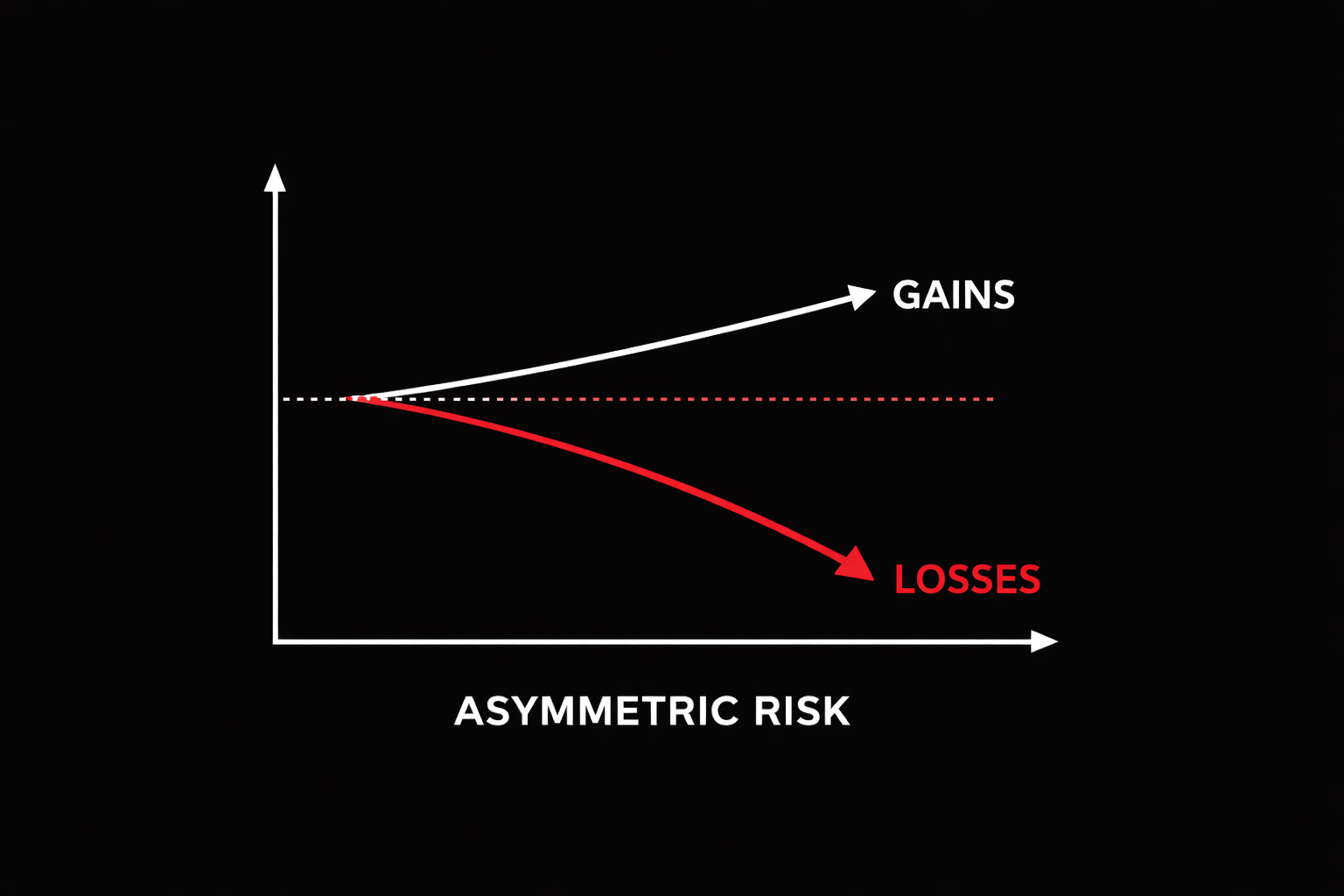
Asymmetric risk is the unequal and disproportionate impact that losses have on invested capital relative to gains due to compounding mathematics. Because losses reduce the capital base, larger percentage gains are required to recover from drawdowns. As a result, downside exposure can impair wealth faster and more permanently than equivalent upside gains can restore it.
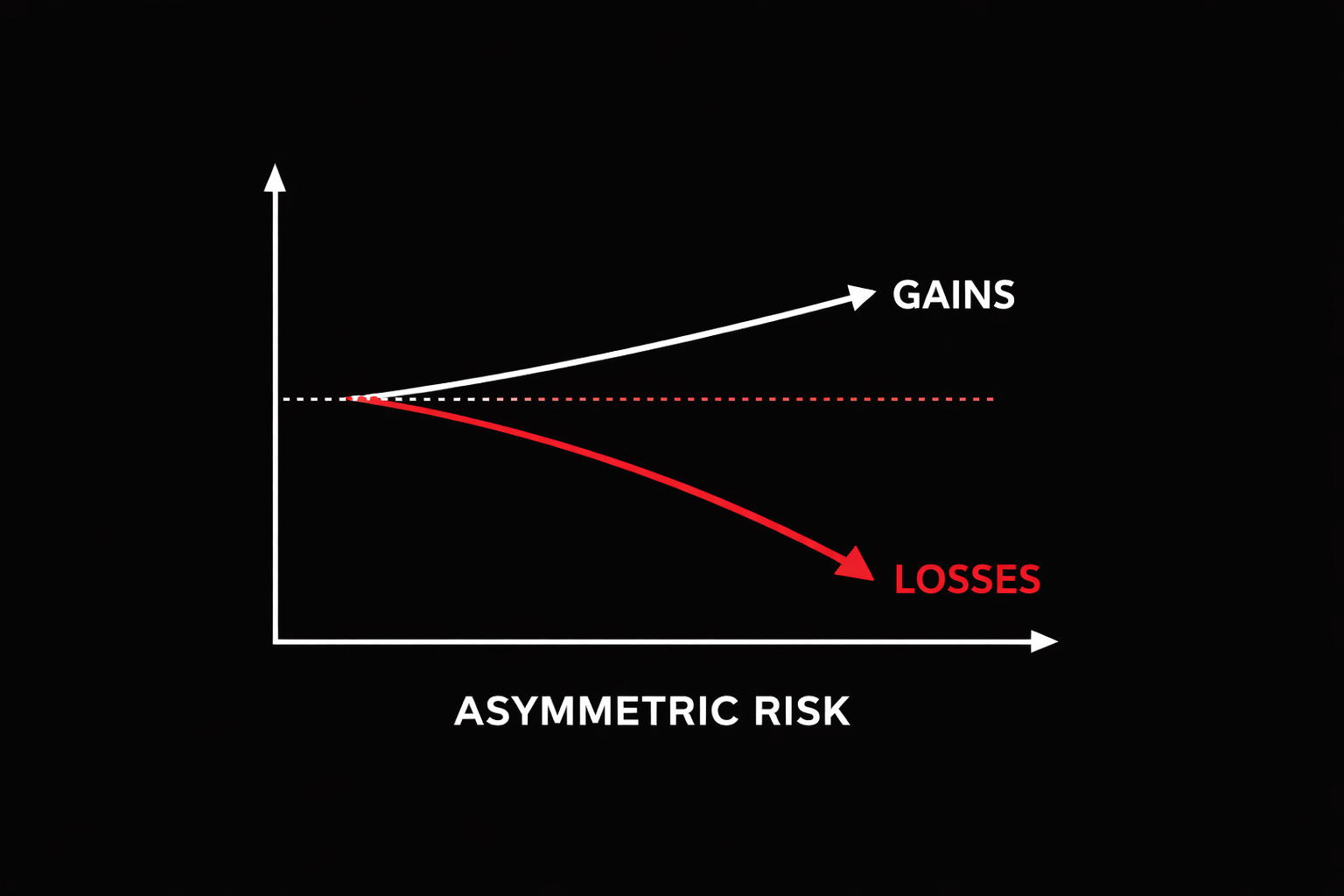
In investing, gains and losses are not mirror images.
They are geometric opposites.
The Mathematics of Asymmetric Risk
Capital compounds multiplicatively, not additively. When a portfolio declines, the base from which future returns compound becomes smaller.
Recovery math makes the asymmetry clear:
- 10% loss → 11.1% gain required to recover
- 20% loss → 25% gain required to recover
- 40% loss → 66.7% gain required to recover
- 50% loss → 100% gain required to recover
The formula is straightforward:
Required Recovery Return = Loss ÷ (1 − Loss)
A 50% decline cuts capital in half. To recover from 0.5 back to 1.0 requires a 100% gain.
Losses compound against you. Gains compound for you.
This is not behavioral. It is arithmetic.
The Hidden Variable: Time
Asymmetric risk is not just about percentage recovery. It is about time.
A deep drawdown does not merely require a larger percentage gain — it requires years of additional compounding to repair. Those years cannot be reclaimed.
For families managing significant capital — business owners following a liquidity event, executives with concentrated equity, physicians building lifetime retirement assets — time is finite.
A 40% decline at age 60 is not equivalent to a 40% decline at age 30.
Recovery math intersects with life math.
That intersection is where asymmetric risk becomes consequential.
Why Volatility Alone Does Not Capture Asymmetry
Traditional risk metrics such as standard deviation and Sharpe ratio treat upside and downside deviations symmetrically around a mean return.
A +20% year and a −20% year contribute equally to measured volatility.
But they do not contribute equally to capital outcomes.
Example:
$1,000,000 +20% → $1,200,000 −20% → $800,000
From $800,000, a 25% gain is required just to break even.
Volatility measures movement. Asymmetric risk measures survivability.
Standard deviation measures dispersion. Asymmetric risk measures capital impairment.
Symmetrical statistics can mask asymmetrical consequences.
Asymmetric Risk Is Not About Prediction
Asymmetric risk is not a statement about market direction.
It is not market timing. It is not forecasting.
It is an acknowledgment of outcome geometry.
Even if the probability of gains and losses appears balanced, the impact on capital is not.
This shifts the central investment question from:
“What return can we expect?”
to:
“What is the maximum capital impairment if we are wrong?”
That reframing transforms portfolio construction from return prediction to risk engineering.
Where Asymmetric Risk Expands
Asymmetric risk tends to increase when:
- Valuations embed optimistic assumptions
- Positioning is crowded
- Leverage is elevated
- Liquidity is abundant and perceived risk is low
In these environments, incremental buyers are limited while downside repricing potential can be substantial. The distribution of outcomes becomes skewed.
Risk is not balanced. It is asymmetric.
Why It Matters for Durable Compounding
Compounding requires survival.
Large drawdowns reduce:
- Future income capacity
- Spending flexibility
- Estate leverage
- Strategic optionality
Avoiding deep capital impairment often contributes more to long-term outcomes than capturing incremental upside.
Returns compound. Losses compound against you.
That is the core principle of asymmetric risk.
Concise Citation Definition
Asymmetric risk refers to the disproportionate impact of losses relative to gains on invested capital due to compounding mathematics, where downside exposure can impair wealth faster, deeper, and more permanently than equivalent upside gains can restore it.
In simple terms:
Losses and gains are not economically equivalent. Drawdowns require larger recoveries. Capital recovery is geometric, not linear. Survival precedes compounding.