
The AI Adoption Gap Is an Asymmetric Edge in Asset Management
Orientation AI has quickly become a strategic priority across asset management, private markets, and institutional research teams. Nearly every firm says it’s investing in AI. But what matters in markets isn’t intentions. It’s constraints.
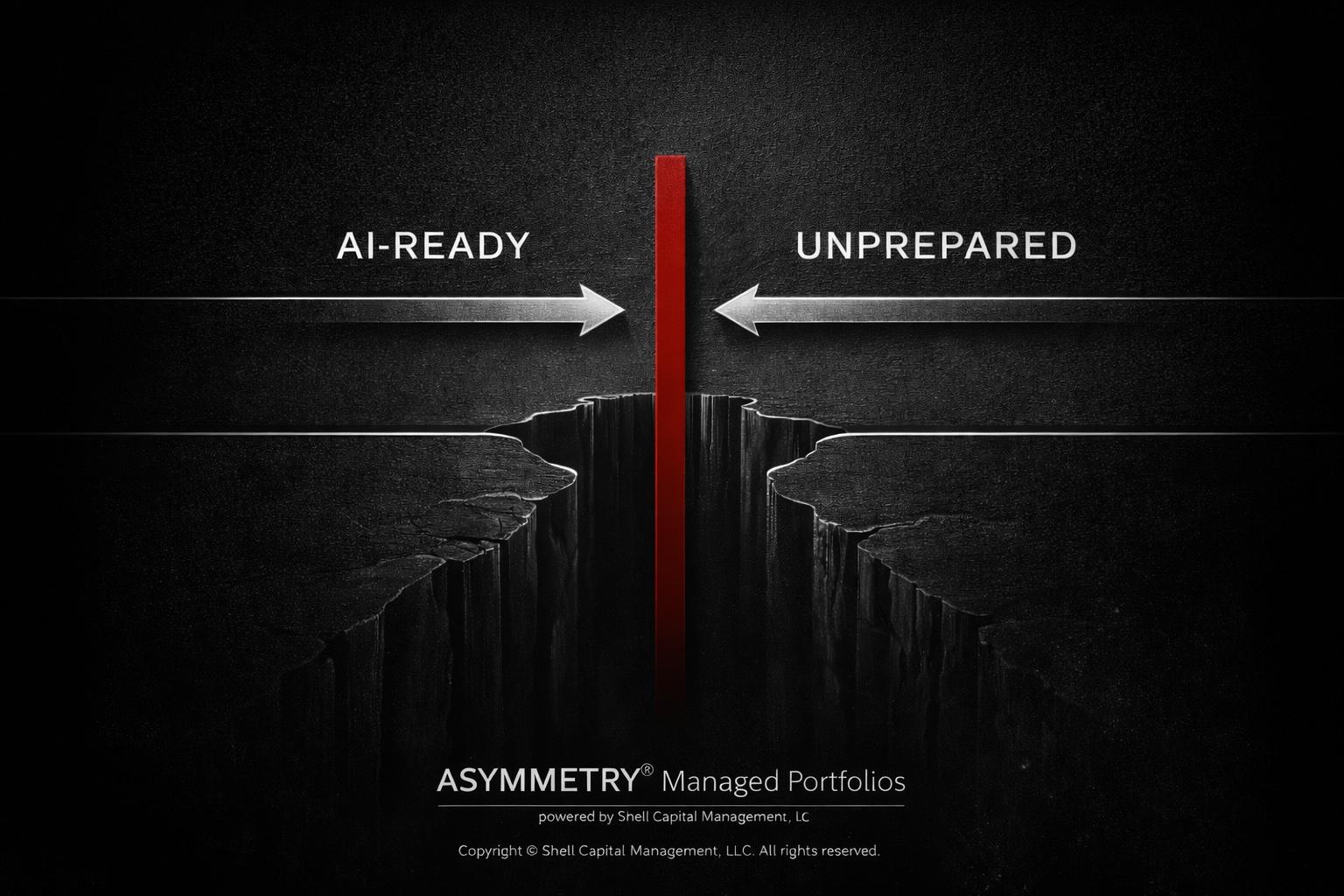
Institutional Investor highlights a widening gap between organizations that want AI and those structurally capable of deploying it. That gap matters because markets are shaped by incentives, infrastructure, and forced flows. When capability dispersion widens, asymmetric opportunities often follow.
From an ASYMMETRY® perspective, the real story isn’t AI adoption itself. It’s the uneven readiness across institutions and the structural consequences that can emerge from that imbalance.
What the research actually says
The article’s core thesis is straightforward: interest in AI across financial institutions far exceeds operational readiness.
Several structural barriers explain the gap.
First, most organizations lack the data infrastructure required for effective AI implementation. Investment processes often rely on fragmented datasets, spreadsheets, and legacy systems that make large-scale model integration difficult.
Second, many firms are running small pilot projects rather than embedding AI into core decision workflows. These experiments demonstrate potential but rarely translate into firm-wide capabilities.
Third, governance and talent constraints remain significant. AI adoption requires technical expertise, clear oversight structures, and organizational alignment between technology teams and investment professionals.
In practice, this means many institutions are enthusiastic about AI but structurally unprepared to operationalize it at scale.
The article’s implication is that AI readiness is not simply about acquiring tools. It requires changes in data architecture, workflow design, and institutional culture.
The ASYMMETRY® perspective
When capability gaps widen across an industry, asymmetry tends to emerge.
AI readiness is less about algorithms and more about market structure.
Building a functional AI infrastructure requires large upfront investment in data systems, integration layers, and technical talent. Those costs are mostly fixed. Once the foundation exists, however, the output can scale across research, risk management, operations, and portfolio construction.
That structure creates asymmetric economics.
The downside is defined: capital investment, implementation time, and organizational friction. The upside, if the system works, is broad optionality across the entire investment process.
The asymmetry also comes from data compounding.
Institutions with structured datasets generate feedback loops that improve models over time. Better models produce better insights, which generate more usable data. The result is a reinforcing cycle of analytical improvement.
Organizations without those foundations cannot easily participate in that loop. The gap may widen rather than close.
In that sense, AI readiness behaves less like a technology upgrade and more like infrastructure. Once installed, it can influence research velocity, risk monitoring, and decision cycles across the platform.
Asymmetric risk/reward geometry
Downside definition
The primary risk in AI investment is implementation failure. Firms may spend significant resources building infrastructure that does not integrate well with existing workflows. From a process perspective, defined risk means limiting capital and organizational exposure to experimental systems while maintaining traditional decision frameworks.
Upside optionality
If the infrastructure works, the upside expands across multiple functions simultaneously. AI systems can augment research throughput, scenario analysis, operational efficiency, and risk monitoring. The optionality is not tied to one trade or strategy but to the decision engine of the entire organization.
Path dependency
AI capability depends heavily on sequencing. Data architecture, governance, and integration must come first. Without those foundations, advanced modeling capabilities tend to stall.
Skew
The structure resembles positive skew. Most initiatives may deliver incremental benefits, but successful implementations can generate disproportionate operational advantages.
Time dimension
This is likely a medium-to-long cycle dynamic. Institutional infrastructure shifts tend to evolve slowly, but once embedded they can persist for extended periods.
Portfolio construction implications
AI readiness can influence several key return drivers within institutional portfolios.
Research velocity and analytical breadth can affect equity beta exposure, factor timing, and thematic positioning. Risk monitoring improvements can influence volatility management and drawdown control. Operational efficiencies can affect liquidity management and implementation costs.
From a portfolio construction perspective, the key issue is not specific securities but process quality. Better data and analytical infrastructure may improve how institutions monitor correlations, manage concentration risk, and adjust exposures as regimes shift.
In practical terms, this could manifest through improved scenario modeling, faster identification of changing return drivers, and more efficient implementation of systematic or discretionary strategies.
Why this matters for families with meaningful capital at stake
Families with meaningful capital often face the same structural challenge institutions do: decision complexity.
Modern portfolios span public markets, private assets, tax considerations, liquidity needs, and multigenerational planning. The number of variables continues to grow.
AI itself isn’t the solution. But better analytical infrastructure can improve how those variables are monitored and managed.
For families transitioning from human capital to permanent financial capital, the goal isn’t technological novelty. It’s disciplined process, defined downside, and resilient decision frameworks.
Failure modes and what we’d watch Several signals would suggest the AI readiness thesis is weakening or becoming commoditized.
First, if AI tools become standardized across the industry, the capability gap may compress quickly.
Second, regulatory constraints could slow deployment or limit how AI systems are used in portfolio decisions.
Third, if data quality challenges persist across institutions, the expected productivity gains may not materialize.
Fourth, organizational resistance inside investment firms could prevent technology adoption from translating into actual decision improvements.
Finally, if AI models converge toward similar outputs, the informational edge may decay as strategies become crowded.
Bottom line
The real asymmetry in AI isn’t the technology itself. It’s the uneven institutional readiness to deploy it.
Source: Institutional Investor, “The Gap Between Wanting AI and Being Ready for It Is Wider Than You Think,” date not provided, https://www.institutionalinvestor.com/article/gap-between-wanting-ai-and-being-ready-it-wider-you-think
ASYMMETRY® Institutional Intelligence is written by Mike Shell, President and CIO of Shell Capital Management, LLC, a registered investment adviser. This is for informational purposes only and is not investment advice.