
Asymmetry vs. Velocity in Gold and Silver
Markets don’t price certainty. They price uncertainty — and right now, precious metals are expressing very different forms of it.
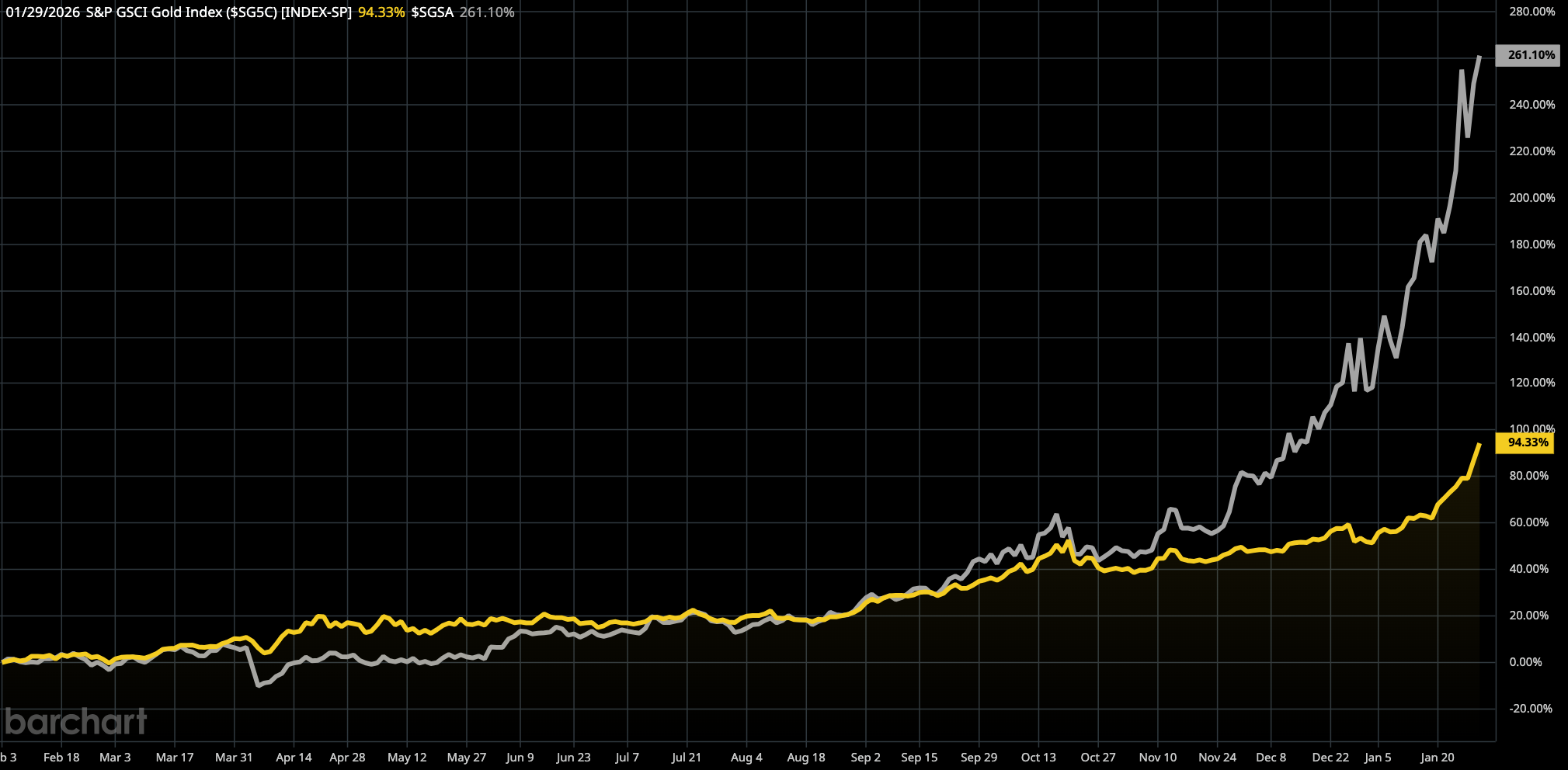
Gold breaking above $5,000 isn’t about inflation headlines or a simple “safe haven” narrative. It’s about policy uncertainty compounding across geographies. Rising Japanese bond yields, unresolved fiscal questions ahead of Japan’s February elections, persistent geopolitical stress, and an easing Fed are all feeding the same behavior: investors reaching for assets that hedge macro policy risk when confidence in sovereign balance sheets and currencies weakens.
That demand has been real. But price matters.
At current levels, gold presents a classic asymmetry problem for tactical investors. A resolution — geopolitical or fiscal — could trigger a retracement as hedging demand unwinds. On the other hand, any further deterioration reinforces consolidation or continuation higher. The near-term setup is binary, not smooth.
Where gold becomes structurally interesting is beyond the tactical horizon. Central bank accumulation — particularly from EM buyers — remains persistent, and private investors have begun reallocating toward gold as the Fed shifts toward easing. Importantly, that forecast assumes only a continuation of recent behavior. It does not fully incorporate a broader private-sector diversification away from traditional policy hedges, which remains a meaningful source of upside optionality.
Gold’s asymmetry is slow, structural, and convex over time — capped downside near-term, uncapped upside if macro risk regimes persist.
Silver is a different animal entirely.
Silver’s rally is not just demand-driven — it’s structurally constrained. A prolonged liquidity squeeze in London, where benchmark prices are set, has thinned inventories to the point where flows now dominate price. As metal was pre-positioned into the US on tariff speculation, available float in London shrank. That creates squeeze dynamics: rallies accelerate as marginal buyers absorb remaining supply, then reverse violently when tightness eases.
Add persistent policy uncertainty around potential Section 232 tariffs — not enacted, but explicitly still under consideration — and silver remains dislocated. The result is extreme volatility in both directions. This isn’t trend persistence; it’s reflexivity amplified by market structure.
Silver’s asymmetry is sharp, unstable, and path-dependent. Upside exists, but so does the risk of violent reversals. This is convexity with teeth.
The key distinction isn’t which metal “wins.” It’s the type of asymmetry each offers.
Gold offers slow-burn convexity tied to monetary policy, fiscal credibility, and reserve behavior. Silver offers episodic convexity driven by liquidity constraints and regulatory uncertainty. One hedges regimes. The other trades dislocations.
The edge isn’t forecasting price targets. It’s recognizing whether the asymmetry you’re exposed to is structural or fragile — and sizing accordingly.
Mike Shell is the Founder and Chief Investment Officer of Shell Capital Management, LLC, a registered investment adviser. He serves as portfolio manager of ASYMMETRY® Managed Portfolios, a separately managed account program with trade execution and custody provided by Goldman Sachs Custody Solutions.
ASYMMETRY® Observations are provided for general informational and educational purposes only. They do not constitute investment advice, a recommendation, or an offer to buy or sell any security or investment strategy. The content is not intended to be a complete description of Shell Capital’s investment process and should not be relied upon as the sole basis for any investment decision.
Any securities, charts, indicators, formulas, or examples referenced are illustrative and are not intended to represent actual client portfolios, recommendations, or trading activity. Past performance is not indicative of future results. All investing involves risk, including the possible loss of principal.
Opinions expressed reflect the judgment of the author at the time of publication and are subject to change without notice as market conditions evolve. Information is believed to be reliable but is not guaranteed, and readers are encouraged to independently verify any information before making investment decisions.
Shell Capital Management, LLC provides investment advisory services only to clients pursuant to a written investment management agreement and only in jurisdictions where the firm is properly registered or exempt from registration.