

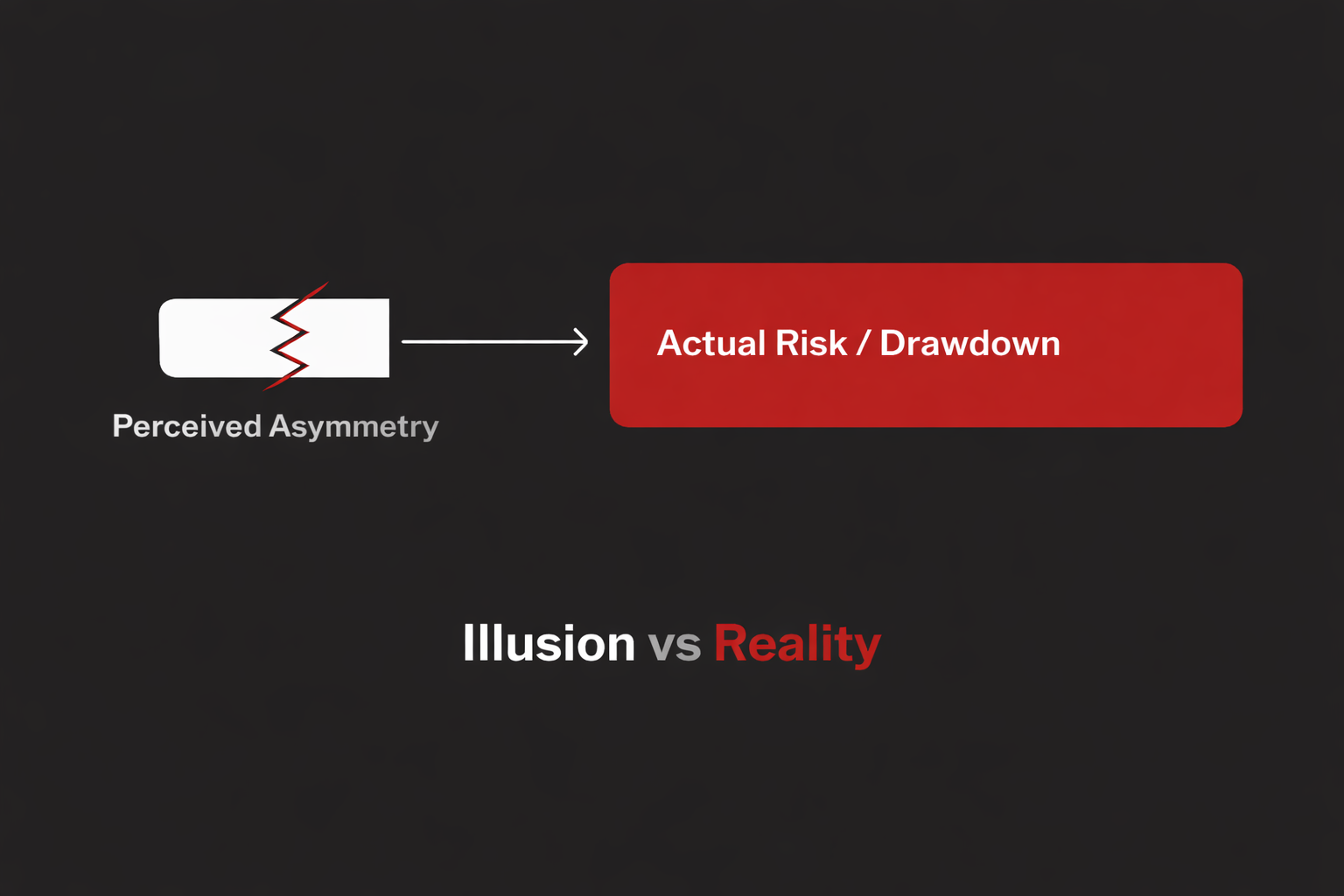
Having traded options for thirty years, I’ve seen the same pattern repeat across decades and market regimes: what looks like consistency is often just risk being deferred.
A recent MarketWatch article, “I experienced a catastrophic financial loss’: How options trader ‘Captain Condor’ led his followers to a $50 million wipeout”, details how an options trader known online as “Captain Condor” led a large group of followers into a catastrophic loss estimated at around $50 million in late December.
The strategy centered on selling short-dated iron condors on the S&P 500—a trade that profits when the market stays within a narrow range. For long periods, the approach generated frequent small gains and appeared highly consistent.
The critical flaw was position sizing.
After losses, exposure was increased using a Martingale-style approach, effectively doubling down in an attempt to recover prior losses. When market conditions shifted during a low-liquidity holiday period and volatility collapsed, the group placed an extremely large final trade.
That trade failed.
Many participants lost a substantial portion — in some cases most — of their invested capital in a matter of days. The article highlights that the market itself finished near record highs, reinforcing that the losses were driven by risk structure, not a market crash.
The Strategy That Worked… Until It Didn’t
What struck me wasn’t the strategy itself.
It was the illusion of asymmetry.
On the surface, everything looked responsible: defined-risk option spreads, high win rates, and a steady stream of small gains.
That combination is seductive — especially to investors who value consistency.
But asymmetry isn’t defined by how a strategy behaves most of the time.
It’s defined by what happens when the market stops cooperating.
Smooth returns are often borrowed from the future
The strategy sold short-dated option premium. That works exceptionally well… until it doesn’t.
Selling volatility is like collecting insurance premiums: you get paid frequently, right up until the claim arrives.
The smoother the return stream, the more likely risk is being deferred rather than eliminated.
True asymmetry embraces variability. False asymmetry hides it.
Defined risk per trade does not mean defined risk overall
Each individual trade had a capped loss.
The portfolio did not.
When losses occurred, position sizes increased in an effort to “get back to even.”
That single decision inverted the entire risk profile.
Risk expanded after losses instead of contracting. Exposure increased when capital was already impaired.
That is the opposite of asymmetry.
In asymmetric systems, losses trigger smaller risk, not larger bets.
Probability is not protection
The strategy was marketed as having a “vanishingly small” chance of catastrophic loss.
That phrase should always raise concern.
Markets don’t resolve risk based on probability. They resolve it based on path.
If a strategy cannot survive a rare outcome, it is not asymmetric — it is fragile.
Asymmetry doesn’t ask, “How likely is this?”
It asks, “What happens if it does?”
Consistency is not the goal — survival is
The most dangerous strategies in finance are the ones that work reliably for a long time.
They condition investors to expect stability. They train behavior that assumes tomorrow will look like yesterday.
Asymmetric strategies assume regimes change. They plan for discontinuity. They define exits before they’re needed.
This strategy depended on the market staying inside a narrow range, and on losses being temporary.
That assumption eventually failed — as it always does.
The real lesson
This wasn’t a failure of options. It wasn’t a failure of retail traders. It wasn’t even a failure of volatility selling.
It was a failure to respect asymmetric risk.
The downside was larger than it appeared. The recovery path required increasing exposure. The terminal outcome was unavoidable.
Asymmetry isn’t about avoiding losses.
It’s about never allowing one outcome to end the game.
Any strategy that trades consistency for fragility is not asymmetric—no matter how calm it looks on the way up.