
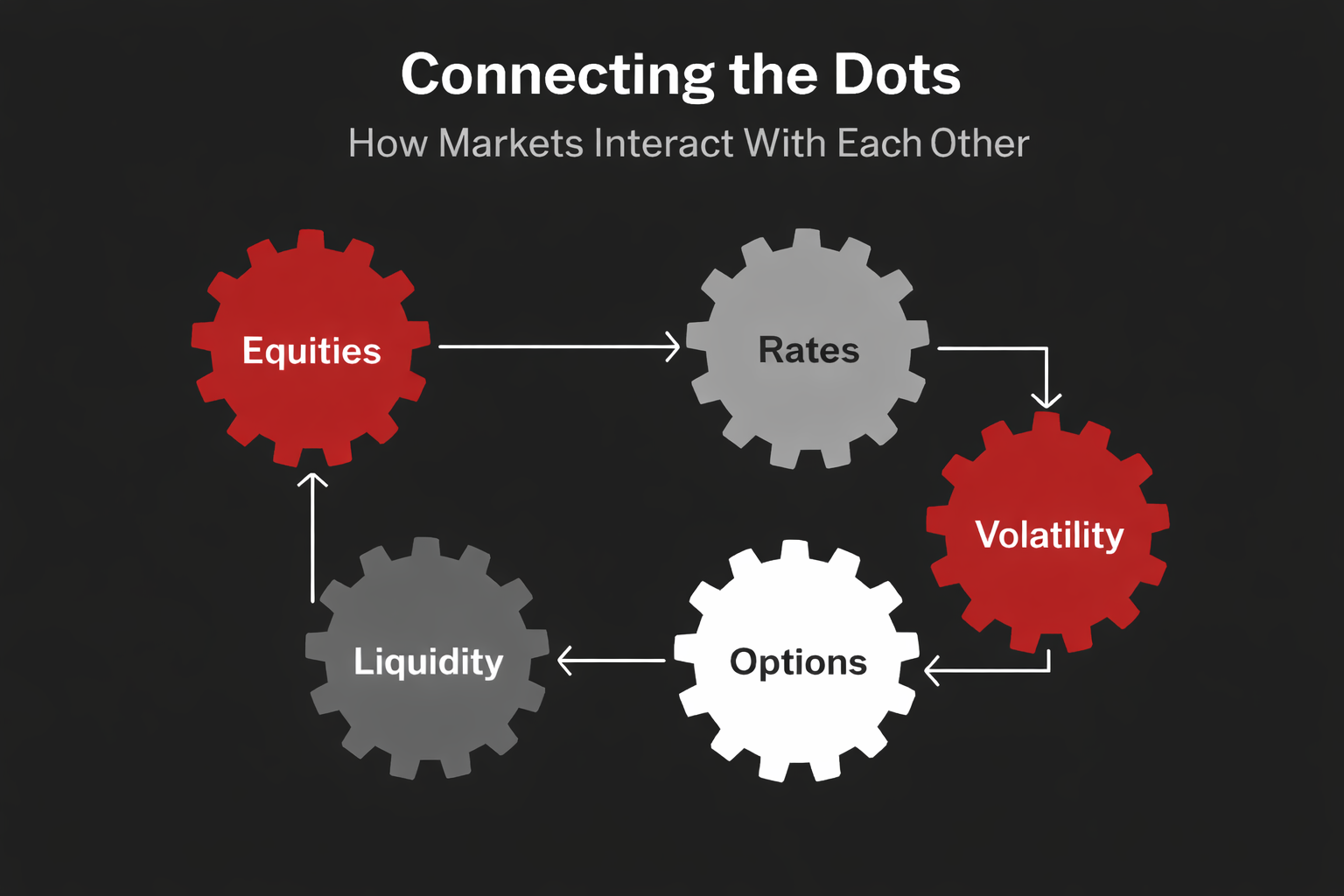
Connecting the Dots Means Understanding How Markets Interact
Most investors analyze markets in isolation.
Stocks. Bonds. Currencies. Commodities. Volatility. Options. Liquidity. Each treated like a separate puzzle.
That’s not how markets actually work.
Markets are interacting systems, not independent variables. Connecting the dots means understanding how pressure in one market transmits into another.
Equities don’t move alone. They respond to rates. Rates respond to inflation and growth expectations. Volatility responds to uncertainty and positioning. Options positioning feeds back into price through hedging mechanics. Liquidity amplifies—or dampens—all of it.
Nothing is standalone.
When I say I “connect the dots,” what I’m really doing is mapping cause-and-effect relationships across markets:
- How interest rate volatility alters equity risk premia
- How volatility suppression changes investor behavior
- How options flow creates feedback loops in price
- How liquidity shifts turn small moves into large ones
- How positioning converts information into forced action
This is why price alone is never enough.
The same price level can mean entirely different things depending on:
- Volatility regime
- Options positioning
- Liquidity conditions
- Trend maturity
- Valuation context
That’s interaction, not observation.
Options flow matters because it shows where mechanical responses will occur. Rates matter because they reprice all long-duration assets. Volatility matters because it governs leverage, behavior, and forced selling.
And when those forces align, markets trend. When they diverge, markets fracture.
Most investors ask, “What do I think the market will do?” I’m asking, “If this moves, who is forced to act—and how does that propagate through the system?”
That’s how asymmetry is identified.
Connecting the dots isn’t about forecasting a single outcome. It’s about understanding how markets interact under stress and opportunity and structuring exposure so upside is open while downside is defined.
That’s not a style. That’s a framework.
And it’s how we navigate markets that are anything but simple.
___________
Mike Shell is the Founder and Chief Investment Officer of Shell Capital Management, LLC, a registered investment adviser. He serves as portfolio manager of ASYMMETRY® Managed Portfolios, a separately managed account program with trade execution and custody provided by Goldman Sachs Custody Solutions.
The observations shared in ASYMMETRY® Observations are for general informational purposes only and do not constitute investment advice or a recommendation to buy or sell any security. The content is not intended to provide a complete description of Shell Capital’s investment process or strategies and should not be relied upon in making investment decisions.
Securities, charts, indicators, formulas, or examples referenced are illustrative in nature and are not intended to represent actual client holdings or recommendations. Past performance is not indicative of future results. Investing involves risk, including the potential loss of principal.
Any opinions expressed are subject to change without notice as market conditions evolve. All information is believed to be reliable but is not guaranteed and should be independently verified. Shell Capital Management, LLC provides investment advisory services only to clients pursuant to a written investment management agreement.
This material is not intended as an offer or solicitation for advisory services in any jurisdiction where such offer or solicitation would be unlawful.