
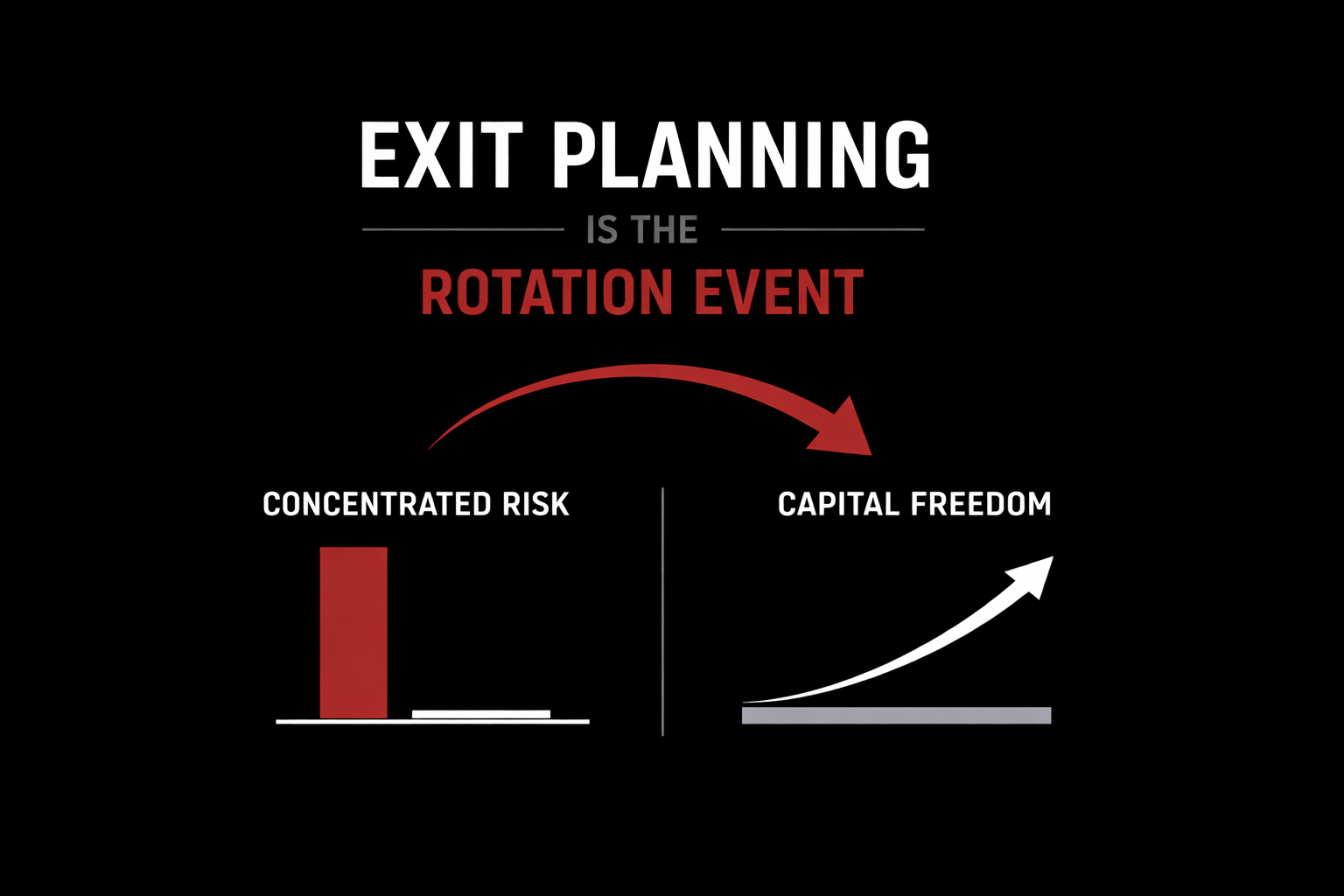
Exit Planning Is the Rotation Event
Most people think financial freedom happens gradually.
It usually doesn’t.
For business owners, it happens all at once — at the moment when effort-based income is converted into capital.
That moment is the exit.
Until then, even the most successful owner is still on the treadmill.
What is exit planning?
Exit planning is a strategic process used by business owners to prepare for leaving their company, aiming to maximize business value, minimize taxes, and ensure a smooth ownership transition. It involves creating a roadmap that addresses financial, legal, and personal goals, often including contingency plans for unforeseen events like illness or death.
Why High Income Isn’t Financial Freedom
Running a profitable business feels like independence, but structurally it isn’t.
Before an exit:
Cash flow depends on operations
Risk is concentrated in one asset
Time is still the binding constraint
You may delegate. You may scale. You may earn more than you ever imagined.
But if the business stops, the engine stops.
That’s not freedom. That’s exposure.
Exit Planning Isn’t About Leaving the Business
This is where most people misunderstand the purpose of exit planning.
It isn’t about quitting. It isn’t about retirement. It isn’t even about timing the market for buyers.
Exit planning is about rotating the source of cash flow.
From:
Human capital → financial capital
Operational risk → portfolio risk
One concentrated bet → engineered diversification
It’s the single largest transition most business owners will ever make — and it’s binary, not gradual.
The Moment You Step Off the Treadmill
When a business is sold, something fundamental changes.
For the first time:
Income no longer requires management
Time becomes optional
Risk can be deliberately defined instead of endured
This is the true transition into the investor level — not because someone now “has money,” but because capital can finally be put to work without consuming the owner’s life.
Liquidity creates freedom only if it’s handled correctly.
Why Selling the Business Isn’t Enough
Here’s the uncomfortable truth.
Many business owners sell their companies and immediately build a new treadmill.
They replace operational stress with:
Market anxiety
Volatility fear
Reactionary decision-making
Poor timing driven by emotion instead of structure
Without a process, capital becomes just another job — one people are often far less prepared to manage than the business they just sold.
Being an investor isn’t passive by default. It’s passive only when risk is engineered.
What Keeps You Off the Treadmill After the Exit
This is where portfolio management matters — not as performance chasing, but as system design.
At Shell Capital, our role begins where the business ends.
We don’t ask former owners to suddenly become money managers. We replace the treadmill with an engineered framework:
- Defined downside risk
- Portfolio-level drawdown controls
- Multiple uncorrelated return drivers
- Intentional asymmetry between risk and reward
The goal isn’t maximum return in any given year. It’s durability, optionality, and control over outcomes.
That’s what allows capital to support life instead of dominate it.
From Owner to Investor to Steward
Exit planning rotates someone into the investor level.
Risk management is what allows them to stay there.
The endgame isn’t doing nothing. It’s choosing what matters without financial pressure distorting decisions.
That’s the real meaning of getting off the treadmill.
The ASYMMETRY® Takeaway
Selling a business creates liquidity. Exit planning creates the transition. Risk-managed portfolio construction creates freedom.
Miss any one of those, and the treadmill never really stops.
Mike Shell is the founder of Shell Capital Management, a registered investment adviser that advises founders and owners of businesses on all things financial and exit planning. Shell Capital uniquely advises owners as a fiduciary, acting solely in the founders' best interest before, during, and after the sale of a company.