
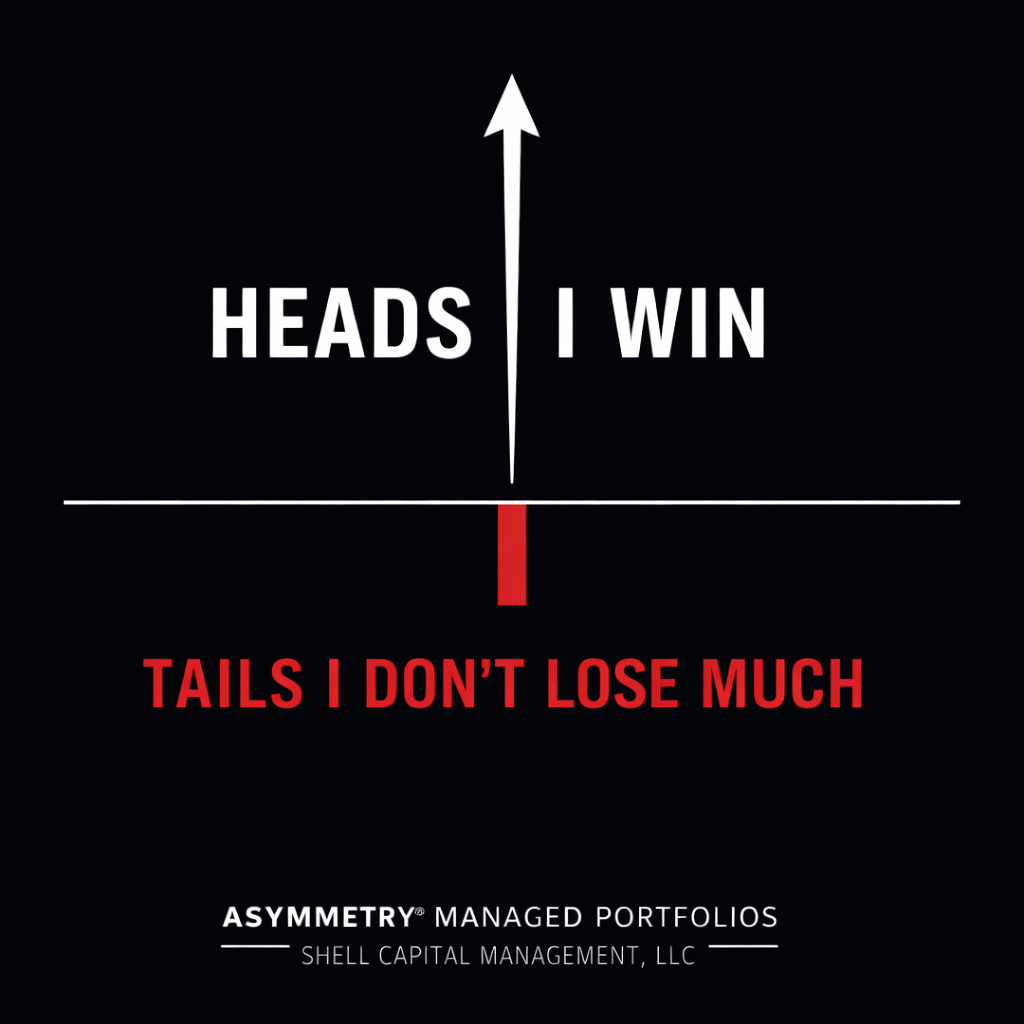
Heads I Win, Tails I Don't Lose Much
Heads I Win, Tails I Don’t Lose Much
This isn’t a slogan. It’s our portfolio management framework.
Most investors structure portfolios around allocation targets. Percentages to equities. Percentages to bonds. Percentages to alternatives.
That’s asset allocation.
“Heads I win, tails I don’t lose much” is different. It’s risk allocation.
The misconception is that portfolio management is about owning the “right mix.” The first-principles reality is that it’s about engineering asymmetric risk/reward across the entire portfolio.
Every position must answer one question:
If I’m wrong, how much do I lose — expressed as a percentage?
That percentage defines position risk. Position risk determines size. The sum of all position risks determines portfolio risk — the total percentage drawdown that would occur if every position simultaneously moved to its predefined exit.
That’s the architecture.
If upside potential is +15% and defined downside is -5%, you’ve structured asymmetry. If upside and downside are both -/+15%, you’ve structured symmetry — and now accuracy must compensate for poor payoff geometry.
Over time, symmetric payoffs demand a high hit rate. Asymmetric payoffs tolerate imperfection.
That tolerance is durability.
Durability is what allows capital to stay in the game when volatility expands, when correlations shift, when breadth deteriorates, when trends rotate.
This framework changes behavior.
It prioritizes:
Defined exits before entry. Sizing based on exit distance. Reducing exposure when selling pressure dominates buying demand. Allowing winners to expand when buying demand remains in control.
It rejects:
Oversized conviction bets. Undefined downside. Static allocation in dynamic regimes. Hope as a risk management tool.
Convexity is not accidental. It is engineered through discipline.
Optionality is preserved when losses are small. Velocity is captured when trends persist.
“Heads I win, tails I don’t lose much” means you don’t need to predict every macro outcome. You need to structure exposure so that when you’re right, upside expands, and when you’re wrong, capital impairment is contained.
This is how asymmetric wealth outcomes are built.
Not through heroic forecasts. Through defined downside and adaptive upside across the portfolio.
For business owners, physicians, and families with meaningful capital at stake, the objective isn’t excitement. It’s controlled compounding with managed drawdown risk expressed as a percentage of equity.
Engineer the downside first. Size intentionally. Let convexity do the rest.
Mike Shell is the founder and chief investment officer of Shell Capital Management, LLC, a registered investment adviser. He serves as portfolio manager of ASYMMETRY® Managed Portfolios, a separately managed account program with trade execution and custody provided by Goldman Sachs Custody Solutions.
ASYMMETRY® Observations are provided for general informational and educational purposes only. They do not constitute investment advice, a recommendation, or an offer to buy or sell any security or investment strategy. The content is not intended to be a complete description of Shell Capital’s investment process and should not be relied upon as the sole basis for any investment decision.
Any securities, charts, indicators, formulas, or examples referenced are illustrative and are not intended to represent actual client portfolios, recommendations, or trading activity. Past performance is not indicative of future results. All investing involves risk, including the possible loss of principal.
Opinions expressed reflect the judgment of the author at the time of publication and are subject to change without notice as market conditions evolve. Information is believed to be reliable but is not guaranteed, and readers are encouraged to independently verify any information before making investment decisions.
Shell Capital Management, LLC provides investment advisory services only to clients pursuant to a written investment management agreement and only in jurisdictions where the firm is properly registered or exempt from registration.