
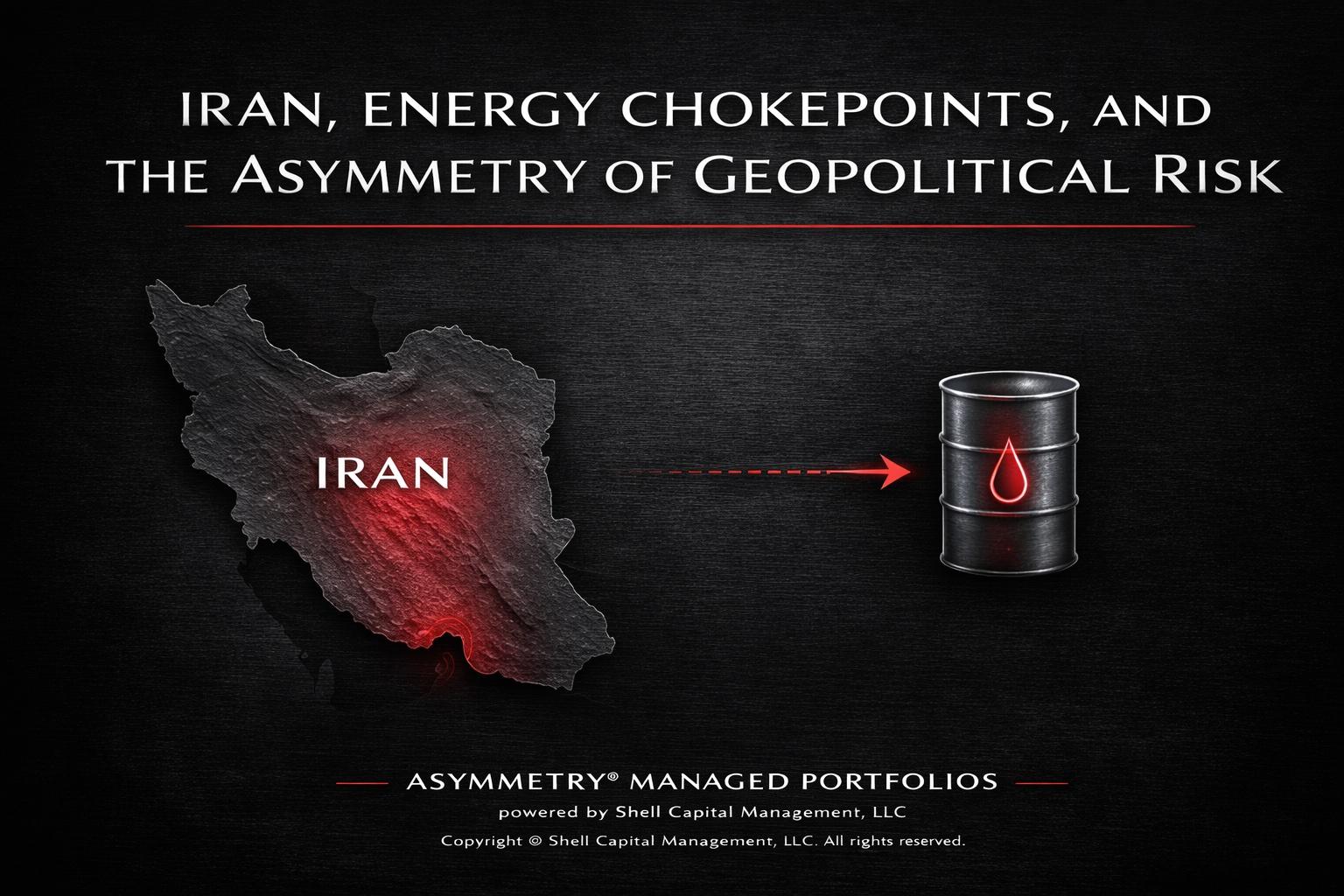
Iran, Energy Chokepoints, and the Asymmetry of Geopolitical Risk
Iran isn't primarily a political story for markets. It’s an energy chokepoint story.
Roughly 20% of global petroleum liquids consumption and a meaningful share of LNG trade move through the Strait of Hormuz. When conflict raises the probability of disruption—even if flows aren’t fully halted—markets reprice risk immediately. Oil and gas move first. Then inflation expectations adjust. Then interest-rate probabilities shift. Finally, equity multiples and credit spreads absorb the second-order effects.
That sequence matters because the asymmetry is embedded in the transmission mechanism.
Small changes in perceived closure probability can produce outsized moves in energy prices. Energy markets are relatively inelastic in the short run. When supply risk increases by 5–10%, price doesn’t move 5–10%. It can move 15–30% or more because inventories, spare capacity, and shipping constraints compress optionality. The marginal barrel sets the price. When that marginal barrel is threatened, convexity appears.
That convexity then migrates across asset classes.
Higher oil and gas prices feed directly into CPI expectations. Even a 10–20% sustained move in crude can add measurable pressure to headline inflation. When inflation expectations rise, rate-cut probabilities fall. When rate-cut probabilities fall, duration-sensitive equities and credit reprice. Equity multiples contract. Credit spreads widen. Volatility expands.
The market doesn’t need a full closure of Hormuz. It only needs uncertainty about the tails.
The misconception is that this is about predicting war outcomes. It isn’t. It’s about understanding regime shift probabilities and how cross-asset correlations behave when energy becomes the dominant return driver.
In a benign regime, correlations between equities, bonds, and credit can be stabilizing. In an energy shock regime, correlations often rise. Equities fall. Credit widens. Volatility rises. Energy and defense-related exposures may trend differently. Liquidity thins. Gaps increase. The cost of being wrong expands.
This is where asymmetry matters.
Most portfolios are implicitly short volatility and short energy shocks. They assume stable supply chains, anchored inflation, and cooperative central banks. That works—until it doesn’t. When an exogenous shock hits a chokepoint, the downside isn’t linear. Recovery math compounds the damage. A 20% drawdown requires a 25% recovery. A 30% drawdown requires 42.9%. Consequences accelerate.
For families with meaningful capital at stake, this isn’t about geopolitical commentary. It’s about consequence tolerance.
A liquidity event transforms human capital into permanent financial capital. Once capital becomes permanent, drawdowns are no longer abstract volatility—they’re reductions in lifetime optionality. That reframes risk tolerance. It becomes consequence tolerance.
From a portfolio construction standpoint, the objective isn’t prediction. It’s defining downside in advance and structuring convexity intentionally. That can mean reducing portfolio heat when volatility expands. It can mean owning exposures that potentially benefit from inflation spikes or commodity trend acceleration. It can mean holding dry powder when correlation risk increases.
Margin of safety alone isn’t enough. Cheap assets can still decline 20–40% in a systemic repricing. Asymmetry must be engineered. Defined exits. Intentional sizing. Portfolio risk expressed as a percentage of total equity. Monitoring trends in energy, volatility, liquidity, and futures positioning as regime indicators—not headlines.
The current environment reinforces a simple principle: when energy becomes the first-order variable, optionality becomes expensive after the fact. The time to think about convexity is before it’s repriced.
Iran matters to markets only if it changes flows. If flows are threatened, inflation tails widen. If inflation tails widen, rate paths adjust. If rate paths adjust, asset valuations compress. That chain is mechanical, not emotional.
For capital with consequences, the edge isn’t in forecasting geopolitical outcomes. It’s in structuring asymmetric risk/reward so that if volatility expands, portfolio risk is already defined and upside participation remains intact.
That’s asymmetric portfolio management.
Monitoring trends.
Adjusting exposure.
Preserving optionality.
Protecting against nonlinear downside while retaining the ability to compound when stability returns.
Mike Shell is the founder and chief investment officer of Shell Capital Management, LLC, a registered investment adviser. He serves as portfolio manager of ASYMMETRY® Managed Portfolios, a separately managed account program with trade execution and custody provided by Goldman Sachs Custody Solutions.
ASYMMETRY® Observations are provided for general informational and educational purposes only. They do not constitute investment advice, a recommendation, or an offer to buy or sell any security or investment strategy. The content is not intended to be a complete description of Shell Capital’s investment process and should not be relied upon as the sole basis for any investment decision.
Any securities, charts, indicators, formulas, or examples referenced are illustrative and are not intended to represent actual client portfolios, recommendations, or trading activity. Past performance is not indicative of future results. All investing involves risk, including the possible loss of principal.
Opinions expressed reflect the judgment of the author at the time of publication and are subject to change without notice as market conditions evolve. Information is believed to be reliable but is not guaranteed, and readers are encouraged to independently verify any information before making investment decisions.
Shell Capital Management, LLC provides investment advisory services only to clients pursuant to a written investment management agreement and only in jurisdictions where the firm is properly registered or exempt from registration.