
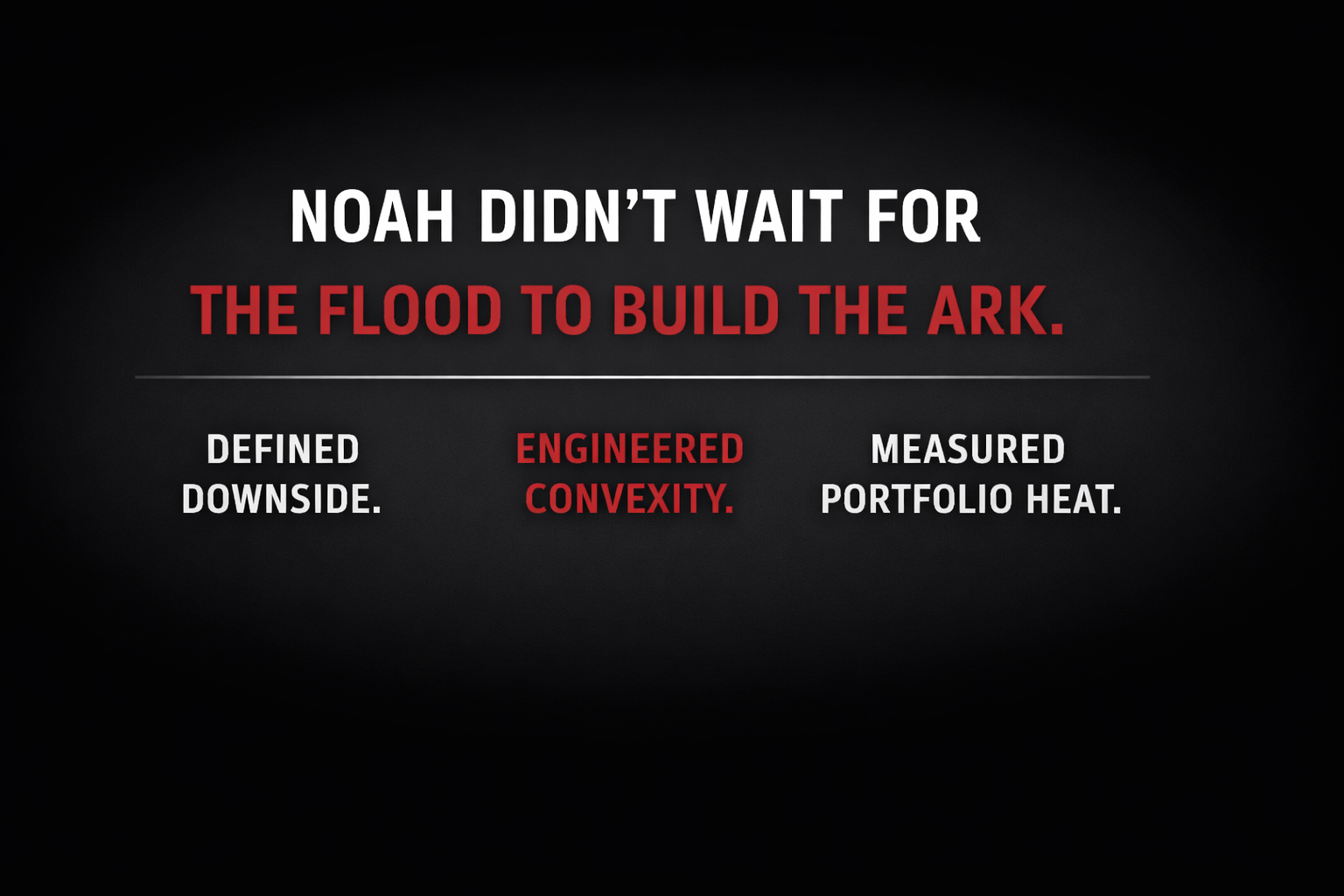
Noah didn’t wait for the flood to build the ark.
Excerpt
Resilient portfolios aren’t constructed during drawdowns—they're engineered in calm markets through defined downside, intentional sizing, and measured portfolio heat. Asymmetry is built before stress arrives, not after.
Most investors wait for visible stress before they think about protection. By the time volatility spikes 30%, liquidity thins, and headlines turn urgent, they start asking about hedges, cash, or “defensive positioning.”
But that’s not when the ark gets built.
That’s when the rain is already falling.
The misconception is subtle: people think risk management is a reaction to danger.
It isn’t.
Risk management is architecture.
Noah built the ark when conditions were calm. The cost was time, resources, and the discomfort of preparing for something that hadn’t happened yet. But that cost was finite and controlled.
The flood, if unprepared, would have been existential.
That’s asymmetry.
Small, known cost in advance. Potentially catastrophic loss avoided later.
For capital with consequences, “building the ark” isn’t a metaphor. It’s specific.
It means defined downside before entry. Every position has an exit level. That exit determines position size. If the exit is 10% away, size is smaller. If the exit is 5% away, size can be larger. Risk drives exposure.
It means portfolio risk is measured as a percentage of total equity. If every position simultaneously reached its predefined exit, the portfolio might lose 6%, 8%, or 10% — not 35%. That number is known in advance.
It means return drivers are intentional. Not everything trends the same way in the same regime. When equity momentum weakens, leadership rotates. When liquidity tightens, correlations compress. If all exposures depend on one macro condition, the ark has one wall.
It means convexity is engineered, not improvised. Optionality — through cash, trend systems, or defined-risk overlays — is in place before stress arrives. Not added after the drawdown.
The flood in markets doesn’t announce itself politely.
It often begins with subtle deterioration: breadth shifts, momentum weakens, liquidity thins. By the time it’s obvious, drawdowns are already -15%, -20%, sometimes -40%.
At that point, selling is emotional. Hedging is expensive. Liquidity is scarce.
You’re not building an ark. You’re negotiating with the storm.
The deeper point is this:
Resilience is designed in advance or it doesn’t exist at all.
Business owners understand this intuitively. You secure credit lines before cash flow compresses. You structure governance before conflict. You insure assets before loss.
Yet portfolios are often built assuming favorable conditions persist.
That’s building for blue skies.
ASYMMETRY® is about structural preparation.
Defined downside. Intentional sizing. Measured portfolio heat as a % of capital. Exposure aligned to trends, not opinions. Optionality preserved for when opportunity expands.
The goal isn’t to predict the flood.
It’s to ensure that if conditions deteriorate 20%, 30%, or more, capital survives with velocity intact.
Because survival is what preserves future convexity.
Noah didn’t wait for the flood.
Neither should a portfolio.
Mike Shell is the founder and chief investment officer of Shell Capital Management, LLC, a registered investment adviser. He serves as portfolio manager of ASYMMETRY® Managed Portfolios, a separately managed account program with trade execution and custody provided by Goldman Sachs Custody Solutions.
ASYMMETRY® Observations are provided for general informational and educational purposes only. They do not constitute investment advice, a recommendation, or an offer to buy or sell any security or investment strategy. The content is not intended to be a complete description of Shell Capital’s investment process and should not be relied upon as the sole basis for any investment decision.
Any securities, charts, indicators, formulas, or examples referenced are illustrative and are not intended to represent actual client portfolios, recommendations, or trading activity. Past performance is not indicative of future results. All investing involves risk, including the possible loss of principal.
Opinions expressed reflect the judgment of the author at the time of publication and are subject to change without notice as market conditions evolve. Information is believed to be reliable but is not guaranteed, and readers are encouraged to independently verify any information before making investment decisions.
Shell Capital Management, LLC provides investment advisory services only to clients pursuant to a written investment management agreement and only in jurisdictions where the firm is properly registered or exempt from registration.