
Oil Shock: When the Buffer Disappears, Risk Becomes Nonlinear
In Goldman Sachs’ latest oil research, the most important number isn’t the new $90 Brent forecast.
It’s 11–12 million barrels per day.
That’s Goldman’s estimate of how fast global oil inventories are drawing down in April because of Persian Gulf production losses. They estimate those losses at 14.5 million barrels per day, enough to shift the oil market from a 1.8 million barrel per day surplus in 2025 to a 9.6 million barrel per day deficit in 2026Q2.
Oil gets the headline.
Inventory is the structure underneath it.
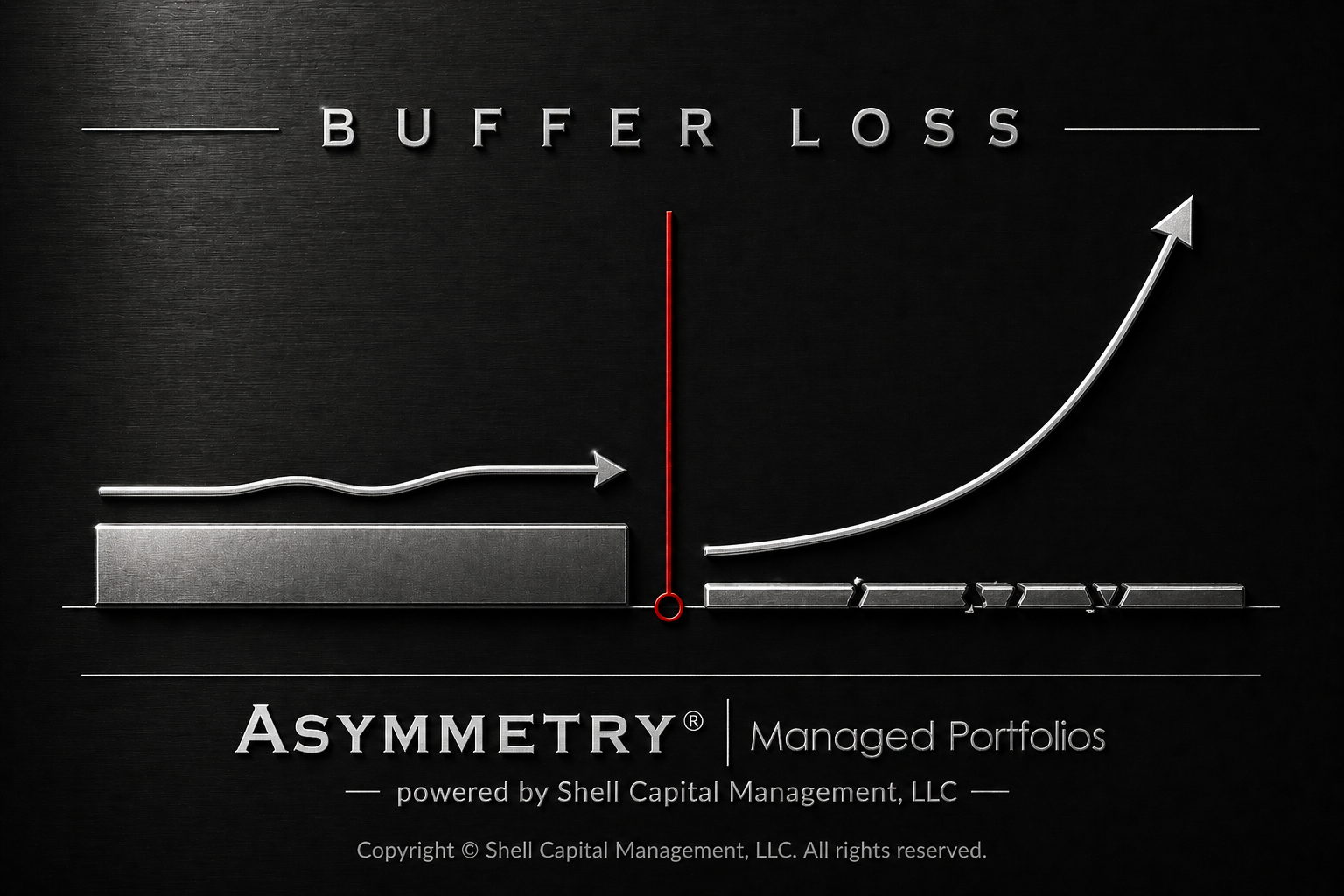
And when the structure loses its buffer, price doesn’t have to move gradually. Risk becomes nonlinear.
That’s the real observation.
Most people look at an oil shock and ask, “How high can crude go?”
That’s not the first question I’d ask.
The better question is, “How much buffer is left in the system?”
Because buffer is what keeps volatility from becoming consequence.
When inventories are high, the system has room to be wrong. Refiners can adjust. Importers can reroute. Governments can release reserves. Consumers can respond slowly. Supply chains have time.
Price still moves, but it isn’t carrying the full burden of adjustment.
When inventories are low, that changes.
Every missing barrel matters more. Every delay matters more. Every transportation constraint matters more. Every policy response creates more second-order risk.
The same shock can produce a larger price response because the system has less capacity to absorb it.
That’s asymmetry.
Goldman’s base case already reflects higher oil prices, with 2026Q4 Brent upgraded to $90 from $80 and WTI upgraded to $83 from $75. But the more important point is the skew. In its adverse scenario, Goldman estimates Brent just above $100. In its severely adverse scenario, Brent approaches $120 if delayed Gulf export normalization is combined with persistent production-capacity scarring.
That isn’t a clean, balanced distribution.
That’s a market with right-tail risk.
And the right tail exists because inventories are the oil market’s margin of safety.
When the margin of safety is wide, shocks are manageable.
When the margin of safety narrows, shocks can become violent.
Why it matters:
This isn’t just an energy issue.
It’s a portfolio-risk issue.
The economy doesn’t consume Brent futures. It consumes gasoline, diesel, jet fuel, petrochemical feedstocks, transportation, shipping, logistics, and energy embedded into nearly every margin structure.
Goldman specifically points to unusually high refined product prices, product shortage risk, and the unprecedented scale of the inventory draw.
That matters because refined products are where the real economy feels the squeeze.
Higher diesel can raise transportation costs.
Higher transportation costs can pressure margins.
Margin pressure can affect earnings.
Inflation pressure can affect rates.
Rates can affect valuations.
Valuations can affect liquidity.
Liquidity can affect behavior.
Behavior can affect the ability to stay invested when the market becomes disorderly.
That’s the chain.
An oil shock can move through a portfolio even if the portfolio doesn’t appear to be directly exposed to oil.
That’s why “I don’t own much energy” is often the wrong conclusion.
You may not own much direct energy exposure, but you may still own the consequences of energy volatility through equities, bonds, inflation sensitivity, business margins, consumer pressure, private company exposure, or sequence risk after a liquidity event.
That’s the CIO problem.
Not predicting the exact price of oil.
Understanding how the shock transmits through the portfolio.
For ASYMMETRY®, this is the distinction between a market opinion and an operating system.
A market opinion asks:
“Where will oil trade?”
A portfolio operating system asks:
“What happens if oil volatility, refined product stress, inflation pressure, rate sensitivity, margin compression, and policy risk rise together?”
Those are different questions.
The first is a forecast.
The second is exposure management.
For business owners, founders, executives, physicians, families after a liquidity event, or anyone with meaningful capital at stake, the second question matters more.
Because after a major money event, the problem changes.
Before the money event, risk is often concentrated in the business. It’s tied to human capital, operating skill, control, reinvestment, customer relationships, and decision speed.
After the money event, risk shifts.
Capital becomes more liquid, but also more exposed to market structure, inflation, interest rates, valuation, taxes, liquidity, behavior, and timing.
A macro shock doesn’t need to destroy the world to matter.
It only has to arrive at the wrong time, hit the wrong exposures, and force the wrong decisions.
That’s why buffers matter.
Oil inventories are a physical buffer.
Cash is a portfolio buffer.
Liquidity is a behavioral buffer.
Position sizing is a loss buffer.
Defined downside is a decision buffer.
Risk offsets are a regime buffer.
When buffers exist, volatility can be managed.
When buffers disappear, volatility becomes consequence.
This is also why policy risk matters.
Goldman Sachs says US oil export restrictions are not its base case, but does not rule them out if the Strait remains effectively closed for longer. That kind of intervention can distort spreads, refinery economics, domestic prices, global prices, production incentives, and product availability.
That’s how shocks evolve.
First physical.
Then financial.
Then political.
By the time policy enters the system, the price signal is no longer clean. It’s mixed with emergency decisions, bottlenecks, incentives, restrictions, and behavioral pressure.
Linear thinking tends to fail in that environment.
The point isn’t that oil must go higher.
The point is that the system has less room to absorb being wrong.
That’s the permanent risk-management lesson.
A barrel in storage is more than a barrel.
It’s time.
It’s flexibility.
It’s negotiating power.
It’s the ability to avoid forced action.
A well-managed portfolio should seek to provide the same thing.
Not certainty.
Not immunity from volatility.
Not a promise.
A process for keeping volatility from becoming forced behavior.
Because when the buffer disappears, risk becomes nonlinear.
And once risk becomes nonlinear, the people who survive best are usually not the ones with the boldest forecast.
They’re the ones who already had an operating system.
Mike Shell is the founder and chief investment officer of Shell Capital Management, LLC, a registered investment adviser. He serves as portfolio manager of ASYMMETRY® Managed Portfolios, a separately managed account program with trade execution and custody provided by Goldman Sachs Custody Solutions.
ASYMMETRY® Observations are provided for general informational and educational purposes only. They do not constitute investment advice, a recommendation, or an offer to buy or sell any security or investment strategy. The content is not intended to be a complete description of Shell Capital’s investment process and should not be relied upon as the sole basis for any investment decision.
Any securities, charts, indicators, formulas, or examples referenced are illustrative and are not intended to represent actual client portfolios, recommendations, or trading activity. Past performance is not indicative of future results. All investing involves risk, including the possible loss of principal.
Opinions expressed reflect the judgment of the author at the time of publication and are subject to change without notice as market conditions evolve. Information is believed to be reliable but is not guaranteed, and readers are encouraged to independently verify any information before making investment decisions.
Shell Capital Management, LLC provides investment advisory services only to clients pursuant to a written investment management agreement and only in jurisdictions where the firm is properly registered or exempt from registration.