
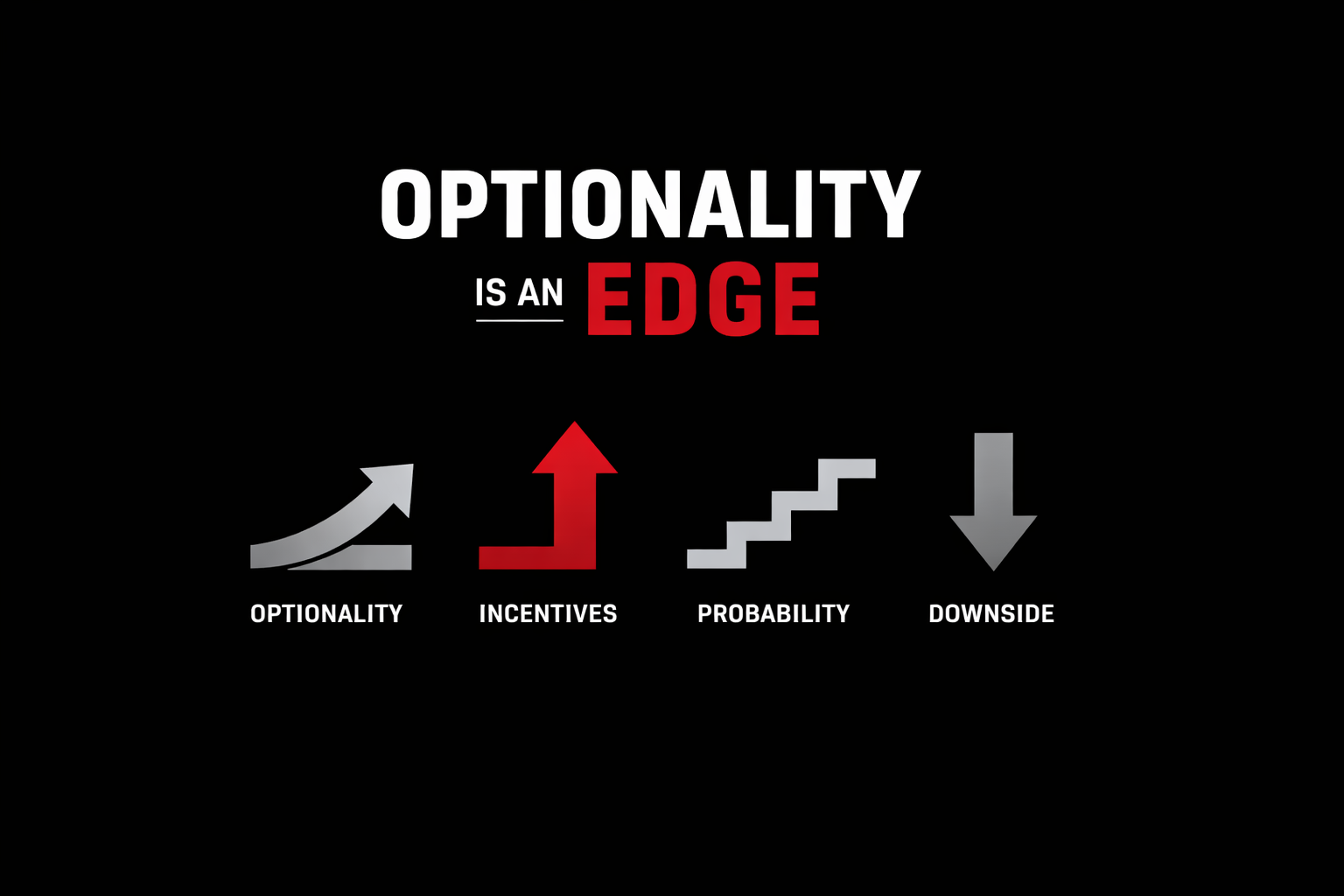
Optionality Is An Edge Behind Asymmetric Payoffs
Prediction markets demonstrate that optionality—not intelligence—drives forecasting accuracy. When participation is optional, capital deploys only when an edge exists, creating asymmetric payoffs. Structure, not prediction, is the foundation of asymmetric outcomes.
A recent New York Times article, “Thousands of Amateur Gamblers Are Beating Wall Street Ph.D.s,” highlighted new academic research showing that prediction markets like Kalshi and Polymarket have, on average, matched — and in some cases exceeded — the forecasting accuracy of professional economists.
But the real authority isn’t the headline.
It’s the research underneath it.
A working paper from the National Bureau of Economic Research, “Are Prediction Markets More Accurate Than Professional Forecasters?” found that prediction market participants have been about as accurate as professional forecasters in predicting key economic indicators over multiple years.
Separate research, “Financial Prediction Markets: A New Measure of Earnings Expectations” by Roberto Gomez Cram, Yunhan Guo, Theis Ingerslev Jensen, and Howard Kung, finds that prediction-market-implied earnings expectations are more accurate and less biased than traditional analyst forecasts.
That’s not a media narrative.
That’s structure.
But the real insight isn’t that “amateurs beat Ph.D.s.”
It’s why.
Professional economists must publish forecasts every month. Whether conviction is high or low. Whether the data is clean or conflicting. Participation isn’t optional.
Prediction market participants can abstain.
They deploy capital only when they believe they have edge. If they don’t see asymmetric probability, they simply don’t participate.
That structural difference matters more than credentials.
Optionality is convex.
The research and commentary around these markets also point to incentive alignment. When participants must put money behind their view, they reveal their true beliefs. Forecasting under capital at risk is different than forecasting under career risk.
Incentives shape signal quality.
There’s another layer. Prediction markets force probabilistic thinking. Not narratives. Not certainty. Instead: What’s the probability? What are the odds?
Markets speak in distributions.
Narratives speak in absolutes.
The research also shows edge tends to be domain-specific. Traders who perform well in one category often don’t in another. That mirrors capital markets. No strategy dominates every regime. No return driver works all the time.
Edge exists in pockets.
Forecasting accuracy, however, isn’t portfolio construction.
Even professional economists note that the value of their work isn’t just the number — it’s the interpretation and analysis beneath it. Forecasting is input. Risk management is outcome.
That’s where this connects directly to ASYMMETRY®.
In our work, cash is the default. Exposure is earned. We don’t force participation in every regime. We define downside risk in advance and allocate capital only when asymmetric risk/reward exists.
We don’t need to forecast every outcome.
We need convexity when it matters.
Prediction markets illustrate something structurally important: when participation is optional, aggregate accuracy improves. The ability not to act is itself an edge.
The misconception is that intelligence wins.
The correction is that structure wins.
Optionality. Incentives. Probability. Defined downside.
When you remove the obligation to always have a view, decision quality improves.
That principle applies to forecasting.
It applies even more to managing meaningful capital.
The future will always surprise. Regimes will always shift. No model eliminates uncertainty.
The question isn’t who predicts best.
The question is who structures exposure best under uncertainty.
That’s asymmetry.
Mike Shell is the founder and chief investment officer of Shell Capital Management, LLC, a registered investment adviser. He serves as portfolio manager of ASYMMETRY® Managed Portfolios, a separately managed account program with trade execution and custody provided by Goldman Sachs Custody Solutions.
ASYMMETRY® Observations are provided for general informational and educational purposes only. They do not constitute investment advice, a recommendation, or an offer to buy or sell any security or investment strategy. The content is not intended to be a complete description of Shell Capital’s investment process and should not be relied upon as the sole basis for any investment decision.
Any securities, charts, indicators, formulas, or examples referenced are illustrative and are not intended to represent actual client portfolios, recommendations, or trading activity. Past performance is not indicative of future results. All investing involves risk, including the possible loss of principal.
Opinions expressed reflect the judgment of the author at the time of publication and are subject to change without notice as market conditions evolve. Information is believed to be reliable but is not guaranteed, and readers are encouraged to independently verify any information before making investment decisions.
Shell Capital Management, LLC provides investment advisory services only to clients pursuant to a written investment management agreement and only in jurisdictions where the firm is properly registered or exempt from registration.