
Private Credit and the Illusion of Smooth Returns
What's going on with private credit?
Private credit has been framed as stable income insulated from public market volatility. The absence of daily marks has been interpreted as lower risk. That framing is incomplete.
What’s happening now isn’t a collapse. It’s a structural transition in the risk distribution.
The misconception
Many investors treat private credit as enhanced fixed income — higher yield, lower volatility, senior in the capital stack, secured by assets.
But private credit isn’t traditional fixed income. It’s floating-rate, sponsor-driven, leveraged corporate exposure with structural illiquidity. The volatility isn’t removed. It’s deferred.
First principles
Private credit is a liquidity transformation trade.
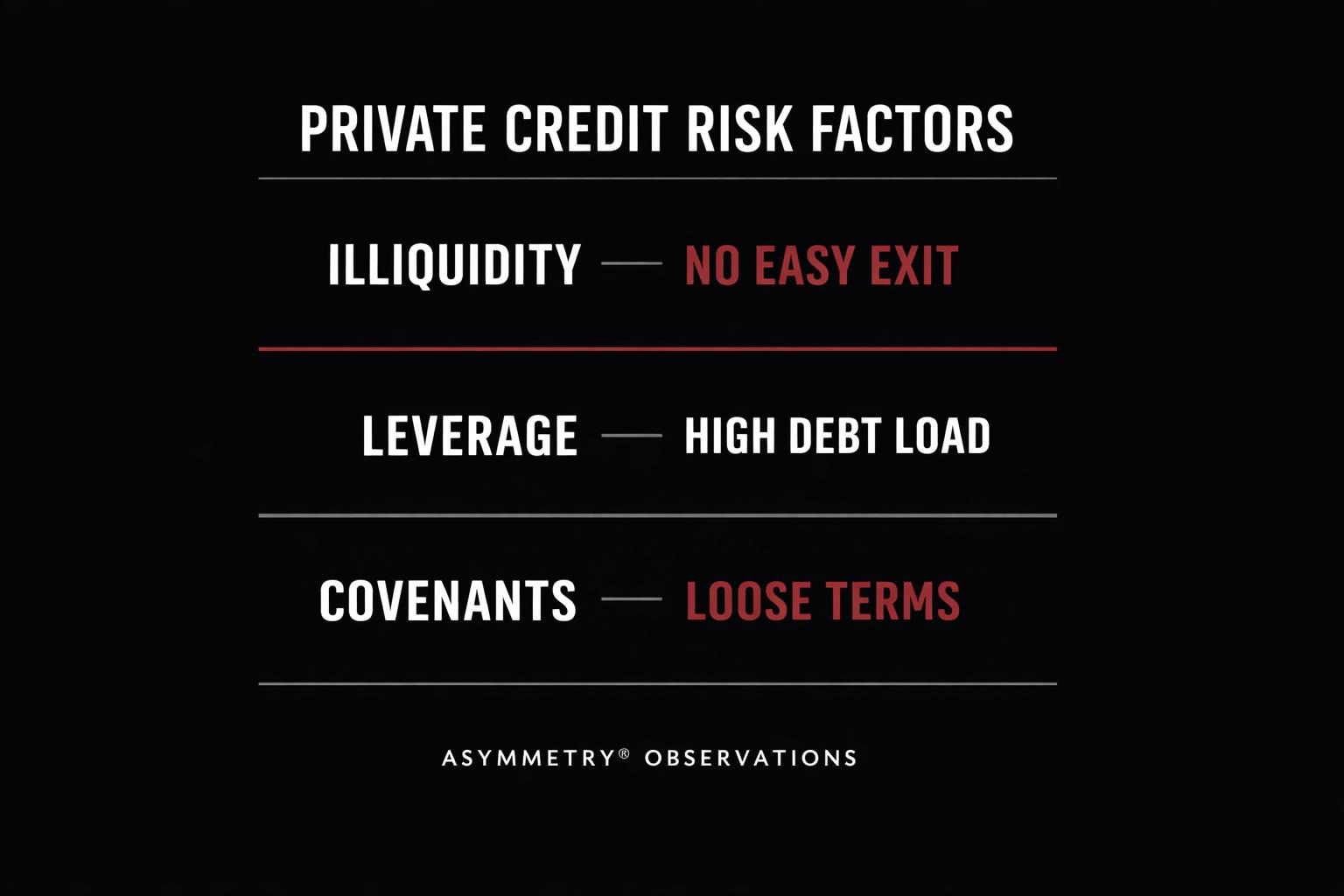
Investors give up daily liquidity. In exchange, they receive a yield premium. That premium compensates for:
- Illiquidity.
- Complex underwriting.
- Borrower leverage.
- Cycle sensitivity.
During benign economic regimes, this trends well. Defaults stay contained. Refinancing markets remain open. Sponsors inject equity to protect positions. Reported volatility stays low.
But that smoothness is accounting-based, not structural.
Higher rates have changed the math.
If base rates increase 3–5%, and loans are floating-rate, borrower interest expense rises equivalently. EBITDA doesn’t automatically adjust upward. Interest coverage compresses. Free cash flow tightens.
Now layer in:
Maturity walls building into 2026–2028. Rising amend-and-extend transactions. Increased use of PIK interest. Covenant-lite structures at higher leverage multiples.
None of these signal immediate distress. They signal cycle management under tighter liquidity.
Asymmetry and convexity
The payoff profile in senior direct lending is capped.
You earn your 8–11% coupon. You collect origination fees. You may benefit from call protection.
Upside convexity is limited.
Downside, however, is path-dependent and clustered. If default rates move from 2–3% toward 6–8% in a contraction, and recovery values fall because enterprise values compress 20–30%, principal impairment becomes nonlinear.
This is negative convexity.
The distribution shifts when:
Spreads compress. Leverage rises. Covenants weaken. Capital floods the strategy.
The yield remains fixed while tail risk expands.
Private credit is not uncorrelated with public markets. It simply trends with a lag. Enterprise value is ultimately linked to public market multiples, exit liquidity, and refinancing conditions.
If those tighten, recovery values compress.
That’s where the asymmetry shifts.
Boundary conditions and failure modes
Private credit functions well when:
Growth is stable. Exit markets are open. Refinancing channels remain available. Sponsors retain access to equity capital.
Fragility emerges when:
Liquidity contracts systemically. Multiple portfolio companies face simultaneous refinancing pressure. Public credit spreads widen materially. Private equity distributions slow, reducing sponsor flexibility.
In those environments, the risk isn’t daily volatility. It’s gating, delayed NAV adjustments, and clustered write-downs.
For capital with consequences
For business owners, founders, and families who have already converted concentrated operating risk into financial capital, the key question isn’t yield.
It’s portfolio risk.
If a portfolio already holds private equity, operating company exposure, real estate, and other illiquid assets, adding private credit may increase embedded liquidity risk even if reported volatility appears low.
Smooth marks can mask cumulative exposure to the same underlying drivers:
- Enterprise value.
- Leverage.
- Liquidity access.
From a CIO perspective, the issue is:
Is private credit being treated as a return driver with equity-like downside? Or is it being treated as a bond substitute?
The classification matters for total portfolio risk.
Where we are in the cycle
The private credit market expanded rapidly during a decade of suppressed rates and abundant liquidity. That capital growth compressed spreads and loosened terms in certain segments.
Now Treasuries yield meaningfully more than they did in the 2010s. The spread premium over public credit has narrowed in parts of the market. Meanwhile, leverage levels and floating-rate burdens remain elevated.
The asymmetry is no longer as lender-favorable as it was when:
Rates were near zero. Liquidity was abundant. Multiples were expanding.
Today the outcome is more regime-dependent.
Conclusion
Private credit isn't inherently fragile. It is structurally sensitive to liquidity and enterprise value.
When liquidity trends favorably, the strategy produces stable income and low reported volatility.
When liquidity contracts, its true risk distribution becomes visible.
The critical variable isn’t the coupon. It’s the convexity profile inside the total portfolio.
Defined downside, liquidity alignment, and position sizing determine whether private credit enhances asymmetry — or concentrates hidden risk.
Mike Shell is the founder and chief investment officer of Shell Capital Management, LLC, a registered investment adviser. He serves as portfolio manager of ASYMMETRY® Managed Portfolios, a separately managed account program with trade execution and custody provided by Goldman Sachs Custody Solutions.
ASYMMETRY® Observations are provided for general informational and educational purposes only. They do not constitute investment advice, a recommendation, or an offer to buy or sell any security or investment strategy. The content is not intended to be a complete description of Shell Capital’s investment process and should not be relied upon as the sole basis for any investment decision.
Any securities, charts, indicators, formulas, or examples referenced are illustrative and are not intended to represent actual client portfolios, recommendations, or trading activity. Past performance is not indicative of future results. All investing involves risk, including the possible loss of principal.
Opinions expressed reflect the judgment of the author at the time of publication and are subject to change without notice as market conditions evolve. Information is believed to be reliable but is not guaranteed, and readers are encouraged to independently verify any information before making investment decisions.
Shell Capital Management, LLC provides investment advisory services only to clients pursuant to a written investment management agreement and only in jurisdictions where the firm is properly registered or exempt from registration.