
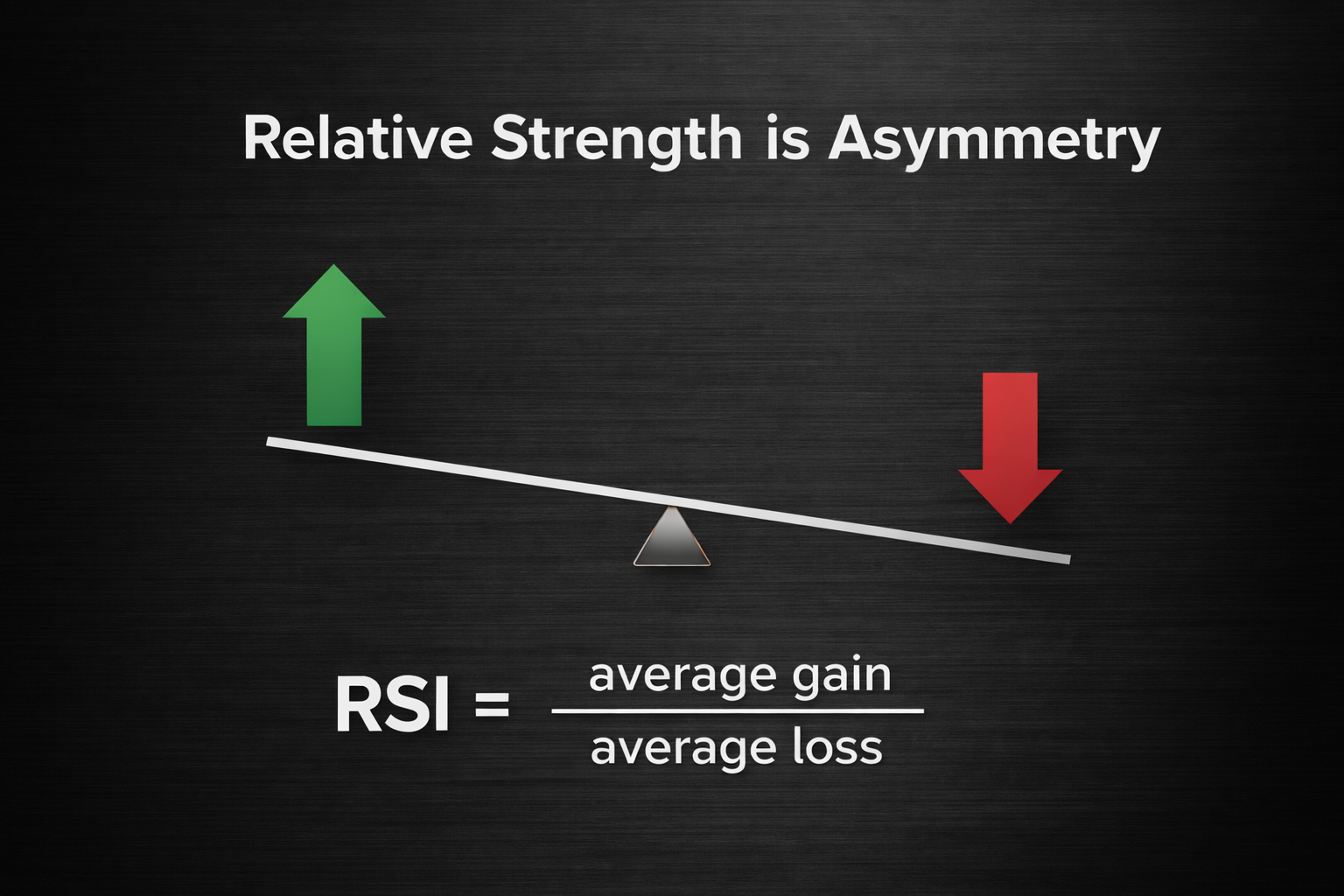
Relative Strength is a Measure of Asymmetry
Relative Strength Is Asymmetry
The Relative Strength Index (RSI) is a momentum indicator built from the relationship between average gains and average losses—and that relationship is inherently asymmetric. Most investors are taught to use RSI as a timing tool. Above 70 is “overbought.” Below 30 is “oversold.” The implication is symmetry—that price naturally self-corrects and reversals are just a matter of time.
That framing is wrong.
RSI is not a reversal indicator. It is a measure of asymmetry.
At its core, RSI is built from Relative Strength:
RS = average gain ÷ average loss
RSI is simply that ratio transformed into a bounded scale. The signal does not come from the scale. It comes from the imbalance inside the ratio.
When gains and losses are balanced, RS hovers near 1 and RSI sits near the midpoint. But markets are rarely balanced. One side almost always dominates — and that dominance is asymmetric.
When average gains dominate average losses, the system is gain-dominant. Demand absorbs supply. Advances persist, pullbacks are interruptions, and RSI tends to live in a higher range because up moves outweigh down moves across the lookback window.
When average losses dominate average gains, the system is loss-dominant. Supply overwhelms demand. Declines persist, rallies fail, and RSI lives lower because losses outweigh gains.
That dominance is the asymmetry.
Nothing in the RSI math says “RSI is low, so price must bounce.” RSI can remain depressed for extended periods if losses continue to outweigh gains. In a loss-dominant regime, downside can compound freely while upside becomes conditional and fragile.
The opposite is also true. RSI can stay elevated for long stretches in gain-dominant regimes because pullbacks never grow large enough, or persist long enough, to overpower gains. In that environment, calling RSI “overbought” isn’t analysis — it’s a misunderstanding of regime.
This is why RSI behaves differently across trends.
In uptrends, RSI tends to oscillate in higher ranges because losses never gain control. In downtrends, RSI shifts lower and stays there because gains fail to offset losses.
RSI doesn’t just capture momentary pressure. It reveals which side can sustain control over time.
That’s why RSI is asymmetric.
It isn’t measuring deviation from balance — it’s measuring which imbalance is winning. Until the gain/loss relationship flips, price behavior remains structurally biased in that direction.
The takeaway: Stop reading RSI as “too high” or “too low.” Read it as a regime signal. RSI tells you whether gains or losses are dominant — and in markets, dominance is everything.
Mike Shell is the Founder and Chief Investment Officer of Shell Capital Management, LLC, a registered investment adviser. He serves as portfolio manager of ASYMMETRY® Managed Portfolios, a separately managed account program with trade execution and custody provided by Goldman Sachs Custody Solutions.
ASYMMETRY® Observations are provided for general informational and educational purposes only. They do not constitute investment advice, a recommendation, or an offer to buy or sell any security or investment strategy. The content is not intended to be a complete description of Shell Capital’s investment process and should not be relied upon as the sole basis for any investment decision.
Any securities, charts, indicators, formulas, or examples referenced are illustrative and are not intended to represent actual client portfolios, recommendations, or trading activity. Past performance is not indicative of future results. All investing involves risk, including the possible loss of principal.
Opinions expressed reflect the judgment of the author at the time of publication and are subject to change without notice as market conditions evolve. Information is believed to be reliable but is not guaranteed, and readers are encouraged to independently verify any information before making investment decisions.
Shell Capital Management, LLC provides investment advisory services only to clients pursuant to a written investment management agreement and only in jurisdictions where the firm is properly registered or exempt from registration.