
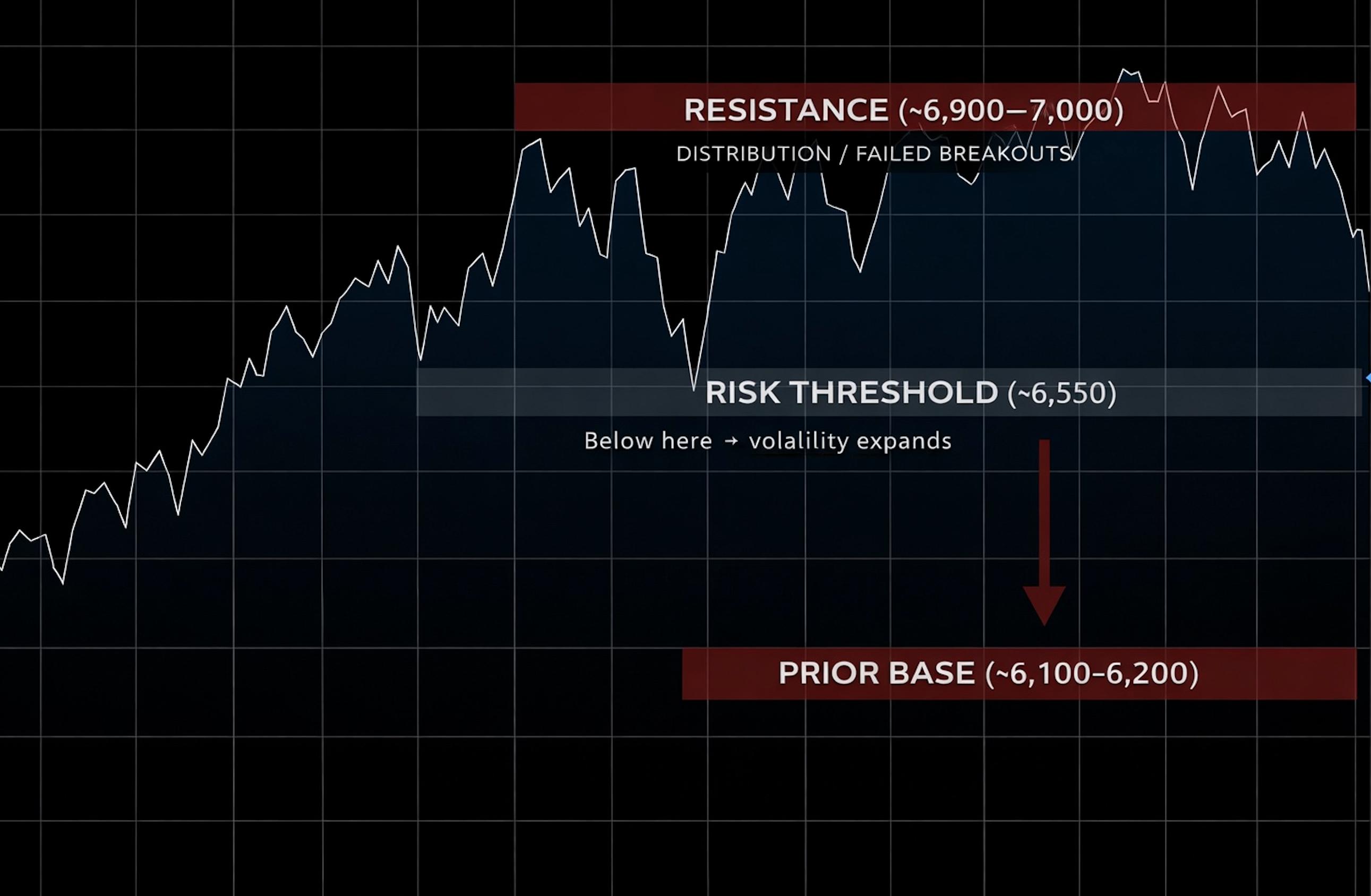
S&P 500: Where Asymmetric Risk Accelerates
Markets don’t break the same way they trend.
They transition.
Right now, the S&P 500 is pressing into a clearly defined structural level near 6,550.
This isn’t just “support.”
It’s a risk threshold.
The difference is critical.
Support suggests a place where markets might bounce.
A risk threshold defines the point where behavior changes.
Above ~6,550, price has been oscillating within a broad distribution range, repeatedly failing near the ~6,900–7,000 area.
That’s not trend continuation.
That’s supply absorbing demand.
Below ~6,550, the structure changes.
Volatility doesn’t just increase—it expands.
Ranges widen.
Correlation tightens.
Downside begins to accelerate.
This is where linear assumptions break.
Most investors experience this shift the same way:
Losses feel manageable… until they aren’t.
Because the move isn’t gradual.
It’s a transition from controlled movement to disorder.
If that threshold gives way, the next structurally relevant level sits near the prior base around ~6,100–6,200.
That’s not a prediction.
It’s where demand previously stabilized.
The mistake isn’t being invested here.
The mistake is being exposed without defining risk at the exact point where risk begins to compound.
For those managing meaningful capital, this isn’t a question of direction.
It’s a question of invalidation.
Where does the position stop working?
Not emotionally.
Not reactively.
Structurally.
Because once price moves through a level like ~6,550, the opportunity isn’t in reacting faster.
It’s in having already defined the downside in advance.
That’s the role of a predefined exit.
Not as a forecast.
But as a constraint.
So the portfolio is built with:
– defined downside at the risk threshold (~6,550)
– position sizing aligned to that distance
– upside participation if trends reassert above the range
That’s how asymmetry is structured.
Not by avoiding exposure.
But by controlling it before volatility expands.
Because in regime transitions, the only thing that remains stable… is the risk you defined ahead of time.
Mike Shell is the founder and chief investment officer of Shell Capital Management, LLC, a registered investment adviser. He serves as portfolio manager of ASYMMETRY® Managed Portfolios, a separately managed account program with trade execution and custody provided by Goldman Sachs Custody Solutions.
ASYMMETRY® Observations are provided for general informational and educational purposes only. They do not constitute investment advice, a recommendation, or an offer to buy or sell any security or investment strategy. The content is not intended to be a complete description of Shell Capital’s investment process and should not be relied upon as the sole basis for any investment decision.
Any securities, charts, indicators, formulas, or examples referenced are illustrative and are not intended to represent actual client portfolios, recommendations, or trading activity. Past performance is not indicative of future results. All investing involves risk, including the possible loss of principal.
Opinions expressed reflect the judgment of the author at the time of publication and are subject to change without notice as market conditions evolve. Information is believed to be reliable but is not guaranteed, and readers are encouraged to independently verify any information before making investment decisions.
Shell Capital Management, LLC provides investment advisory services only to clients pursuant to a written investment management agreement and only in jurisdictions where the firm is properly registered or exempt from registration.