
The Fed Meeting Isn’t the Only Thing Markets Are Watching This Week
Every financial headline this week will revolve around the same question:
What will the Federal Reserve do?
Will they raise rates, cut rates, or hold steady? Will Powell sound hawkish or dovish?
Those questions dominate the news cycle because they’re easy to discuss.
But they’re not always what moves markets.
Markets often move more because of liquidity conditions than because of the Fed’s words.
Interest rates are only one lever of monetary policy. The other—often more important one—is system liquidity.
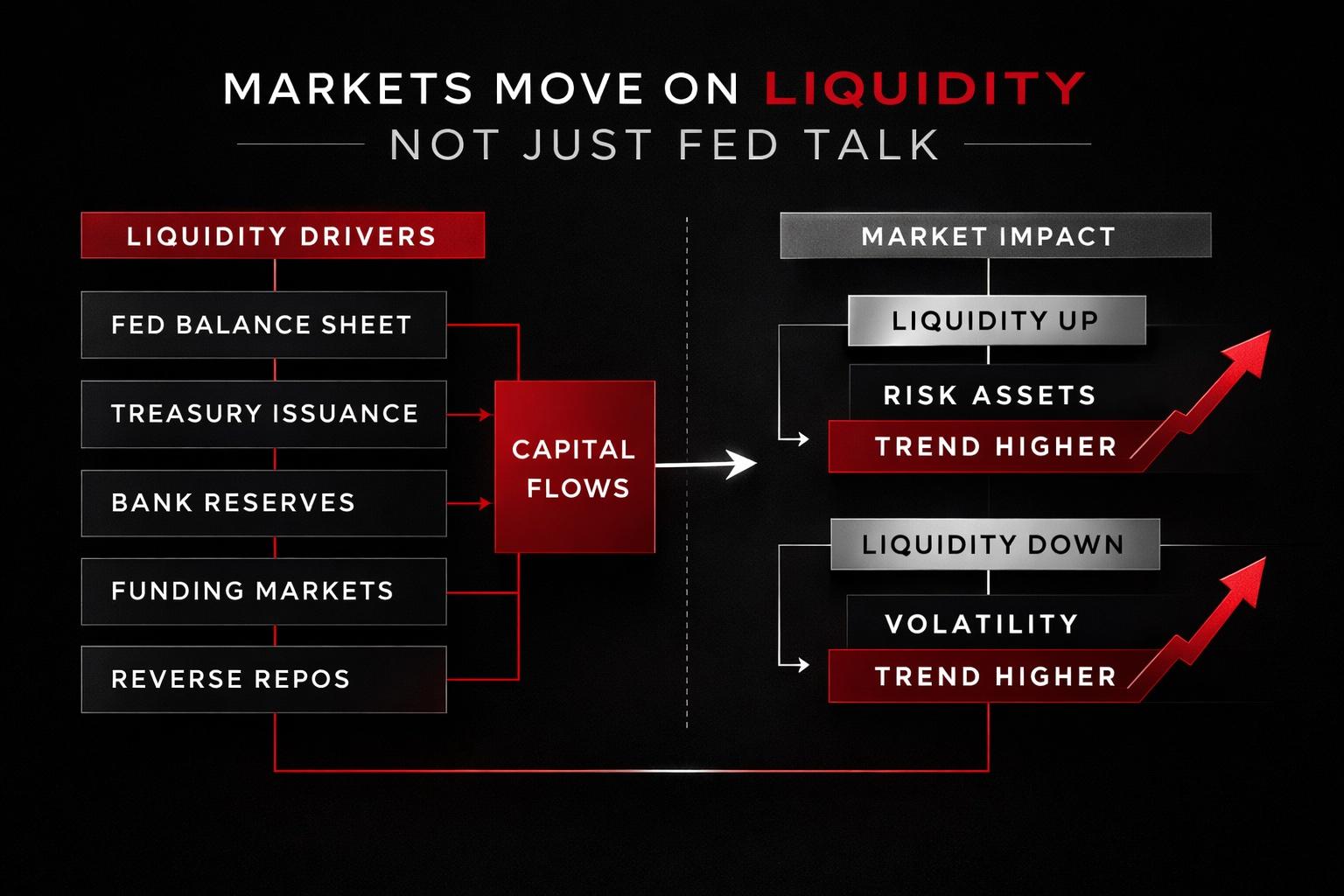
Liquidity is the amount of capital available to buy financial assets. It flows through several channels:
Federal Reserve balance sheet policy. Treasury issuance and government cash balances. Bank reserves and funding markets. Reverse repo flows and money market demand.
These forces determine how much capital is actually circulating through the financial system.
When liquidity expands, risk assets frequently trend higher.
When liquidity contracts, volatility tends to increase as capital becomes more selective.
That dynamic is why markets sometimes rally even after a “hawkish” press conference, or decline after a seemingly dovish one. Expectations are already priced in. Liquidity conditions determine what happens next.
In other words, the press conference may dominate the headlines, but the underlying liquidity environment often shapes the trend.
For families responsible for meaningful capital, the objective isn’t predicting the tone of the next press conference.
The objective is structuring portfolios that can operate through changing regimes—monitoring trends, volatility, momentum, and liquidity while defining downside risk in advance.
Because when liquidity conditions shift, markets can move quickly.
And when capital has consequences, portfolio management isn’t about reacting to headlines.
It’s about understanding the structural forces behind them.
Mike Shell is the founder and chief investment officer of Shell Capital Management, LLC, a registered investment adviser. He serves as portfolio manager of ASYMMETRY® Managed Portfolios, a separately managed account program with trade execution and custody provided by Goldman Sachs Custody Solutions.
ASYMMETRY® Observations are provided for general informational and educational purposes only. They do not constitute investment advice, a recommendation, or an offer to buy or sell any security or investment strategy. The content is not intended to be a complete description of Shell Capital’s investment process and should not be relied upon as the sole basis for any investment decision.
Any securities, charts, indicators, formulas, or examples referenced are illustrative and are not intended to represent actual client portfolios, recommendations, or trading activity. Past performance is not indicative of future results. All investing involves risk, including the possible loss of principal.
Opinions expressed reflect the judgment of the author at the time of publication and are subject to change without notice as market conditions evolve. Information is believed to be reliable but is not guaranteed, and readers are encouraged to independently verify any information before making investment decisions.
Shell Capital Management, LLC provides investment advisory services only to clients pursuant to a written investment management agreement and only in jurisdictions where the firm is properly registered or exempt from registration.