
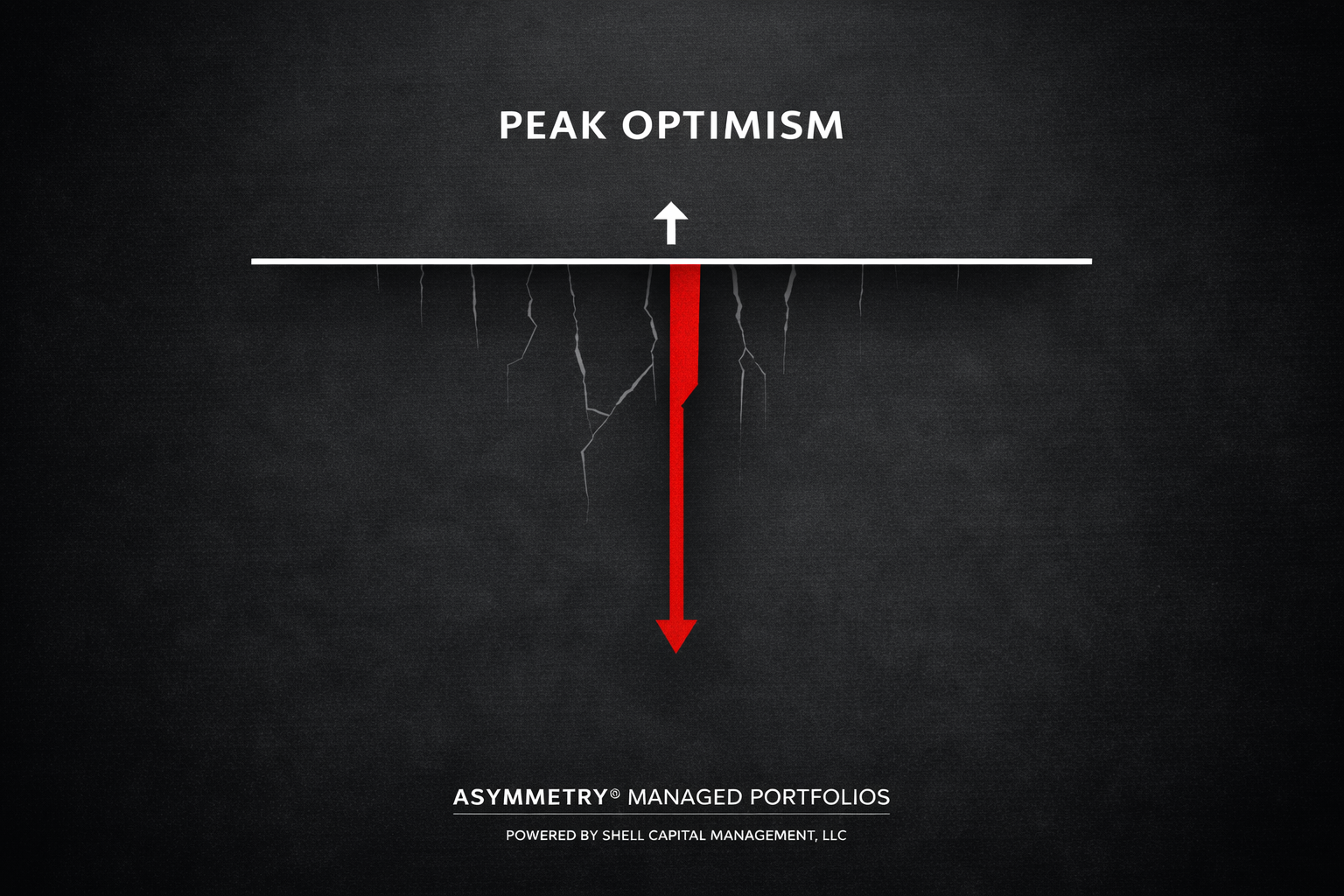
The Most Dangerous Asset Is Optimism
Markets don’t top on bad news. They top on good news that’s fully believed.
Cycles of fear and greed are really cycles of asymmetric risk. And the most dangerous time to deploy meaningful capital is when optimism feels safest.
Consider the business owner who sells the business in Q4 2021.
The exit multiple exceeded expectations. The sale process was competitive. Advisors are congratulatory. The S&P 500 is printing all-time highs. The narrative is frictionless.
The instinct is understandable: put the proceeds to work immediately. Move into a “balanced portfolio.” Stay invested. Don’t miss out. That's what most advisors would say anyway.
By October 2022, broad equity indexes were down roughly 25% from their highs.¹
For a long-term saver, that’s uncomfortable. For a business owner who just converted decades of work into $40 million of liquid capital, a 25% drawdown in year one materially alters optionality, spending flexibility, philanthropic timing, and reinvestment capacity in a way no subsequent recovery restores on the same timeline.
This isn’t a story about prediction. It’s a story about asymmetry at peak certainty.
The common narrative is emotional: markets swing between fear and greed.
The first-principles reality is structural: markets oscillate between underpricing risk and underpricing opportunity.
When optimism becomes universal, prices already reflect the good outcome. Expectations are elevated. Positioning is crowded. Incremental buyers are exhausted.
That’s when the geometry flips.
There’s limited incremental upside left — consensus has already priced the best case. But downside remains open. If expectations disappoint even slightly, there are few fresh buyers to absorb selling pressure. Price can gap. Drawdowns can accelerate. Downside velocity expands.
Optimism isn’t the problem. Unpriced optimism is.
At peak optimism, structural fragility hides beneath surface stability:
Implied correlation trends toward 1.0 — diversification becomes decorative, not protective. Volatility skew flattens — tail risk is underpriced even as leverage quietly builds. Trend strength persists while momentum breadth narrows — fewer leaders carry more weight. Liquidity appears abundant — until it’s needed simultaneously.
The market isn’t offering convexity. It’s offering crowded consensus at full price.
For a physician with $3 million in retirement assets, a poorly timed allocation is inconvenient.
For a founder deploying $40 million from a once-in-a-lifetime liquidity event, it’s path dependent. You can’t re-run the exit. You can’t recover lost time. You can’t reclaim optionality surrendered to a consensus allocation made at peak valuation.
The defense isn’t clairvoyance.
It’s structure.
This is why ASYMMETRY® begins with exits, not entries.
We define the scenario where we’re wrong before we define the scenario where we’re right. Position size is determined by predefined downside. Portfolio Risk is the sum of those defined exposures — not a hope that markets cooperate.
At Shell Capital, we monitor trends, volatility, liquidity, and positioning not to forecast headlines, but to measure whether the risk/reward geometry is truly asymmetric. When optimism becomes frictionless, we tighten exit levels, reduce position size, and demand stronger confirmation before allocating incremental capital.
Not because we predict reversals.
Because we refuse undefined downside when upside is already priced.
Cycles are inevitable. Reversals are inevitable. Mean reversion in sentiment is inevitable.
The question isn’t whether optimism will fade.
The question is whether consensus has already removed uncertainty from the price — and whether you defined your downside before the market defined it for you.
Optionality comes from discipline. Convexity comes from controlled exposure. Asymmetry comes from buying uncertainty — not certainty.
And the most dangerous asset in a portfolio isn’t volatility.
It’s optimism that everyone already believes.
Mike Shell is the founder and chief investment officer of Shell Capital Management, LLC, a registered investment adviser. He serves as portfolio manager of ASYMMETRY® Managed Portfolios, a separately managed account program with trade execution and custody provided by Goldman Sachs Custody Solutions.
ASYMMETRY® Observations are provided for general informational and educational purposes only. They do not constitute investment advice, a recommendation, or an offer to buy or sell any security or investment strategy. The content is not intended to be a complete description of Shell Capital’s investment process and should not be relied upon as the sole basis for any investment decision.
Any securities, charts, indicators, formulas, or examples referenced are illustrative and are not intended to represent actual client portfolios, recommendations, or trading activity. Past performance is not indicative of future results. All investing involves risk, including the possible loss of principal.
Opinions expressed reflect the judgment of the author at the time of publication and are subject to change without notice as market conditions evolve. Information is believed to be reliable but is not guaranteed, and readers are encouraged to independently verify any information before making investment decisions.
Shell Capital Management, LLC provides investment advisory services only to clients pursuant to a written investment management agreement and only in jurisdictions where the firm is properly registered or exempt from registration.