
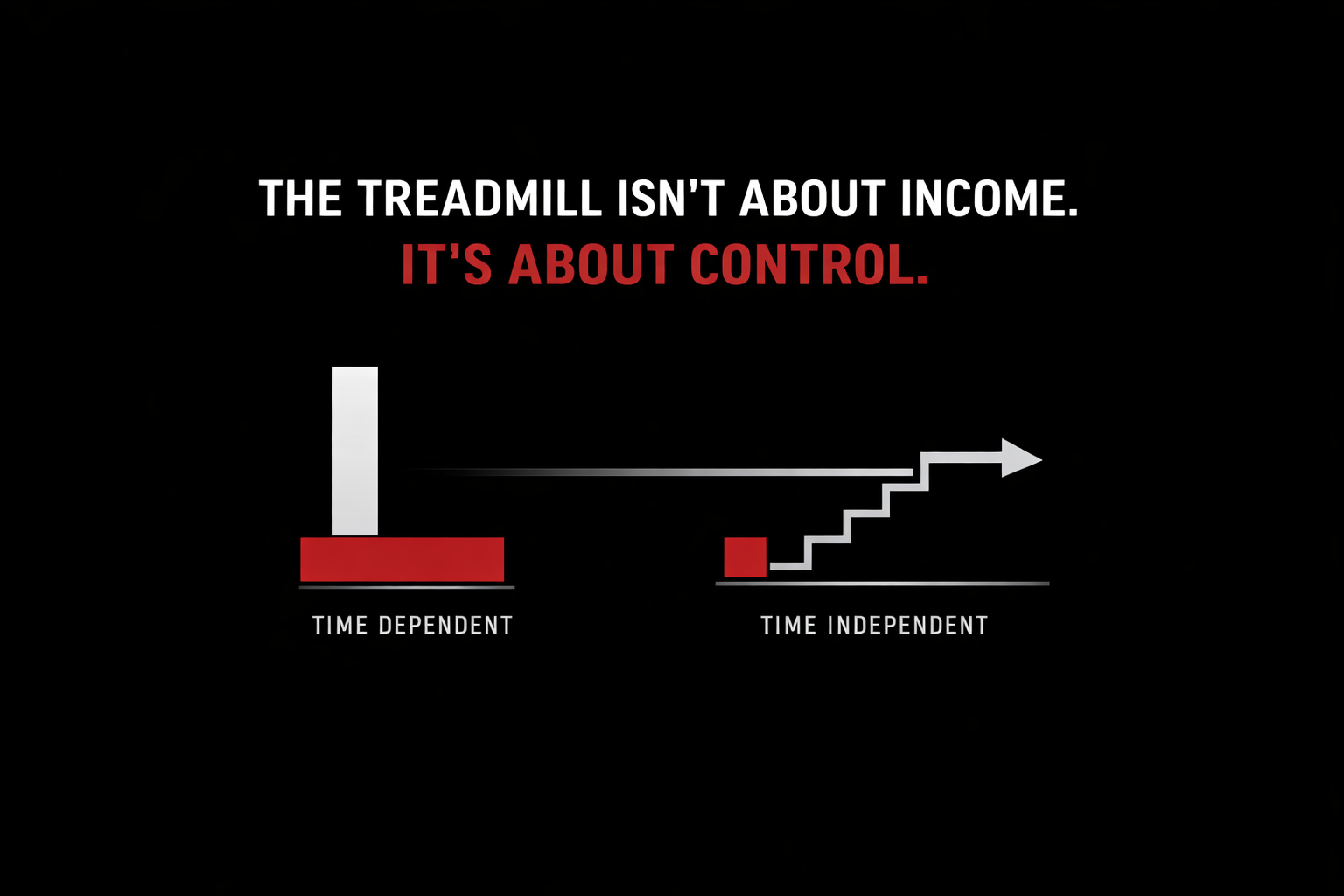
The Treadmill Isn’t About Income. It’s About Control.
Financial freedom isn’t about income levels—it’s about control. This ASYMMETRY® Observation reframes the classic four-quadrant model as levels of dependency, resilience, and optionality, showing why getting off the treadmill is a risk-management decision, not a lifestyle one.
Most people think financial progress is about earning more. It isn’t.
It’s about where your cash flow comes from, how dependent it is on your time, and how fragile it becomes when conditions change.
The popular “four quadrants” framework is useful, not because of what it’s called, but because it quietly exposes something most people never model: levels of financial freedom are really levels of control over time, risk, and optionality.
I frame it as getting off the treadmill.
Not quitting work. Not retiring early. But reducing the degree to which your future depends on showing up tomorrow.
Level One: Time-for-Money Dependence
At the first level, income is directly tied to effort and presence.
If you stop working, cash flow stops. If you get sick, injured, or burned out, the system breaks. If markets tighten or employers retrench, exposure is immediate.
This isn’t a moral judgment. It’s a risk profile.
From an asymmetry lens, this level has:
- Defined upside
- Undefined downside
- Little optionality
Most people don’t realize they’re taking concentrated risk here because the paycheck feels stable—until it isn’t.
Level Two: Leveraged Effort, Still Fragile
The next step looks like progress. You’re earning more. You may have employees, clients, or systems.
But cash flow still depends on active involvement. The treadmill is faster, not gone.
The asymmetry improves slightly:
- More upside potential
- Still significant downside if you disengage
- Complexity risk replaces simplicity risk
This level is where many successful professionals and business owners get stuck. Income is high, but freedom is low.
Level Three: Decoupling Time from Cash Flow
This is where the real shift happens.
Income begins to persist even when effort pauses. Cash flow is no longer strictly linear with hours worked.
The defining feature here isn’t passivity—it’s resilience.
From an ASYMMETRY® perspective, this level introduces:
- Positive optionality
- Reduced personal drawdown risk
- The ability to absorb shocks without forced decisions
You’re not off the treadmill yet—but you can step off without everything collapsing.
Level Four: Optionality and Control
The final level isn’t about “never working again.” It’s about choice.
You work because you want to, not because the system requires it to survive.
Capital is doing more of the work. Risk is defined. Downside is managed. Upside remains open-ended.
This is where asymmetry shows up most clearly:
- Losses are survivable
- Time becomes flexible
- Decisions improve because urgency fades
Ironically, this is often where people produce their best work—because they’re no longer optimizing for short-term cash flow.
The Misconception
People think the goal is a higher quadrant, a better title, or a bigger number.
The real goal is reducing forced outcomes.
Forced work. Forced sales. Forced risk-taking. Forced liquidation at the wrong time.
Getting off the treadmill isn’t about escape. It’s about engineering a system that doesn’t punish you for pausing.
Why This Matters for Capital With Consequences
For business owners, founders, physicians, and families with real capital at stake, this framework isn’t philosophical—it’s practical.
Liquidity events, market drawdowns, health events, and transitions don’t ask permission.
If your cash flow structure is fragile, timing becomes your enemy. If your structure is resilient, volatility becomes manageable.
The difference isn’t intelligence or effort. It’s architecture.
The ASYMMETRY® Takeaway
Financial freedom isn’t binary. It’s a progression of reduced dependency and increased optionality.
The fastest way to get off the treadmill isn’t running harder. It’s redesigning the system so stopping doesn’t equal failure.
That’s what asymmetry looks like in real life.
Mike Shell is the Founder and Chief Investment Officer of Shell Capital Management, LLC, a registered investment adviser. He serves as portfolio manager of ASYMMETRY® Managed Portfolios, a separately managed account program with trade execution and custody provided by Goldman Sachs Custody Solutions.
ASYMMETRY® Observations are provided for general informational and educational purposes only. They do not constitute investment advice, a recommendation, or an offer to buy or sell any security or investment strategy. The content is not intended to be a complete description of Shell Capital’s investment process and should not be relied upon as the sole basis for any investment decision.
Any securities, charts, indicators, formulas, or examples referenced are illustrative and are not intended to represent actual client portfolios, recommendations, or trading activity. Past performance is not indicative of future results. All investing involves risk, including the possible loss of principal.
Opinions expressed reflect the judgment of the author at the time of publication and are subject to change without notice as market conditions evolve. Information is believed to be reliable but is not guaranteed, and readers are encouraged to independently verify any information before making investment decisions.
Shell Capital Management, LLC provides investment advisory services only to clients pursuant to a written investment management agreement and only in jurisdictions where the firm is properly registered or exempt from registration.
Exit planning isn’t about retirement — it’s the rotation event that moves business owners from effort-based income to capital-driven freedom. This ASYMMETRY® Observation explains why selling a business is only the beginning, and how engineered risk management keeps owners off the treadmill for good.