
Why Feeling the Loss Matters
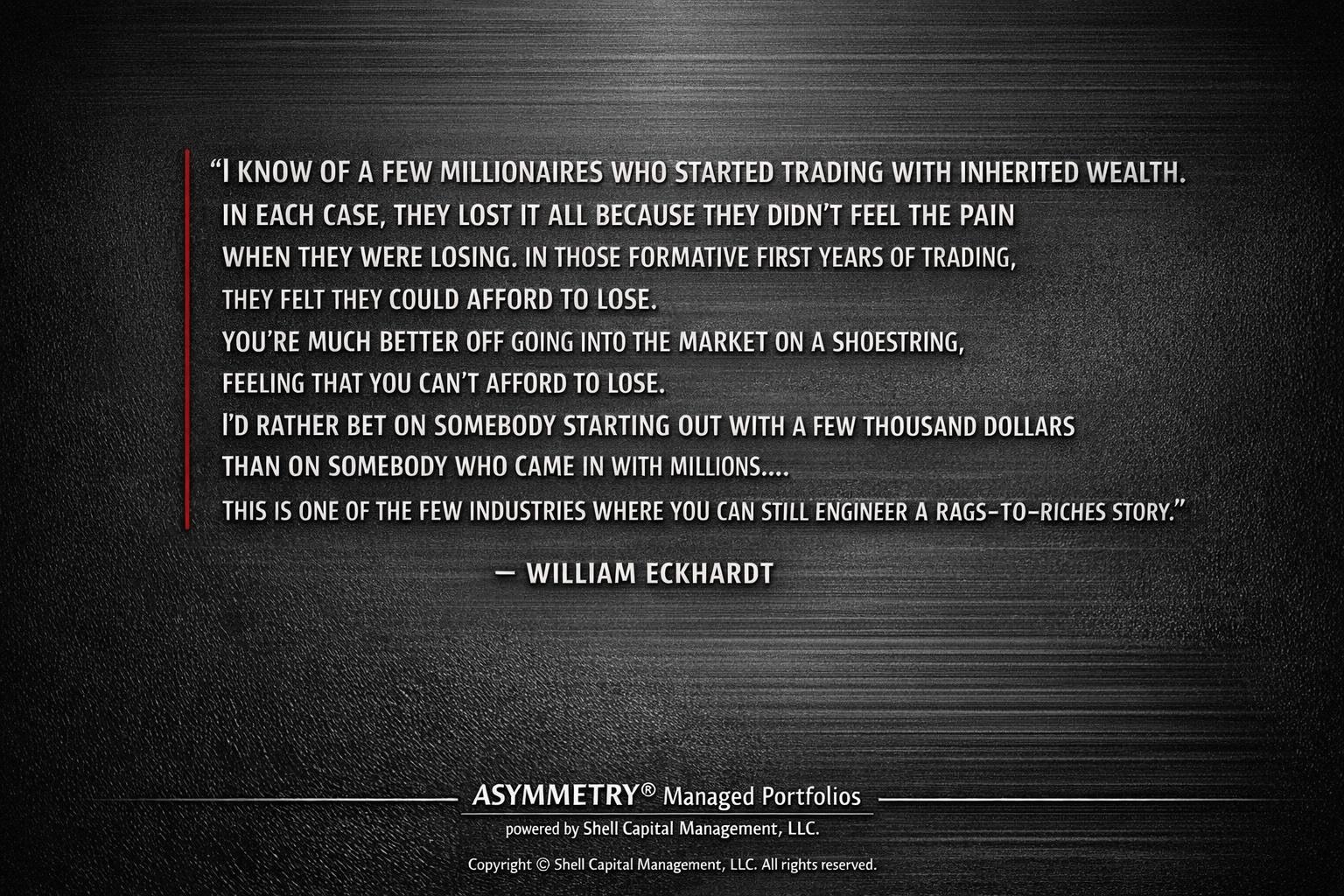
“I know of a few millionaires who started trading with inherited wealth. In each case, they lost it all because they didn’t feel the pain when they were losing. In those formative first years of trading, they felt they could afford to lose. You’re much better off going into the market on a shoestring, feeling that you can’t afford to lose. I’d rather bet on somebody starting out with a few thousand dollars than on somebody who came in with millions….This is one of the few industries where you can still engineer a rags-to-riches story. Richard Dennis started out with only hundreds of dollars and ended up making hundreds of millions in less than two decades – that’s quite motivating.”
I can sure relate.
That observation is worth taking seriously because Eckhardt isn’t just another market commentator. He’s one of the most respected quantitative traders in modern history, best known for his partnership with Richard Dennis and the Turtle Trading experiment. He built his reputation studying probability, risk, and trading behavior in the real world, not in theory. When he talks about what causes people to lose capital, he’s speaking from repeated observation across cycles and people.
His point is deeper than trading. It applies to anyone managing capital with consequences.
The common assumption is that more starting capital should improve decision-making. More money should mean more staying power, more flexibility, and better odds of success.
But behavior rarely works that way.
When someone starts with capital they didn’t have to earn, or with so much excess capital that losses don’t feel consequential, the feedback loop breaks. Losses become intellectually acknowledged but not emotionally registered. That’s dangerous because pain is information. It tells you when risk is too large, when exposure is poorly defined, and when downside is no longer under control.
If the loss doesn’t hurt, the lesson often doesn’t stick.
That’s the real asymmetry in Eckhardt’s quote. People who start small often have no choice but to respect risk. They have to think in terms of survival. They have to define downside in advance. They have to size positions intentionally because a large mistake actually matters. The discipline is forced on them.
People with abundant capital can bypass that discipline for a while. They can confuse a lack of immediate consequences with skill. They can tolerate losses that should have triggered a reduction in exposure. They can stay oversized because nothing is forcing them to feel the weight of being wrong.
That works until it doesn’t.
The broader implication is especially relevant for business owners, founders, physicians, executives, and families who’ve transitioned from earning capital to protecting permanent capital. Once you’ve already won economically, the game changes. The objective is no longer to prove you can take risk. It’s to manage risk so that one period of poor judgment doesn’t impair what took decades to build.
That’s why risk tolerance is often the wrong frame. The better question is consequence tolerance.
How much drawdown can your capital sustain before it changes your options, your timeline, your family’s flexibility, or your future decision-making?
That’s the number that matters.
Eckhardt’s insight also helps explain why operator skill doesn’t automatically translate into investor skill. Many highly successful people are used to solving problems by leaning in harder, pushing through volatility, and trusting their own judgment. That works in operating businesses where effort and control can change the outcome. Markets are different. In markets, conviction without risk discipline can magnify losses instead of solving them.
The lesson isn’t that people should start with less capital. The lesson is that they need a process that preserves the informational value of loss without suffering catastrophic damage from it.
That means defining risk before entry. It means sizing exposure so the exit point determines the loss. It means monitoring portfolio risk as a total percentage of capital, not just evaluating each position in isolation. And it means accepting that unmanaged downside is usually not a market problem. It’s a process failure.
Eckhardt’s quote endures because it identifies something permanent about human behavior: when people don’t feel the cost of being wrong, they tend to stay wrong longer and bigger.
In investing, that can be fatal.
Mike Shell is the founder and chief investment officer of Shell Capital Management, LLC, a registered investment adviser. He serves as portfolio manager of ASYMMETRY® Managed Portfolios, a separately managed account program with trade execution and custody provided by Goldman Sachs Custody Solutions.
ASYMMETRY® Observations are provided for general informational and educational purposes only. They do not constitute investment advice, a recommendation, or an offer to buy or sell any security or investment strategy. The content is not intended to be a complete description of Shell Capital’s investment process and should not be relied upon as the sole basis for any investment decision.
Any securities, charts, indicators, formulas, or examples referenced are illustrative and are not intended to represent actual client portfolios, recommendations, or trading activity. Past performance is not indicative of future results. All investing involves risk, including the possible loss of principal.
Opinions expressed reflect the judgment of the author at the time of publication and are subject to change without notice as market conditions evolve. Information is believed to be reliable but is not guaranteed, and readers are encouraged to independently verify any information before making investment decisions.
Shell Capital Management, LLC provides investment advisory services only to clients pursuant to a written investment management agreement and only in jurisdictions where the firm is properly registered or exempt from registration.