
Why Structural Change Doesn’t Guarantee Asymmetric Alpha
Just because sales and earnings are trending with velocity doesn't necessarily mean the price trend of the stocks will follow. Fundamental themes and trends can be right, but the asymmetric alpha is gone.
The chart breaks U.S. retail sales into three categories over time: department stores, warehouse clubs, and e-commerce.
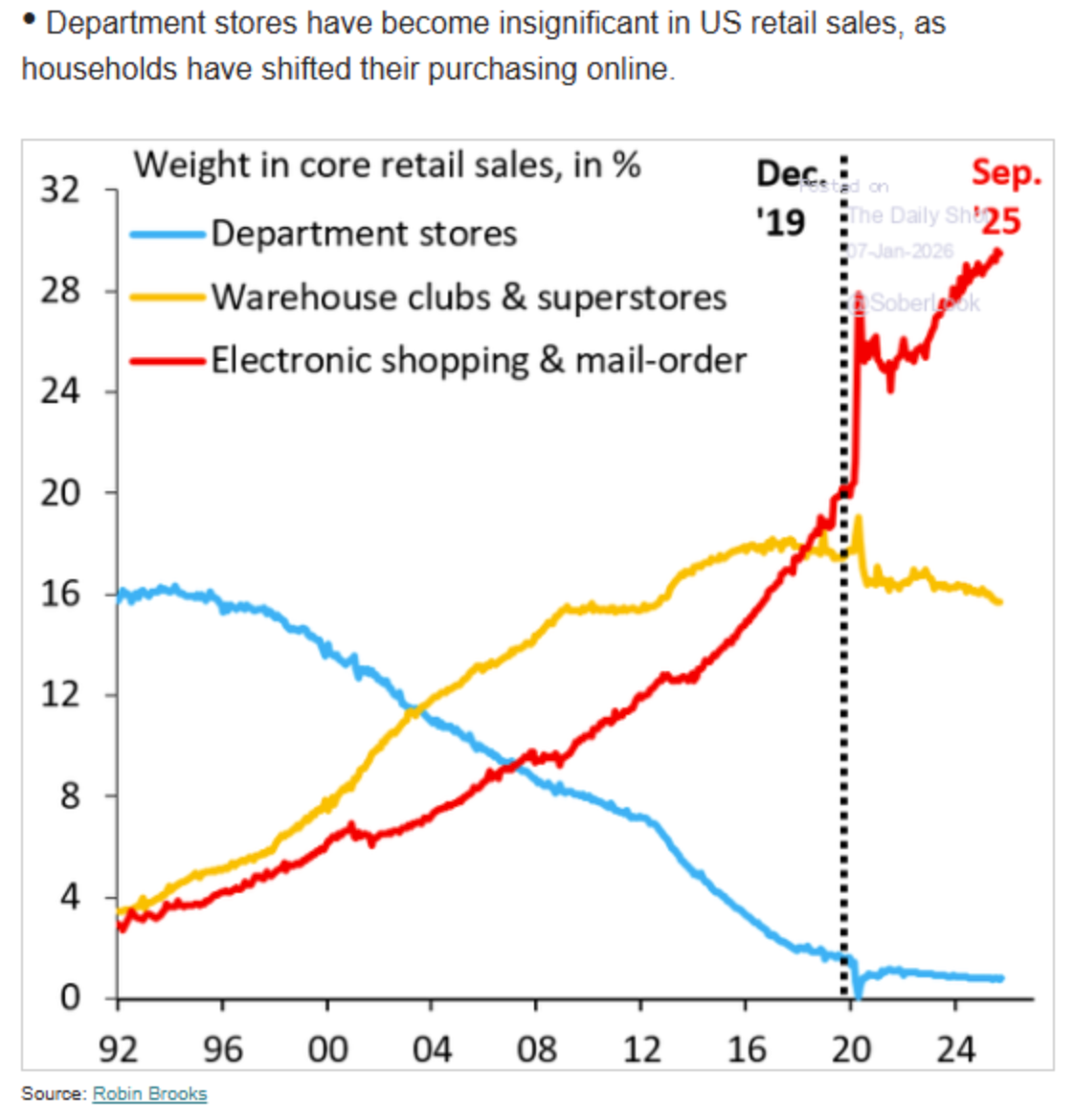
Department store sales collapse from a meaningful share of retail spending to near irrelevance. Warehouse clubs gain share early, then plateau. E-commerce absorbs nearly all of the incremental consumer dollar.
That chart shows where consumer spending actually went.
If markets rewarded fundamentals directly, the trade would have been simple and persistent: long e-commerce, short brick-and-mortar retail.
For a time, that worked — when the shift was still uncertain and capital was misallocated.
Now look at the chart of the ETF price trends. It compares equity price trends for a long/short online-versus-stores retail strategy against broader consumer and market exposure. Despite e-commerce’s continued dominance in sales, the long/short retail trade stops compounding and is the opposite of relative strength.
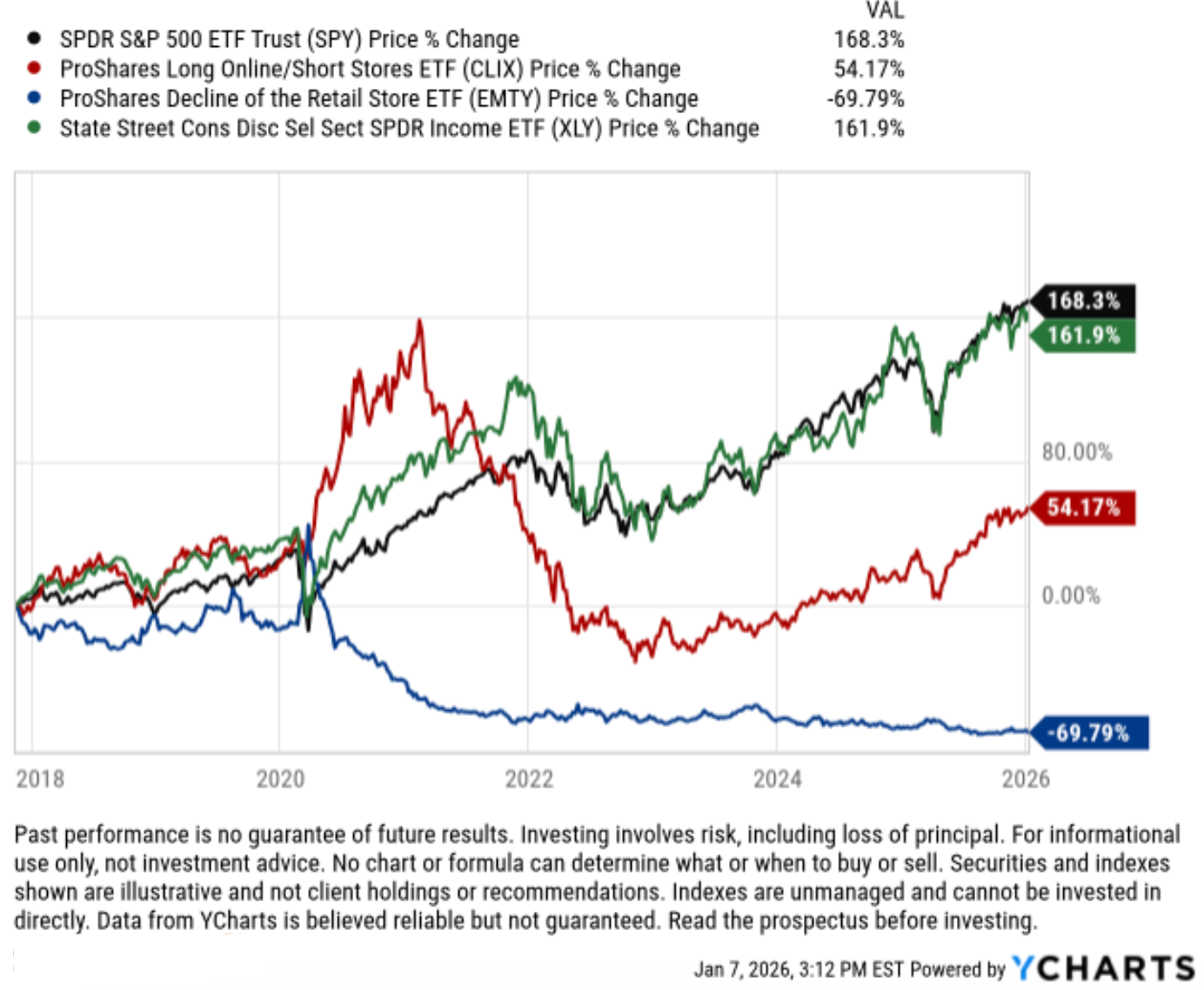
Nothing in the sales data reversed. What changed was pricing.
That’s the asymmetry.
The first chart shows what changed in the economy. The last chart shows when the market stopped paying for it.
Markets don’t wait for confirmation in the data. They anticipate it. By the time the sales shift became obvious, equities had already discounted it. The winners were fully owned. The losers were depleted. The spread that once existed had been arbitraged away.
This is where investors consistently go wrong.
They confuse structural truth with structural advantage.
A trend can remain intact for years and still stop producing excess returns once it becomes consensus. When uncertainty collapses, asymmetry disappears — even if fundamentals continue to trend in the same direction.
The ASYMMETRY® takeaway
Fundamentals explain the destination. Prices are driven by the journey.
The opportunity exists only in the gap between the two.
Markets don’t pay you for being correct. They pay you for being early — before the data proves it, before consensus forms, and before the asymmetry is consumed.
The price trend is the final arbiter.
The first chart explains the theme. The last chart explains the market.
Knowing the difference is the edge.
______________________
Mike Shell is the Founder and Chief Investment Officer of Shell Capital Management, LLC, a registered investment adviser. He serves as portfolio manager of ASYMMETRY® Managed Portfolios, a separately managed account program with trade execution and custody provided by Goldman Sachs Custody Solutions.
The observations shared in ASYMMETRY® Observations are for general informational purposes only and do not constitute investment advice or a recommendation to buy or sell any security. The content is not intended to provide a complete description of Shell Capital’s investment process or strategies and should not be relied upon in making investment decisions.
Securities, charts, indicators, formulas, or examples referenced are illustrative in nature and are not intended to represent actual client holdings or recommendations. Past performance is not indicative of future results. Investing involves risk, including the potential loss of principal.
Any opinions expressed are subject to change without notice as market conditions evolve. All information is believed to be reliable but is not guaranteed and should be independently verified. Shell Capital Management, LLC provides investment advisory services only to clients pursuant to a written investment management agreement.
This material is not intended as an offer or solicitation for advisory services in any jurisdiction where such offer or solicitation would be unlawful.