
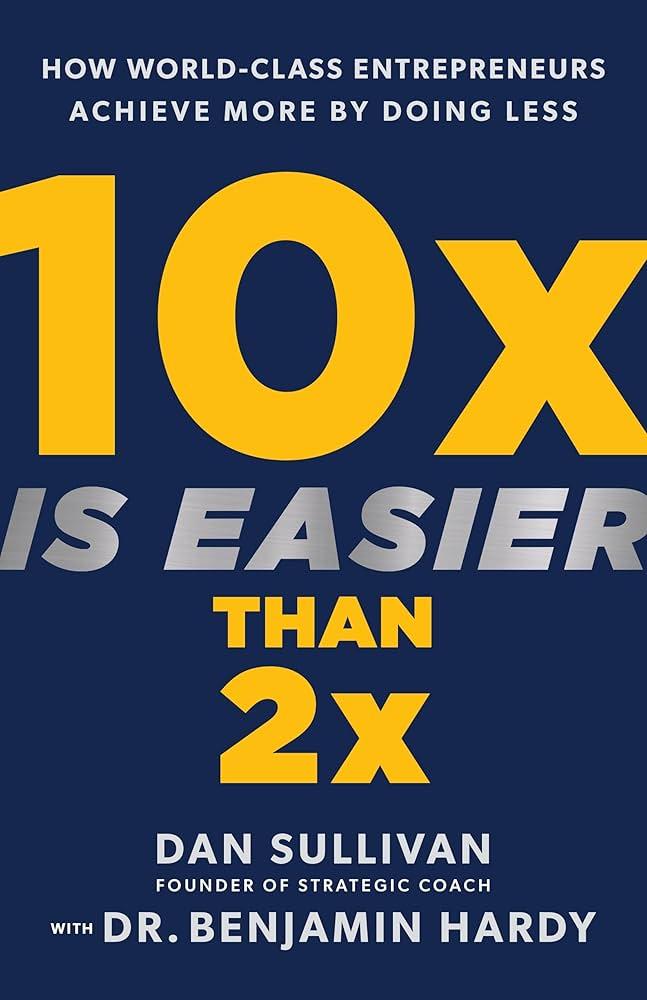
10x Is Easier Than 2x: How World-Class Entrepreneurs Achieve More by Doing Less
10x Is Easier Than 2x By Dan Sullivan and Benjamin Hardy

What the book says
The core thesis of 10x Is Easier Than 2x is counterintuitive: pursuing 10x growth is often simpler, cleaner, and less exhausting than aiming for incremental 2x improvement. The authors argue that 2x thinking keeps people trapped in complexity, scarcity, and optimization of what already exists, while 10x thinking forces clarity, subtraction, and focus on what truly creates outsized results.
The opening chapters establish the psychological trap of 2x goals. Incremental improvement feels safe, but it encourages doing more of everything: more hours, more inputs, more marginal effort. This compounds complexity, stress, and diminishing returns. In contrast, a 10x objective immediately disqualifies most activities. You cannot do everything 10x, so you must decide what matters and what does not. This reframes growth as a question of identity and standards, not effort.
The book then introduces the idea of “unique ability.” World-class entrepreneurs do not scale by becoming better at everything. They scale by doubling down on the narrow set of activities where they create disproportionate value and delegating, automating, or eliminating the rest. 10x growth comes from alignment between unique ability and leverage, not from personal heroics.
A major theme is subtraction as a growth strategy. The authors emphasize that success comes faster when entrepreneurs remove constraints, distractions, and low-value commitments. Letting go of “good” opportunities is necessary to make room for great ones. This requires a willingness to disappoint, say no, and abandon sunk costs. 10x growth demands courage to simplify.
Time is reframed as a strategic asset rather than something to manage minute-by-minute. The book argues that elite performers design their future from a long-term vantage point, working backward to determine what must be true for a 10x outcome to occur. This future-based planning creates pull toward higher-leverage decisions today, rather than reactive busyness.
The authors also address mindset and identity shifts. 10x is not just a bigger target; it requires becoming a different version of yourself. Entrepreneurs must upgrade their standards, environment, and collaborators. Who you work with becomes more important than how hard you work. Teams, partnerships, and systems replace personal effort as the primary engine of growth.
In later chapters, the book emphasizes that 10x thinking reduces risk rather than increasing it. By concentrating resources on the highest-impact activities and eliminating marginal bets, entrepreneurs reduce noise, errors, and exhaustion. Focus improves decision quality, and simplicity increases consistency. The result is more reliable progress with less friction.
Overall, the book presents 10x growth as a qualitative shift, not a quantitative one. It is about choosing a different game entirely, defined by clarity, leverage, and intentional design.
The ASYMMETRY® perspective
From an ASYMMETRY® lens, 10x Is Easier Than 2x is fundamentally a book about convexity and optionality. The authors are implicitly describing asymmetric payoff structures: limited downside from subtraction and focus, paired with uncapped upside from concentrating on unique ability and leverage.
2x thinking resembles symmetric risk. You add more inputs for proportionally small gains, exposing yourself to burnout, errors, and complexity risk with little incremental reward. This is linear effort with linear returns, often negative after costs.
10x thinking, by contrast, seeks convex outcomes. By eliminating low-value activities, downside is capped. By reallocating time and capital toward the few variables that drive exponential impact, upside becomes non-linear. This mirrors how asymmetric investment strategies work: fewer bets, tighter risk definitions, and exposure only when the payoff profile is skewed favorably.
The book also aligns with regime awareness. 10x outcomes require recognizing when incremental optimization no longer works and a regime shift is required. In markets, this is the difference between grinding in range-bound conditions versus positioning for trend, dispersion, or structural change. In business, it is knowing when to stop refining the old model and design a new one with embedded leverage.
Finally, the emphasis on identity and standards maps directly to risk management discipline. Just as investors must operate with predefined exits and portfolio risk limits, entrepreneurs pursuing 10x must operate with non-negotiable filters on time, energy, and focus. Subtraction is not laziness; it is risk control.
In short, 10x Is Easier Than 2x is not about doing more. It is about engineering asymmetry: defining the downside, eliminating noise, and positioning for outcomes where a small number of right decisions can dominate the results.
Disclaimer and attribution
This summary is an original analysis for educational and commentary purposes. It is not affiliated with or endorsed by the authors or publisher. All concepts are discussed under fair use and interpreted independently through an ASYMMETRY® investment and risk-management framework for business owners looking to scale and sell their business.