
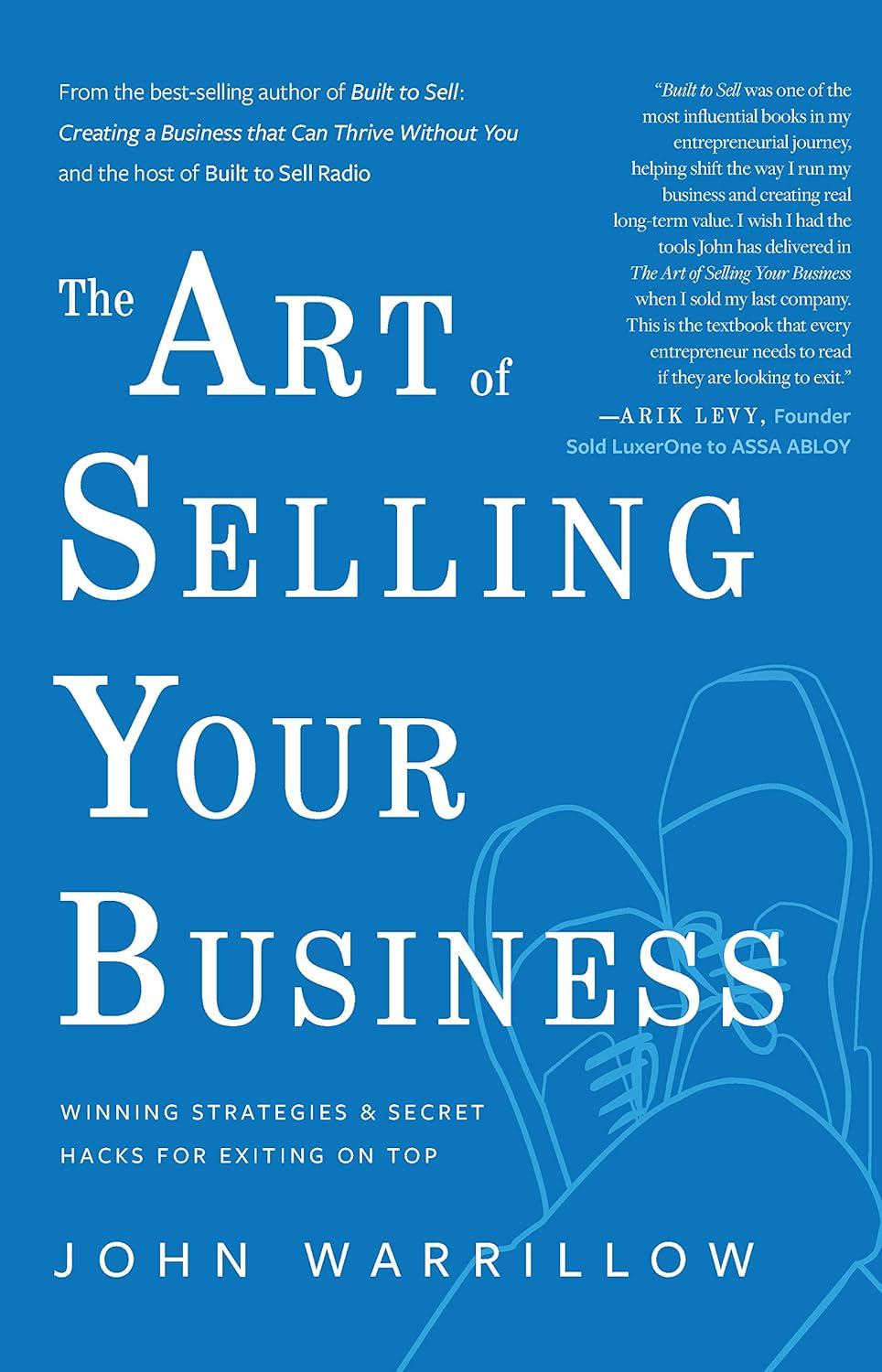
The Art of Selling Your Business: Winning Strategies & Secret Hacks for Exiting on Top
The Art of Selling Your Business: Winning Strategies & Secret Hacks for Exiting on Top by John Warrillow
Overall Summary
The Art of Selling Your Business is a practical, field-tested guide for entrepreneurs who want to exit their companies on favorable terms rather than being forced into a reactive sale. Warrillow draws from real transactions, broker insights, and buyer psychology to show why most business owners leave money on the table and how a small number of strategic decisions dramatically change outcomes. The book reframes selling a business as a long-term positioning exercise rather than a one-time transaction, emphasizing preparation, optionality, and leverage. Owners who engineer multiple buyers, reduce dependence on themselves, and package their businesses correctly create asymmetry where upside expands while downside risk is capped.
Chapter-by-Chapter Summary
The opening chapters focus on why most owners sell poorly. Warrillow explains that entrepreneurs tend to overestimate what buyers value and underestimate how risk-averse acquirers actually are. Buyers discount businesses heavily when revenue is concentrated, systems are informal, or the owner is essential to daily operations. This mismatch creates a structural disadvantage for sellers who wait too long or rely on a single buyer.
The book then introduces the concept of exit optionality. Warrillow argues that the goal is not to sell as soon as possible, but to build a company that could sell at any time. Optionality changes the negotiation dynamic because urgency transfers from the seller to the buyer. When a business can be sold but doesn’t need to be sold, valuation expands and deal terms improve.
A central section of the book addresses buyer psychology. Strategic buyers, private equity firms, and individual acquirers each value different attributes. Strategic buyers pay for synergies, private equity pays for scalable cash flows, and individuals pay for lifestyle and predictability. Understanding which buyer type you are building for determines everything from pricing models to reporting metrics.
Warrillow then dives into revenue quality and concentration risk. He shows how customer concentration, supplier dependency, and volatile earnings reduce valuation multiples. Predictable, recurring, diversified revenue increases both price and deal certainty. The emphasis is not just higher profits, but higher-quality profits that survive due diligence.
Another major theme is owner dependency. Businesses that rely on the founder for sales, relationships, or decision-making are viewed as fragile. Warrillow outlines steps to professionalize management, document systems, and delegate authority so the business appears durable without the owner. This shift alone can materially change valuation.
The book also covers how to create competitive tension. Warrillow explains how running a controlled auction process, even with a small number of qualified buyers, dramatically improves pricing and terms. Buyers behave differently when they know they are competing. Optionality again shows up as the key driver of leverage.
Later chapters focus on deal structure, not just headline price. Earn-outs, rollover equity, seller financing, and representations and warranties can matter as much as valuation. Warrillow stresses that the best exits balance price, certainty, and post-sale freedom rather than maximizing a single number.
The final chapters address timing and personal readiness. Selling too early leaves growth on the table, but selling too late exposes the owner to fatigue, market shifts, or declining relevance. Warrillow encourages owners to align the business exit with personal goals, financial independence, and life design rather than reacting to burnout or unsolicited offers.
How the Book Applies to Asymmetric Risk/Reward and ASYMMETRY®
From an ASYMMETRY® perspective, Warrillow’s framework is fundamentally about engineering convex outcomes. Exit optionality is equivalent to owning a call option on your own business. By limiting downside risks such as concentration, dependency, and volatility, while expanding upside through multiple buyers and scalable systems, the payoff distribution becomes asymmetric.
Building a business that can be sold at any time mirrors risk-managed investing. The owner defines the downside by systematizing operations and diversifying revenue, then leaves the upside uncapped by letting buyers compete. Competitive tension functions like volatility expansion in markets, where price discovery accelerates in the seller’s favor.
The emphasis on revenue quality over raw growth aligns with geometric compounding. Stable, repeatable cash flows reduce drawdowns in valuation during diligence, just as lower volatility improves long-term portfolio outcomes. The focus on buyer psychology parallels market regimes, where understanding who the marginal buyer is determines price behavior.
Most importantly, Warrillow reinforces that exits are not binary events but probabilistic distributions. Owners who prepare early create a skewed payoff where multiple favorable outcomes are possible and unfavorable ones are minimized. That is the essence of asymmetry applied to entrepreneurship.