
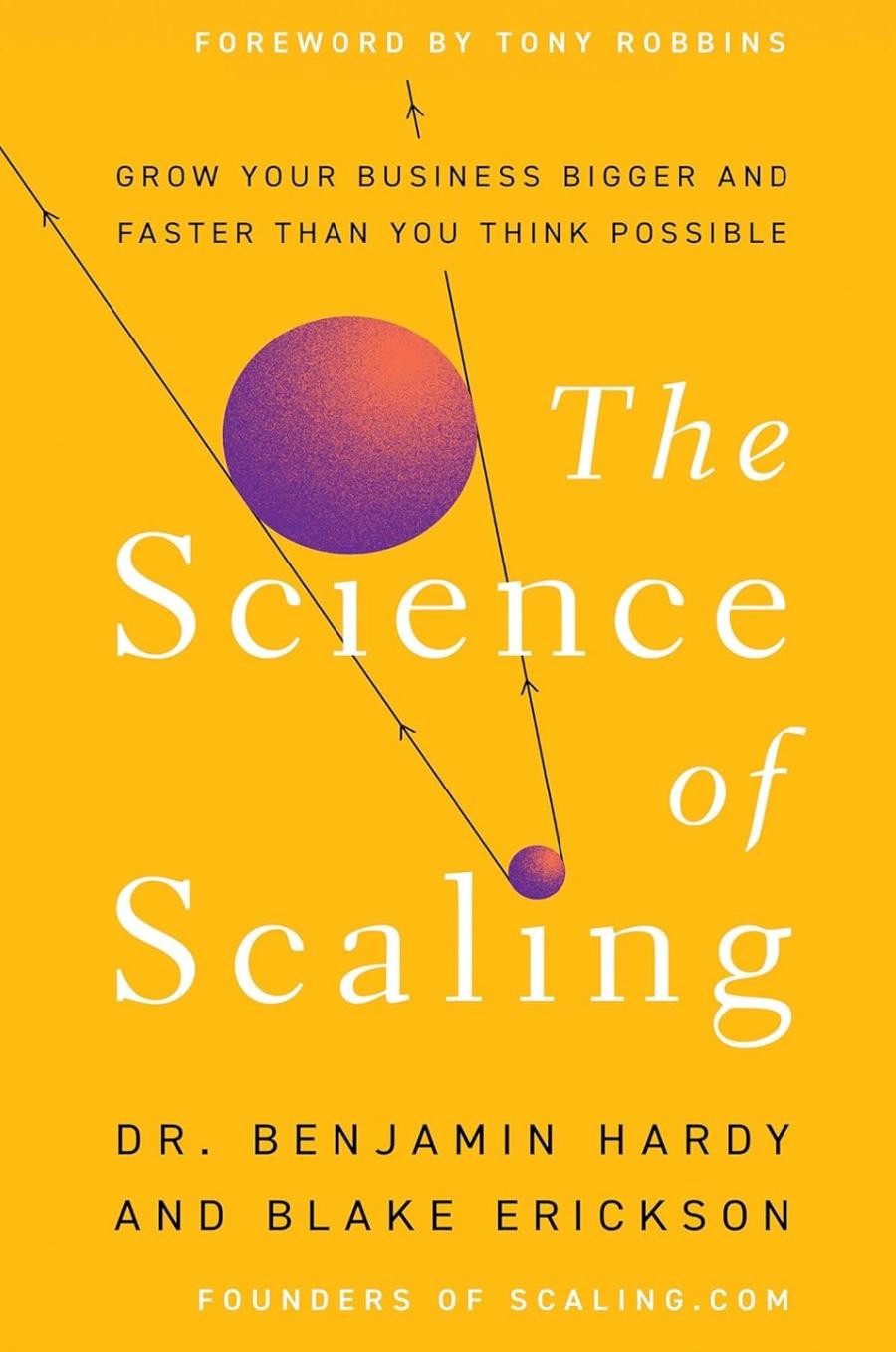
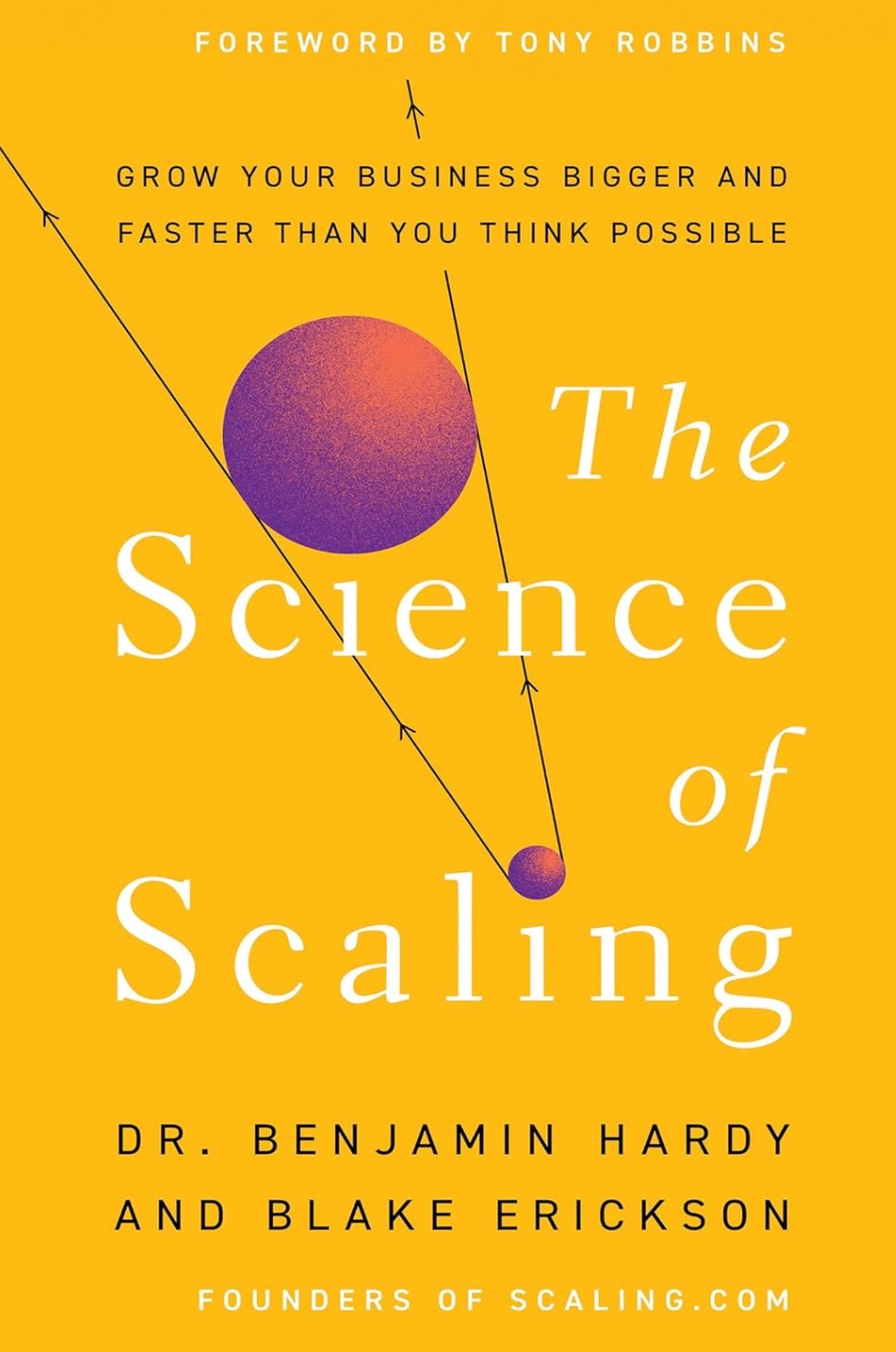
The Science of Scaling: Grow Your Business Bigger and Faster Than You Think Possible
Book Review and Summary: The Science of Scaling: Grow Your Business Bigger and Faster Than You Think Possible by Dr. Benjamin Hardy, Blake Erickson , et al.
What the Book Says
The Core Premise
The Science of Scaling argues that most businesses fail to grow not because of market limitations or lack of effort, but because they attempt to scale using linear thinking in a non-linear environment. Founders often try to do more of what worked early on, instead of redesigning the systems, constraints, and leverage points required for exponential outcomes.
Scaling, according to Hardy and Erickson, is not a motivation problem. It is a systems design problem.
Chapter 1: Why Growth Breaks Down
Early success hides structural weaknesses. In the beginning, founders substitute effort, intuition, and long hours for systems. As complexity increases, those personal inputs stop scaling.
The result is a familiar ceiling: more revenue requires disproportionate effort, stress, and cost. Growth becomes fragile, and the business becomes increasingly dependent on a few key individuals.
Chapter 2: Linear Growth vs. Exponential Growth
The authors draw a sharp distinction between businesses that grow linearly and those that grow exponentially.
Linear businesses require proportional increases in time, labor, or capital to grow. Exponential businesses redesign the model so that output grows faster than input. This requires intentional simplification, leverage, and repeatability rather than brute force expansion.
Chapter 3: Constraints as Leverage Signals
Constraints are not the enemy of growth. They are signals pointing to where leverage must be built.
Decision bottlenecks, unclear ownership, weak metrics, and founder dependency are framed as structural choke points. Scaling requires identifying the constraint that limits throughput and redesigning around it rather than pushing harder through it.
Chapter 4: Identity, Focus, and Direction
Hardy emphasizes that scaling begins with identity. Businesses that attempt to scale without clarity about who they are, who they serve, and what they do best tend to diffuse effort and dilute results.
Strategic focus is positioned as a prerequisite for exponential growth. Optionality expands only after direction is clearly defined.
Chapter 5: Systems That Replace Heroics
Growth accelerates when success becomes repeatable.
The authors stress that businesses dependent on individual heroics are inherently fragile. Scalable organizations embed performance into systems, processes, and standards so results can be reproduced consistently without constant founder involvement.
Chapter 6: Measurement That Drives Behavior
Not all metrics matter.
The book distinguishes between lagging indicators such as revenue and profit, and leading indicators tied to execution quality, throughput, and decision velocity. Scalable businesses measure what drives future performance rather than what merely reports past outcomes.
Chapter 7: Leadership as a Scaling Function
As businesses grow, leadership must transition from doing the work to designing the system.
Founders who remain too close to execution often become the primary constraint. Scaling requires delegation with accountability, decision frameworks, and the intentional development of leaders beneath the founder.
Chapter 8: Culture as Infrastructure
Culture is treated as an operating system, not a set of slogans.
In scalable organizations, incentives, expectations, and decision rights are aligned so that the correct decisions are made even when leadership is absent. When culture is misaligned, growth amplifies dysfunction rather than performance.
Chapter 9: Scaling Without Chaos
The final chapter addresses the fear that growth inevitably leads to loss of control.
Hardy and Erickson argue that chaos is not caused by growth itself, but by unmanaged complexity. With the right systems, transparency, and accountability, businesses can grow faster while becoming more stable rather than more fragile.
The ASYMMETRY® Perspective
From an ASYMMETRY® lens, The Science of Scaling is fundamentally about engineering convexity inside an operating business.
Most businesses grow by increasing exposure symmetrically. Revenue, complexity, fixed costs, and operational risk all rise together. That is linear growth with linear risk.
What Hardy and Erickson advocate is structural asymmetry.
Proper scaling increases upside faster than downside by embedding leverage into systems, decision-making, and culture. Each new layer of infrastructure expands optionality while reducing dependency on any single individual.
This mirrors how we think about asymmetric investing.
Early-stage businesses often benefit from favorable asymmetry: concentrated effort, control, and uncapped upside. As they grow, many owners unintentionally reverse that geometry by adding rigidity, fragility, and hidden tail risks.
The book is effectively a warning against turning a convex opportunity into a concave one.
For business owners approaching a liquidity event, this distinction is critical. Buyers and acquirers pay premiums for businesses with scalable systems, durable cash flows, and low key-person risk. Businesses that rely on heroics may show strong historical performance, but embed downside risk that shows up during stress, succession, or sale negotiations.
The same mistake often repeats post-exit, when capital is redeployed without regard for asymmetric risk/reward.
Scaling a business and managing wealth after a sale are governed by the same principle: Define and limit the downside so the upside can remain uncapped.
Who This Book Is For
This book is best suited for founders and business owners who have already achieved traction and are encountering complexity, time constraints, or organizational friction.
It is less about early startup hustle and more about designing durable, scalable enterprises that preserve optionality as they grow.
Final Takeaway
The Science of Scaling reframes growth as a design problem, not an effort problem.
Businesses scale when systems, not people, carry the load. That shift is what transforms linear growth into asymmetric outcomes.
Disclosure: This summary is an independent analysis for educational purposes only for business owners doing exit planning to scale and sell their business. It is not affiliated with or endorsed by the authors or publisher.