
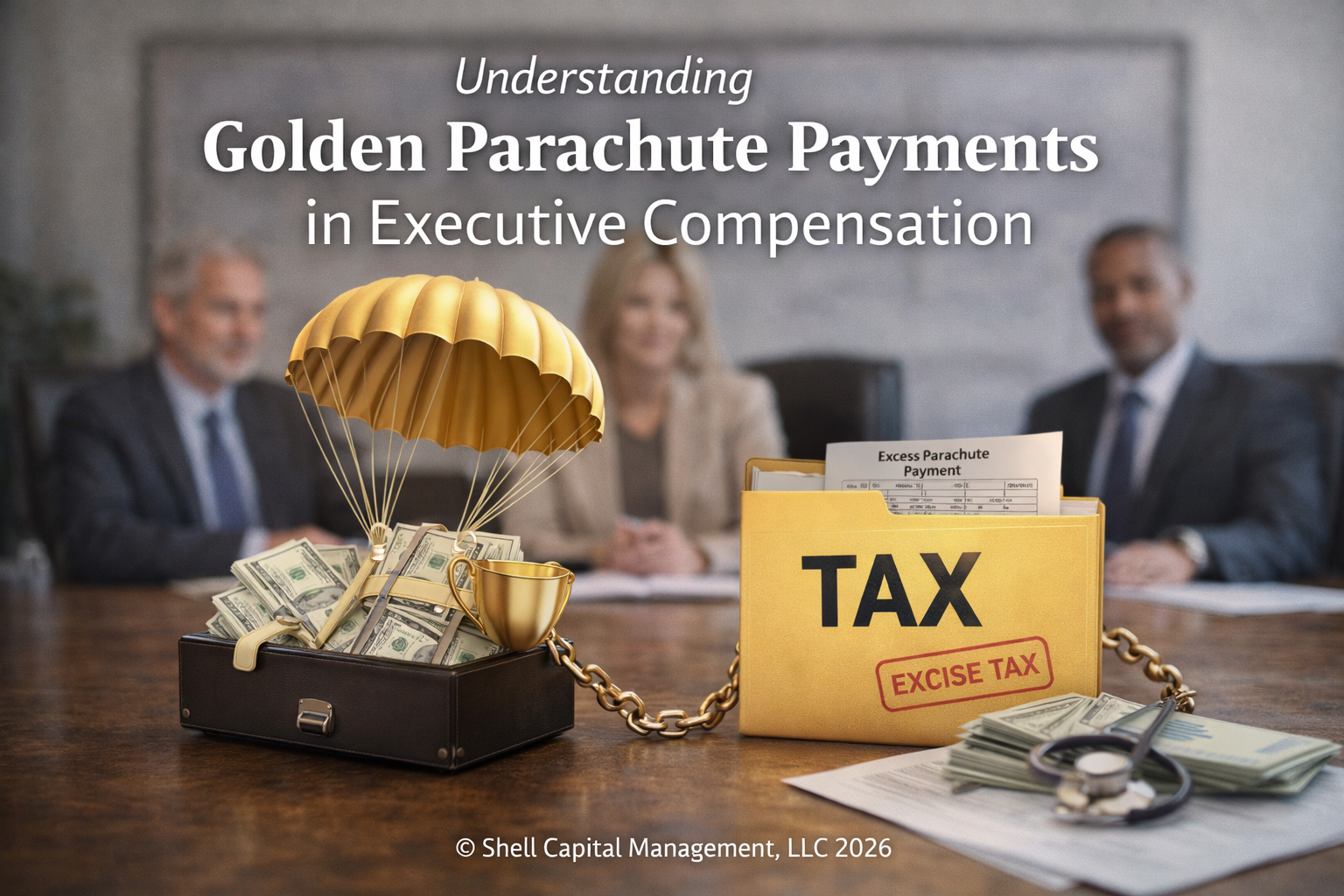
Understanding Golden Parachute Payments in Executive Compensation
Executive compensation agreements sometimes include provisions that are triggered when a company undergoes a significant corporate transaction.
These provisions are commonly known as golden parachute arrangements. They are designed to provide compensation or financial protection to executives if a merger, acquisition, or other change in corporate control affects their position within the organization.
Golden parachute payments may include several different forms of compensation.
Common components may involve severance payments, bonuses connected to the transaction, accelerated vesting of equity awards, continuation of certain employee benefits, or other compensation tied to the change-in-control event.
While these arrangements are often intended to provide stability during corporate transitions, they can also introduce additional tax considerations.
Certain tax rules apply when payments triggered by a change in control exceed specific thresholds relative to an executive’s historical compensation. When those thresholds are exceeded, part of the payment may be treated as an excess parachute payment and may be subject to an additional excise tax.
These rules can affect both the executive receiving the payment and the company providing it.
For the executive, the excess portion of the payment may be subject to an additional tax beyond ordinary income taxes. For the employer, the tax rules may limit the company’s ability to deduct certain compensation payments associated with the transaction.
Calculating the total value of potential parachute payments can be complex.
Multiple forms of compensation may be included in the calculation, such as cash severance, accelerated stock compensation, bonuses, and certain benefits tied to the change-in-control event.
Because these provisions can significantly affect the financial outcome of a corporate transaction, executives may benefit from understanding how change-in-control compensation is structured and how it interacts with applicable tax rules.
Evaluating these arrangements in advance may help executives better understand the financial implications of major corporate events and integrate those considerations into broader financial planning decisions.

Written by Christi Shell, CWS®, AAMS®, BFA™, CETF®, Managing Director and Private Wealth Strategist at Shell Capital Management, LLC.
To speak with Christi about your financial situation, request a private consultation.
Shell Capital Management, LLC is a registered investment adviser. This material is for informational and educational purposes only and does not constitute investment, legal, or tax advice. Advisory services are only offered to clients or prospective clients where Shell Capital Management, LLC is properly registered or exempt from registration. Any views are as of the date published and may change. Investing involves risk, including the possible loss of principal. Past performance is not indicative of future results.