
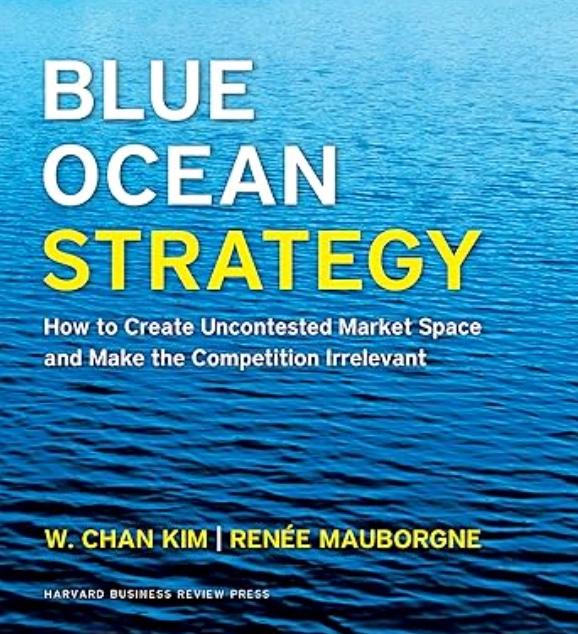
Blue Ocean Strategy by W. Chan Kim and Renée Mauborgne: Engineering Strategic Space That Expands Enterprise Value Before Exit
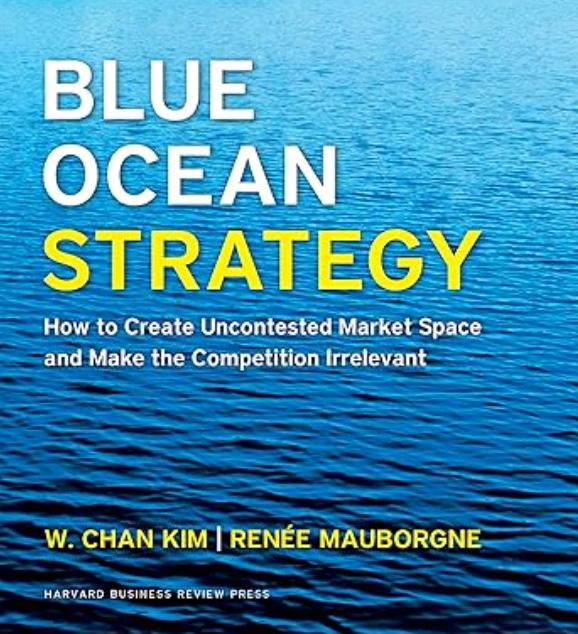
Blue Ocean Strategy by W. Chan Kim and Renée Mauborgne: Creating Strategic Space Blue Ocean Strategy argues that most companies compete in “red oceans” — crowded markets defined by price pressure, incremental differentiation, and shrinking margins. The alternative is to create “blue oceans”: uncontested market space where competition becomes irrelevant because you’ve redefined the value curve.
For business owners 12 months to 5 years from exit, this isn’t abstract strategy. It’s valuation geometry. Red-ocean businesses trade on EBITDA multiples constrained by margin compression, customer concentration, and commoditization risk. Blue-ocean businesses expand buyer imagination. They earn premium multiples because buyers underwrite growth narratives, pricing power, and structural differentiation.
The practical edge of this book is its framework for reconstructing market boundaries. It introduces tools — the strategy canvas, four actions framework, and eliminate–reduce–raise–create grid — that allow owners to reshape demand instead of fighting over it. That shift can increase enterprise value nonlinearly. A modest change in positioning can alter margin durability, reduce cyclicality, and attract a different class of buyer.
The asymmetry is clear. Downside risk in red oceans compounds quietly through margin erosion and competitive saturation. Blue oceans, when engineered thoughtfully, create defined competitive risk with potentially uncapped upside through new demand pools. For owners planning liquidity, that difference isn’t academic. It can mean several turns of multiple.
Who this book is for
This book is for founders and business owners who feel competitive pressure increasing every year. It’s for operators whose margins are being squeezed, whose sales teams are competing on price, or whose differentiation sounds similar to everyone else in their industry.
It’s particularly relevant for owners within a 3–5 year exit window who want to expand their buyer universe. Strategic buyers pay for category leadership and defensible positioning. Financial buyers pay for durable cash flow. Blue ocean thinking can improve both.
What the book says
Kim and Mauborgne’s central thesis is that companies don’t have to choose between differentiation and low cost. Through value innovation, they can pursue both simultaneously by redefining what factors the industry competes on.
Instead of benchmarking competitors, the authors suggest analyzing alternative industries, strategic groups, buyer groups, complementary offerings, functional versus emotional appeal, and time trends. The objective is to discover overlooked demand and reconstruct the industry’s value curve.
The core mechanism is eliminating and reducing factors that add cost without creating meaningful buyer value, while raising and creating elements that unlock new demand. This changes the cost structure and the perceived value simultaneously.
The book also emphasizes fair process — engaging teams in strategy formation to reduce execution risk. A strategy that looks good on paper but fails in implementation destroys value quickly.
Chapter-by-chapter summary
The opening chapters contrast red oceans with blue oceans. The mechanism is industry boundary reconstruction. The practical implication is that owners should stop defining competitors narrowly and instead map the full competitive substitute landscape.
The section on analytical tools introduces the strategy canvas. This visual mapping of competitive factors reveals convergence and overinvestment. The implication is diagnostic clarity — you can see where you’re overbuilt and where opportunity exists.
The four actions framework — eliminate, reduce, raise, create — operationalizes value innovation. The mechanism is cost-value reconfiguration. The implication for owners is disciplined reallocation of capital and attention.
The chapters on reconstructing market boundaries explore six paths, including looking across alternatives and across time trends. The mechanism is perspective shift. The implication is growth without proportionate capital intensity.
The final sections address execution risk through tipping point leadership and fair process. The mechanism is organizational buy-in. The implication is that strategy without internal alignment increases perceived key-person and cultural risk in due diligence.
The edge
Most business strategy advice focuses on outperforming competitors. Blue Ocean Strategy focuses on making them irrelevant.
The edge is structural repositioning. Instead of optimizing within an existing competitive framework, you redefine the framework itself. Owners and advisors often miss this because they focus on incremental margin improvement rather than demand creation.
For exit planning, this changes everything. Buyers don’t simply price current EBITDA. They underwrite future defensibility. A credible blue ocean narrative reframes risk perception.
The ASYMMETRY® perspective for business owners
From an ASYMMETRY® standpoint, red oceans create linear payoffs. Revenue growth requires proportionate increases in cost, sales effort, and competitive response. Risk is symmetric: margin compression on the downside, incremental growth on the upside.
Blue oceans introduce convexity. Small strategic shifts in positioning can create nonlinear demand expansion. The downside is partially defined by reduced direct competition. The upside is uncapped because you’ve expanded the total addressable market.
Optionality increases because more buyer types become interested. Strategic acquirers value category expansion. Private equity values scalable differentiation. Even minority investors see growth levers.
Velocity improves because capital efficiency often increases when you eliminate low-value complexity.
Failure modes exist. Not every “blue ocean” is real. Some are misread demand signals. Without disciplined validation, owners risk investing in features customers won’t pay for. Regime awareness matters. In capital-constrained environments, execution discipline is critical.
Exit planning translation: valuation geometry
Blue ocean positioning directly impacts enterprise value drivers.
Quality and durability of earnings improve when pricing power increases and customer churn declines.
Margin stability improves when competition is reduced and cost structures are simplified through elimination and reduction.
Revenue concentration risk can decline if new demand pools diversify the client base.
Growth narratives become more credible. Buyers underwrite TAM expansion, not just incremental share capture.
Key-person risk can decline if the value proposition is embedded in systems rather than personality-driven relationships.
Operational scalability improves when you simplify offerings and focus on high-value segments.
Strategic buyers may pay premium multiples for category leadership or adjacency expansion. Financial buyers may justify leverage because cash flow durability improves.
The result can be multiple expansion. Even a one-turn increase on EBITDA materially increases after-tax proceeds.
Practical moves: the 90-day playbook
Map your current strategy canvas and identify where you mirror competitors.
Interview top clients to understand which features they truly value versus tolerate.
Identify one offering or segment to eliminate or reduce to simplify operations.
Prototype a differentiated offer targeting an underserved buyer group.
Analyze your cost structure to quantify savings from elimination.
Stress-test your positioning with potential acquirers or investment bankers to gauge narrative resonance.
Reallocate capital toward high-value differentiators and away from low-return complexity.
Document the strategy clearly to reduce execution ambiguity.
Conversation starters for owners and spouses/partners
Are we competing on the same factors as everyone else?
If a buyer evaluated us today, what would they view as truly differentiated?
Where are we overbuilt relative to customer willingness to pay?
What part of our revenue feels most commoditized?
If we could eliminate one major line of business without hurting value, what would it be?
Are we building a category or renting space in someone else’s?
How would our valuation change if we reduced margin volatility?
How Shell Capital thinks about this
We think in terms of process over prediction. Blue ocean strategy is not about visionary guesswork. It’s about structured reconstruction of demand.
Define downside first. What happens if the new offering underperforms? Can you test it with limited capital at risk?
Build optionality early. Don’t wait until the final year before exit to reposition. Buyers reward demonstrated traction.
Avoid forced timing. Strategic repositioning takes time to compound.
Engineer asymmetric outcomes. That’s the objective: defined competitive downside, convex enterprise upside.
Closing synthesis
Blue Ocean Strategy is ultimately about escaping commoditization before it escapes your multiple.
For owners planning an exit, the question isn’t whether you can compete harder. It’s whether you can compete differently. When you redefine value in a way competitors can’t easily replicate, you change the risk profile buyers underwrite.
That shift — from crowded red waters to differentiated blue space — can transform enterprise value geometry 3–5 years before liquidity.
This is provided for educational purposes only and reflects an independent analysis. It is not investment, tax, or legal advice. Any examples are illustrative and not a guarantee of outcomes. Business, investment, and exit-planning decisions involve risk, including the potential loss of capital.