
Asymmetry in AI: When Generation Is Cheap and Verification Is Expensive
Artificial intelligence can now generate complex outputs in seconds—code, financial models, legal drafts, mathematical proofs. The marginal cost of production is trending toward 0.0%.
But abundance creates a new constraint.
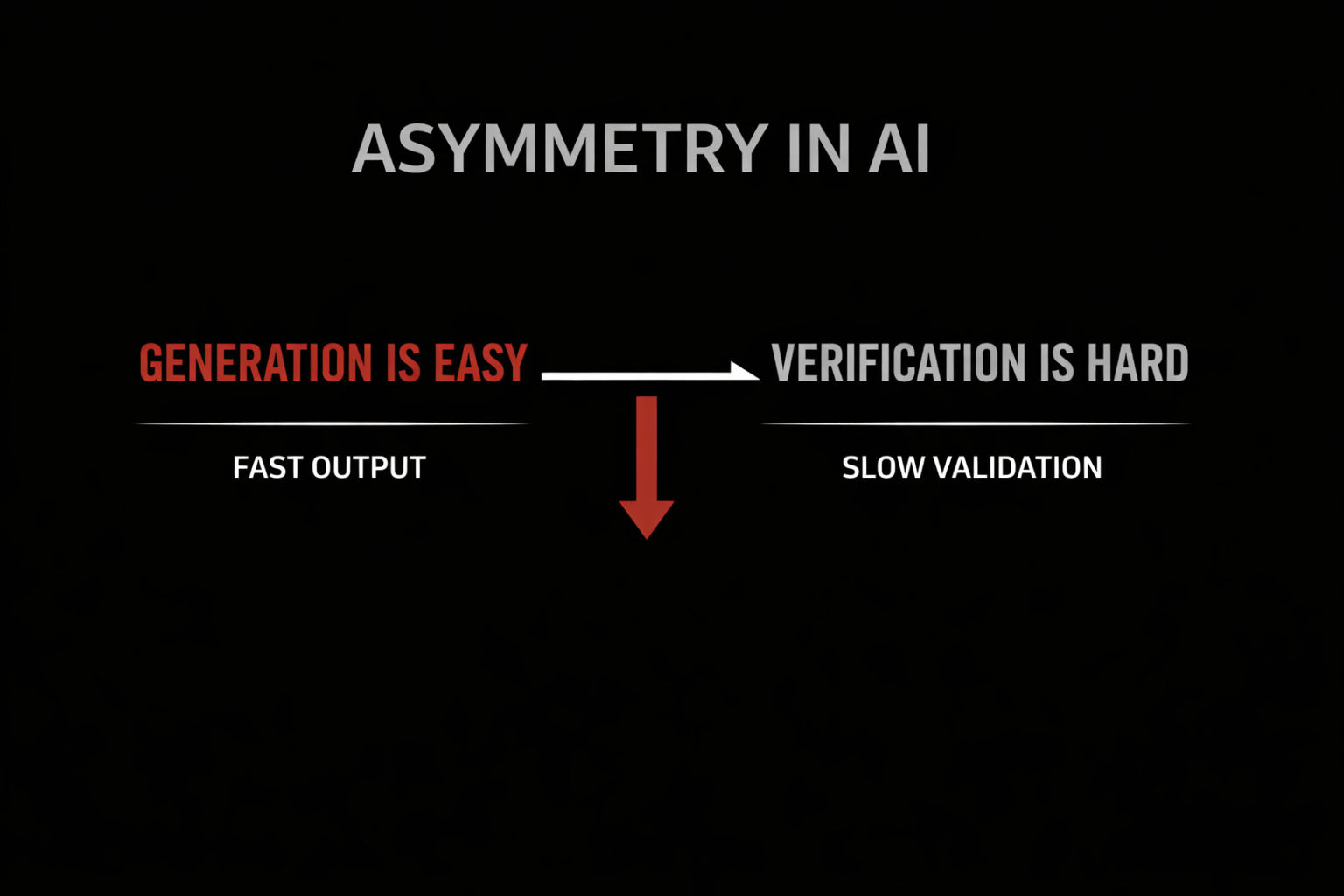
The bottleneck isn’t generation. It’s verification. That’s where asymmetry lives.
The misconception
Most people frame AI progress as a straight line: better models should mean proportionally better answers. If generation improves, correctness should improve alongside it.
Structurally, it doesn’t work that way.
AI systems are probabilistic pattern engines. They generate statistically coherent responses, but they don’t independently verify truth. An output can sound precise, look internally consistent, and still be wrong.
First principles: generation and verification aren’t symmetric
In many problem classes, producing a candidate solution is easier than proving it’s correct. AI scales that imbalance.
A model can generate 1,000 lines of functional-looking code in seconds. Verifying that code may require deep scrutiny:
- Edge cases and failure modes
- Security assumptions and attack surface
- Correctness under stress and weird inputs
- Integration behavior with downstream systems
- Monitoring and rollback when it breaks in production
Generation scales with compute and data. Verification scales with scrutiny, expertise, and consequence. As output cost trends toward 0.0%, validation cost often stays fixed—or rises as a percentage of total effort.
That gap is structural asymmetry.
Where it breaks: high-consequence domains
This asymmetry becomes dangerous when error costs aren’t linear. In high-consequence domains, “mostly right” can still be catastrophically wrong.
- Medical decision support
- Legal interpretation and compliance
- Financial modeling and risk systems
- Automated trading workflows
- Geopolitical and conflict analysis
If verification is underweighted, error velocity increases. Incorrect answers can scale faster than the organization’s ability to audit them.
The risk isn’t that answers are slow. The risk is that incorrect answers are fast and confident.
The capital parallel: returns are easy to “generate,” risk is hard to verify
This maps cleanly to markets.
Return narratives are cheap. Risk verification is expensive. Anyone can generate a compelling backtest. It’s much harder to verify what survives across regimes and stress.
Here’s what “verification” looks like in portfolio terms:
- Does the edge persist across different market regimes?
- How does the strategy behave when volatility expands?
- What happens to liquidity when everyone’s rushing for the same exit?
- Do correlations converge in drawdowns?
- What’s the recovery math after -20.0%, -30.0%, or -50.0% declines?
In portfolio construction, verification means defining downside in advance. If you don’t predefine exit distance, you can’t calculate position size. If you can’t calculate position size, you can’t quantify position risk. If you can’t aggregate position risk, you can’t measure total portfolio risk as a percentage of equity.
That’s the same asymmetry: generation is easy; verification is hard.
How to turn it into positive asymmetry
Asymmetry works for you when downside is defined and limited, while upside remains open-ended. In AI, that means bounded deployment and explicit verification gates where consequences are nonlinear. In portfolios, that means predefined exits, intentional sizing, and measured portfolio heat.
When generation is cheap and verification is hard, risk transfers to whoever assumes correctness without proof.
If you reverse the sequence and make verification the constraint, the payoff distribution shifts:
- Downside is predefined as a percentage of capital
- Upside isn’t artificially capped
- Exposure is sized intentionally, not emotionally
That’s intentional asymmetry.
Related ASYMMETRY® Observations
- Asymmetry Is Defined by Downside, Not Upside
- Asymmetric Returns Don’t Come from a Margin of Safety — They’re Engineered Through Structure
- The Three Dimensions of Risk — And How We Engineer Around Them
- The Most Dangerous Asset Is Optimism
Mike Shell is the founder and chief investment officer of Shell Capital Management, LLC, a registered investment adviser. He serves as portfolio manager of ASYMMETRY® Managed Portfolios, a separately managed account program with trade execution and custody provided by Goldman Sachs Custody Solutions.
ASYMMETRY® Observations are provided for general informational and educational purposes only. They do not constitute investment advice, a recommendation, or an offer to buy or sell any security or investment strategy. The content is not intended to be a complete description of Shell Capital’s investment process and should not be relied upon as the sole basis for any investment decision.
Any securities, charts, indicators, formulas, or examples referenced are illustrative and are not intended to represent actual client portfolios, recommendations, or trading activity. Past performance is not indicative of future results. All investing involves risk, including the possible loss of principal.
Opinions expressed reflect the judgment of the author at the time of publication and are subject to change without notice as market conditions evolve. Information is believed to be reliable but is not guaranteed, and readers are encouraged to independently verify any information before making investment decisions.
Shell Capital Management, LLC provides investment advisory services only to clients pursuant to a written investment management agreement and only in jurisdictions where the firm is properly registered or exempt from registration.