
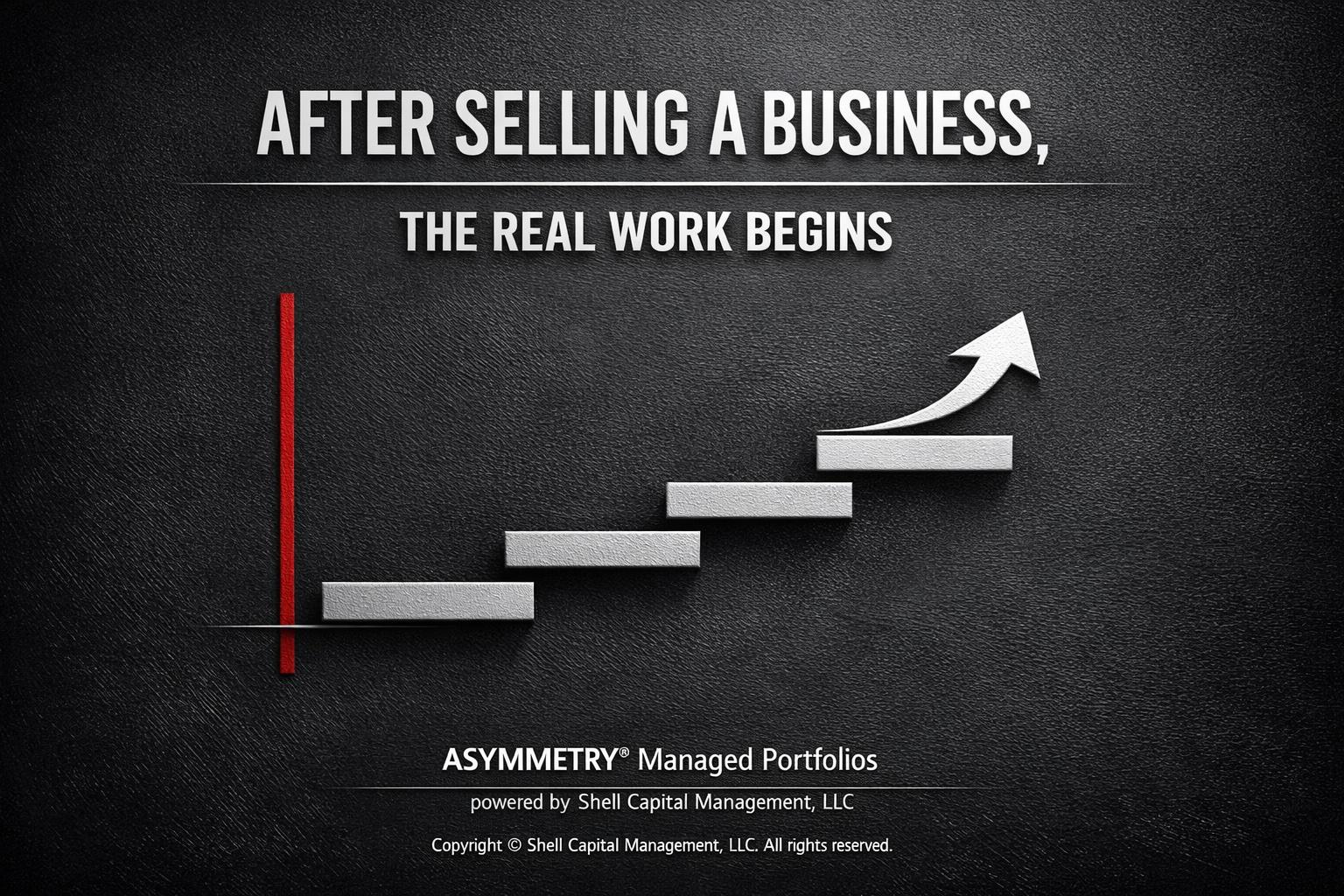
After Selling a Business, the Real Work Begins
After the Exit, the Real Work Begins
For many entrepreneurs, selling a business feels like the finish line.
Years—sometimes decades—of risk, stress, and decision-making finally culminate in a liquidity event. The transaction closes, the capital arrives, and the immediate pressure of operating a company disappears.
But what I can tell you after advising business owners for nearly three decades is that moment isn’t the end of the journey.
It’s the beginning of a very different one.
While building a company, most entrepreneurs have a balance sheet dominated by human capital and enterprise value. Their wealth is tied to a single asset they actively control and influence every day.
If conditions deteriorate, they can respond. They can pivot strategy, change pricing, hire differently, or pursue new opportunities.
In other words, they have agency.
After the sale, that dynamic changes immediately.
Human capital becomes a smaller component of the balance sheet, and financial capital becomes the dominant one. The wealth that once existed inside an operating business is now sitting in liquid markets that move based on forces outside the owner’s control.
This transition is one of the most underestimated shifts in wealth management.
Because the risk profile of the capital has fundamentally changed.
During the operating years, concentration often creates extraordinary wealth. A founder may have 80% or more of their net worth tied to a single enterprise. That concentration is rational because it aligns with their expertise and control.
After the liquidity event, the objective is different.
The capital is no longer being built. It now needs to endure.
That requires a different approach to portfolio construction.
Permanent capital must navigate decades of changing economic regimes, market cycles, inflation environments, and liquidity conditions. The risks that matter most are no longer operational risks inside a company but financial risks inside a portfolio.
- Sequence risk.
- Large drawdowns.
- Overexposure to a single return driver.
- Portfolios built for average markets rather than adverse ones.
This is where many newly liquid entrepreneurs encounter a surprising challenge.
They are exceptional operators, but the discipline required to manage permanent financial capital is different from the discipline required to build a company.
Operating businesses reward decisive concentration and aggressive reinvestment.
Financial capital requires risk architecture.
Defined downside. Intentional position sizing. Multiple return drivers across different market regimes. Optionality that preserves flexibility when conditions change.
The goal is not simply to grow wealth.
The goal is to ensure the capital continues to serve the family’s objectives across decades—supporting future opportunities, philanthropy, and generational responsibility.
This is why the period immediately after a liquidity event is so important.
Because once the operating risk disappears, the responsibility shifts.
The company is gone.
But the capital it created now needs a structure capable of surviving uncertainty, volatility, and time.
For many entrepreneurs, that’s when the real work begins.
Let's talk about it.
Mike Shell
Founder, President & Chief Investment Officer
Shell Capital Management, LLC