
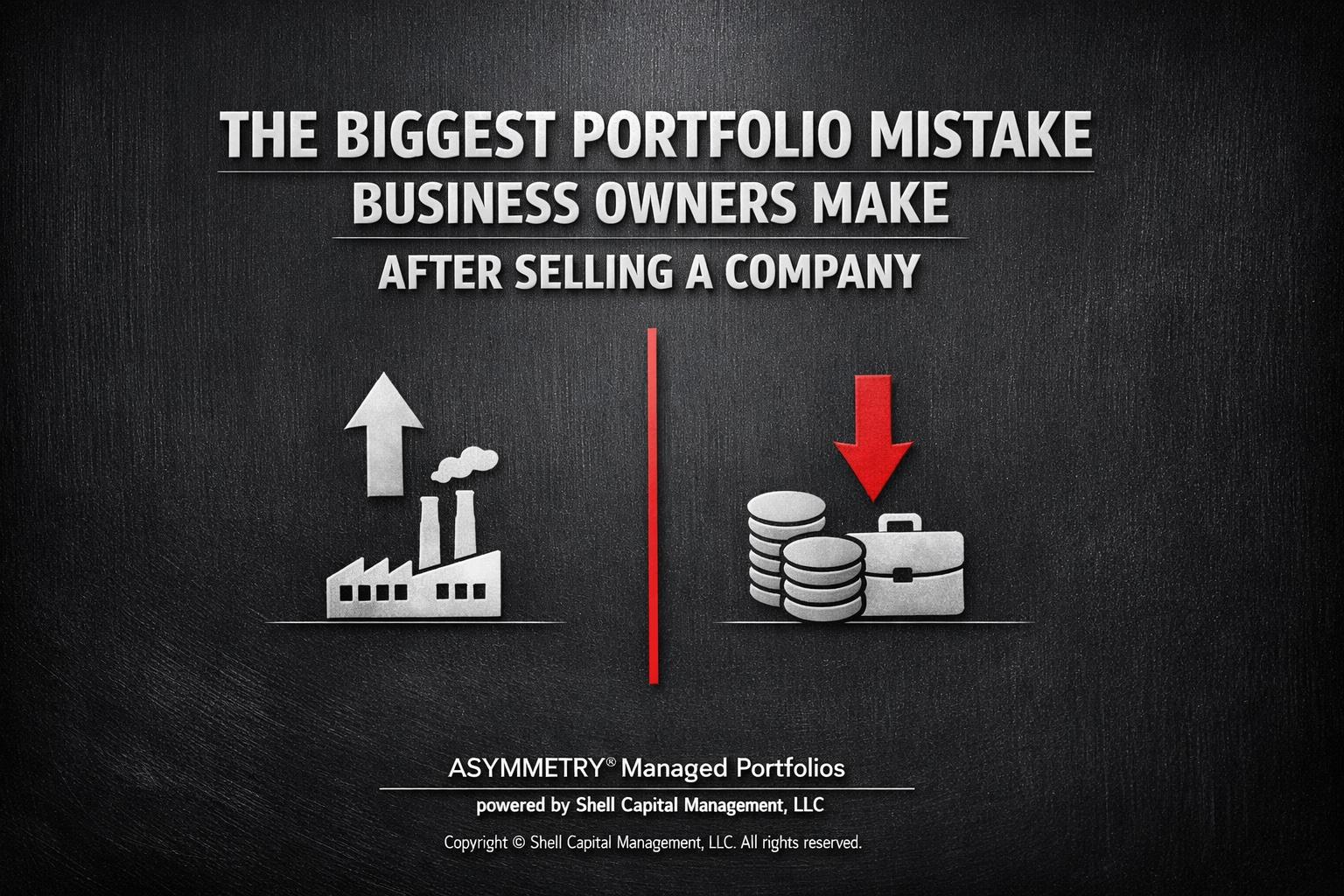
The Biggest Portfolio Mistake Business Owners Make After Selling a Company
When a business owner sells a company, something fundamental changes.
For years, most of their wealth was concentrated in one enterprise they understood deeply. They controlled the inputs. They could influence the outcome. Risk felt manageable because it was familiar.
Then the liquidity event happens.
Human capital converts into financial capital. Control converts into exposure.
And many owners make the same portfolio mistake immediately afterward.
They invest their life’s work as if nothing changed.
The result is a portfolio structure that quietly ignores the single most important shift in their financial life.
Consequence.
Running a company and managing permanent capital are fundamentally different problems.
Operating businesses tolerate volatility because the owner can intervene. They can change strategy, cut costs, hire talent, pivot products, or raise prices. Agency is part of the risk equation.
Financial markets don’t offer that same control.
Once capital is deployed into markets, outcomes depend on forces outside the owner’s influence: liquidity cycles, trend persistence, volatility regimes, and investor behavior.
Yet many post-exit portfolios end up built around the same mindset that built the company: concentration, conviction, and patience.
That framework worked when the owner had control.
It can become fragile once wealth is fully financial.
The mistake isn’t simply concentration.
It’s failing to redefine risk after the liquidity event.
Before the sale, the primary risk was business failure.
After the sale, the primary risk becomes permanent capital impairment.
Those two risks require completely different portfolio architectures.
Operating businesses thrive on concentration because upside comes from scale and execution.
Permanent financial capital survives through asymmetry.
That means structuring portfolios where downside is intentionally defined and upside remains open.
It means combining multiple return drivers rather than relying on a single engine.
It means monitoring trend, volatility, liquidity, and momentum instead of assuming time alone solves risk.
And it means thinking like an institutional CIO rather than a founder.
Many entrepreneurs instinctively rebuild the same exposure they just exited.
They move from one concentrated bet into another—often the public equity market—because the experience feels familiar.
But markets are not operating companies.
A founder can’t step into the boardroom of the S&P 500 and change strategy.
They can only manage exposure.
That shift—from operator to allocator—is the most important transition after a liquidity event.
And it’s where asymmetry becomes essential.
Instead of asking “What do I believe in?” the more important question becomes:
How is downside defined before capital is deployed?
If the exit created permanent capital meant to support a family for decades, the portfolio can’t depend on prediction.
It has to depend on structure.
Defined downside.
Intentional position sizing.
Multiple return drivers.
Adaptive exposure as conditions change.
The entrepreneurs who understand this transition tend to treat their portfolio the way institutions treat an endowment.
They don’t rely on a single market outcome.
They design a system.
Because after the company is sold, the objective isn’t building a business anymore.
It’s protecting the outcome of building one.
And that requires a different framework for risk entirely.
Mike Shell
Founder, President & Chief Investment Officer
Shell Capital Management, LLC