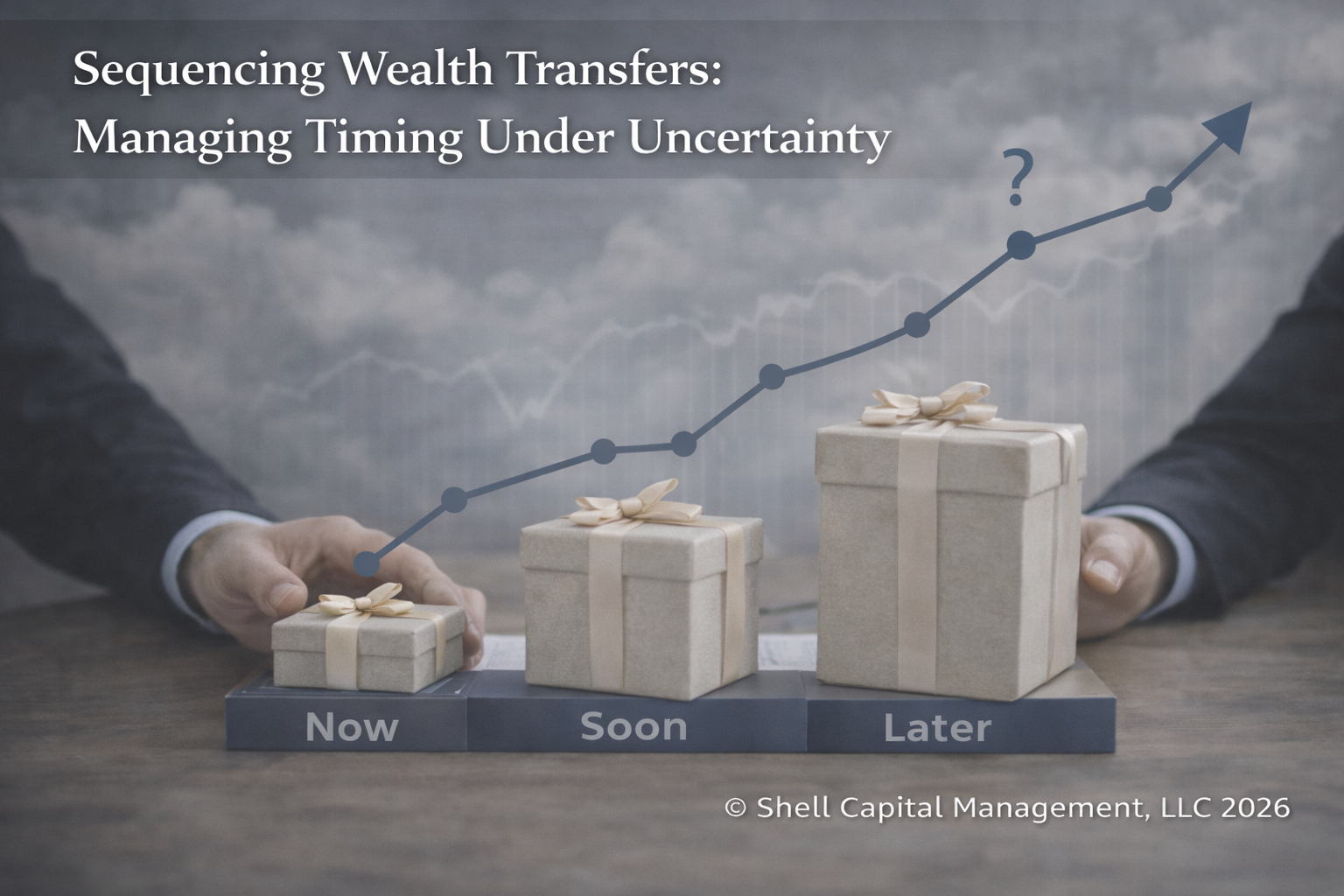
Sequencing Wealth Transfers: Managing Timing Under Uncertainty
Wealth transfer timing is not binary. Sequencing decisions shape flexibility, risk exposure, and long-term outcomes.

Private Wealth Strategist is where Christi Shell, Certified Wealth Strategist®, shares insights from her work advising business owners, physicians, executives, and families responsible for meaningful capital.
Families with complex financial lives eventually face a consistent set of wealth decisions—how to structure a business exit, how to reduce tax drag, how to protect assets from liability, how to generate retirement income, how to transfer wealth efficiently to heirs, and how to support family, philanthropic, and legacy goals.
Private Wealth Strategist explores those issues through the lens of integrated wealth strategy. Articles address topics such as investment strategy and portfolio management, tax planning, risk management and insurance, asset protection structures, executive compensation and stock options, business succession planning, education and family support, charitable giving strategies, retirement planning, estate distribution, and liquidity or credit management.
Rather than treating these decisions in isolation, Private Wealth Strategist examines how they interact—because the structure of one decision often shapes the outcome of another.
Christi Shell serves as Managing Director and Private Wealth Strategist at Shell Capital Management, LLC.
Wealth transfer timing is not binary. Sequencing decisions shape flexibility, risk exposure, and long-term outcomes.

Without clear governance, wealth transfers may create unintended complexity across generations.

Gifting strategies that ignore cash flow constraints can introduce unintended pressure on long-term financial stability.

The lifetime exemption is finite. How and when it is used requires careful coordination within a broader wealth framework.

Illiquid assets require careful valuation when transferred, adding complexity to gift tax planning.

Not all financial support is treated equally under gift tax rules, particularly when payments are made directly for education or medical care.

The annual gift tax exclusion allows families to transfer wealth incrementally. Structuring these transfers intentionally can improve coordination and long-term outcomes.

Financial support for family members may trigger gift tax considerations. Understanding how the system works can help improve coordination and long-term planning outcomes.

Education planning requires balancing funding goals with control, tax awareness, and long-term coordination.
Accelerated depreciation once allowed immediate expensing of major purchases. As bonus depreciation phases down, capital investment timing becomes more strategic for business owners.
Tax season is a diagnostic moment. For families with complex income and concentrated assets, filing reveals whether decisions were coordinated—or made in isolation. The risk is not technical error. It is sequencing. Timing, liquidity, and governance determine whether tax season confirms discipline or exposes friction.

If you’re near AMT and considering a meaningful gain or an ISO exercise, the headline “20% long-term capital gains” can be a misleading planning anchor. The issue isn’t the stated capital gains rate; it’s how capital gains can reduce the AMT exemption and change the economics of timing, sizing, and sequencing liquidity events.

If you find yourself with a bit of extra time on your hands in the upcoming months, you may want to use this time to check in with your family’s finances.

This blog will share five classic Christmas stories to get readers into the holiday spirit.

A look at the reasons an etrike might provide an economical and environmental alternative to the car, as well as the differences from the two-wheeled models.